Sleep laboratory 07 · The vanishing report
Why Dreams Are Quickly Forgotten
A dream can feel immense at the moment of waking and disappear before breakfast. The problem is not that dreams are inherently meaningless, but that sleep provides poor conditions for creating and retrieving a stable waking memory.

Three core signals
At a glance
SIGNAL 01
Encoding
The brain state of sleep is not ideal for laying down a durable episodic record.
SIGNAL 02
Retrieval
Dreams have few stable external cues that can trigger later recollection.
SIGNAL 03
Interference
Movement, conversation and new waking thoughts rapidly compete with the fragile trace.
Research note 01
Experience is not the same as memory
A person may have a rich experience during sleep but fail to retain it after waking. Dream recall therefore depends on at least two events: a dream must occur, and enough of it must be encoded and retrieved to produce a report.
This is why no-report awakenings are ambiguous. They may reflect dreamless sleep, a feeling without recall, or rapid forgetting.[1]
Research note 02
The chemistry of poor encoding
During REM sleep, noradrenaline and serotonin are strongly reduced while acetylcholine remains relatively active. Combined with altered hippocampal-prefrontal coordination, this state is not favourable for forming the kind of durable episodic memory expected during waking.[1], [2]
The explanation is not a single missing chemical. Stage, arousal, timing and the transition into waking all influence retention. Non-REM dreams are also forgotten, even though their neurochemical setting differs from REM sleep.
The sleep-wake transition is a memory bottleneck
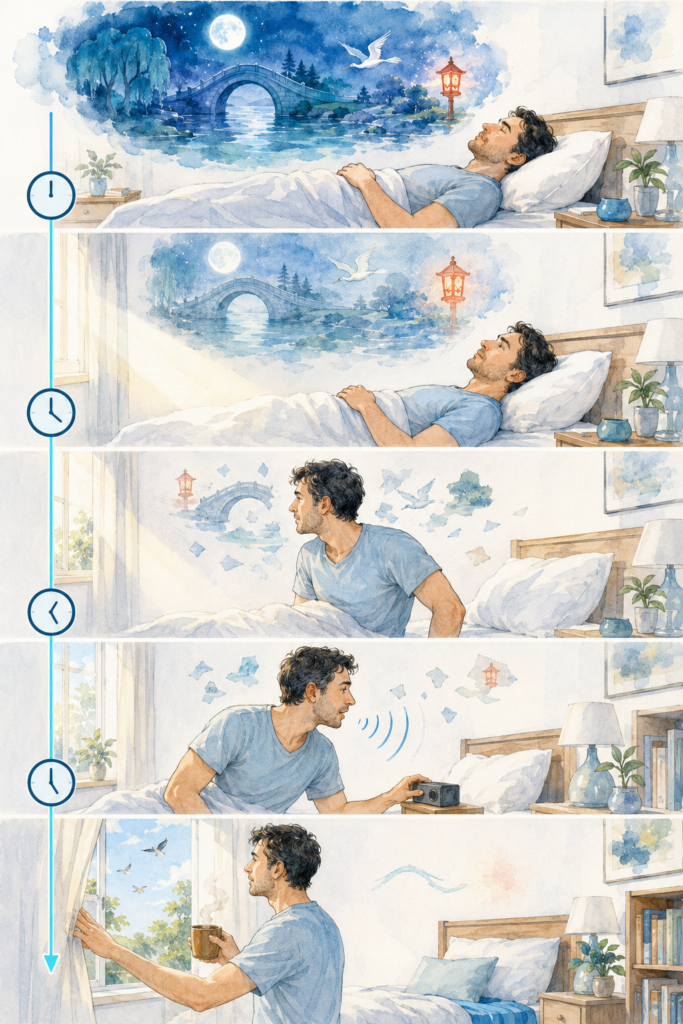
The final seconds before and after awakening can determine whether a dream becomes a story or disappears as a vague feeling. A brief arousal may allow a trace to be encoded, but a rapid shift into planning, speaking or moving replaces the internal context with the demands of the room.
Laboratory evidence supports the importance of these transitions. High-frequency dream recallers spend more time awake after sleep onset and have more awakenings than low recallers, particularly from N2 sleep.[3] This does not mean that disrupted sleep is desirable. It shows why two people who may both have dream experiences can carry different amounts into morning memory.
EEG findings also connect recall with the activity present before awakening. Greater frontal theta activity in the 5-7 Hz range predicted recall after REM sleep, whereas lower right-temporal alpha activity in the 8-12 Hz range predicted recall after N2 sleep.[4] The patterns differ by stage, which argues against a single “remember dream” signal.
Popular articles sometimes claim that exactly 95% of dreams are forgotten. There is no universal measurement that justifies such precision. Recall depends on whether people are awakened in a laboratory, asked in the morning, keeping a diary or estimating their usual habits. The defensible conclusion is simpler: dream memory is often fragile and highly method-dependent.
Research note 03
Why external cues matter
Waking memories are embedded in stable places, actions and conversations that can later prompt retrieval. Dream events are internally generated and often lack corresponding cues in the bedroom.
On waking, remaining still and attending to the last image or feeling can preserve a route back into the sequence. Looking at a phone or beginning a conversation supplies competing cues and new material.
A dream can return from one small cue
Forgetting is not always complete erasure. A dream that seems lost may reappear when a person returns to the same body position, hears a phrase or encounters an image linked to the original experience. Memory retrieval is cue-dependent, and a fragment can sometimes reopen a larger sequence.
Dreams are especially vulnerable because their cues are unstable. A place may transform, a character may have two identities, and the emotional logic may be clearer than the physical setting. Waking memory has difficulty reconstructing an event whose organising context no longer exists.
A simple recording practice can improve access: pause after waking, search backwards from the final image, and note a few concrete words before doing anything else. The benefit comes from attention and rehearsal, not from improving sleep or increasing dream production. Setting repeated alarms solely to collect dreams can fragment sleep and is not necessary for health.
The distinction also matters clinically. A sudden change in recall may accompany stress, nightmares, medication changes or altered sleep, but recall frequency alone does not diagnose a disorder. Persistent disturbing dreams, sleep disruption or daytime impairment deserve individual assessment; ordinary forgetting does not.
Research note 04
Reports are reconstructed
Even immediate reports are not perfect recordings. The dreamer selects words, imposes order and may fill gaps while speaking or writing.
Researchers reduce delay, use neutral prompts and distinguish remembered content from later interpretation, but no report is completely free of reconstruction.
A process, not a single switch
Dream research becomes clearer when experience is treated as a changing process. Sleep stage, local brain activity, memory, emotion, bodily state, awakening and the wording of the report can all influence what is observed.
A brain correlate is evidence about the conditions of a dream. It is not automatically an interpretation of the dream.
What the evidence supports
| Claim | Current standing | Reason |
|---|---|---|
| Dream memories are often fragile after waking | Well supported | Recall declines without rehearsal or recording. |
| No recall proves no dreaming occurred | False | Failure may occur at encoding or retrieval.[1] |
| REM neurochemistry contributes to forgetting | Plausible and supported | Neuromodulatory conditions are unfavourable for episodic encoding, but are not the only cause.[1], [2] |
| Immediate reports are exact transcripts | False | All reports involve selection and reconstruction. |
Interpretive boundaries
Dream neuroscience is most informative when it states clearly what a method measures and where inference begins. The following boundaries prevent an interesting finding from becoming an exaggerated claim.
- Do not treat confidence as a guarantee of accuracy.
- Dream journals change recall habits and may change what is noticed.
- Morning recall favours dreams near awakening.
- Laboratory reports still depend on language and cooperation.

Source desk
Key research and further reading
- Nir and Tononi, Dreaming and the Brain.
- Marzano et al., Recalling and Forgetting Dreams.
- van Wyk et al., Increased Awakenings from NREM Sleep Explain Differences in Dream Recall Frequency.
- Mangiaruga et al., Spotlight on Dream Recall.
- Scarpelli et al., What About Dreams?.
Research changes as methods improve. Links are provided so that readers can distinguish direct findings, reviews and theoretical interpretation.
References
- Nir Y, Tononi G. Dreaming and the brain: from phenomenology to neurophysiology. Trends Cogn Sci. 2010;14(2):88-100. doi:10.1016/j.tics.2009.12.001. PMID: 20079677.
- Hobson JA, Friston KJ. Waking and dreaming consciousness: neurobiological and functional considerations. Prog Neurobiol. 2012;98(1):82-98. doi:10.1016/j.pneurobio.2012.05.003. PMID: 22609044.
- van Wyk M, Solms M, Lipinska G. Increased awakenings from non-rapid eye movement sleep explain differences in dream recall frequency in healthy individuals. Front Hum Neurosci. 2019;13:370. doi:10.3389/fnhum.2019.00370. PMID: 31680920.
- Marzano C, Ferrara M, Mauro F, et al. Recalling and forgetting dreams: theta and alpha oscillations during sleep predict subsequent dream recall. J Neurosci. 2011;31(18):6674-6683. doi:10.1523/JNEUROSCI.0412-11.2011. PMID: 21543596.
- Mangiaruga A, Scarpelli S, Bartolacci C, De Gennaro L. Spotlight on dream recall: the ages of dreams. Nat Sci Sleep. 2018;10:1-12. doi:10.2147/NSS.S135762. PMID: 29391838.
The measured night
In summary
Dreams vanish because consciousness during sleep and memory for consciousness are different achievements. A fragile trace must survive a rapid change of brain state and then compete with the returning world.