Polarity, current and the temptation of a simple brain map
Transcranial Direct Current Stimulation (tDCS)
tDCS applies a low-intensity direct current through electrodes on the scalp. It can alter the electrical conditions in which neurons are already operating, but it does not simply switch a chosen brain region on or off.
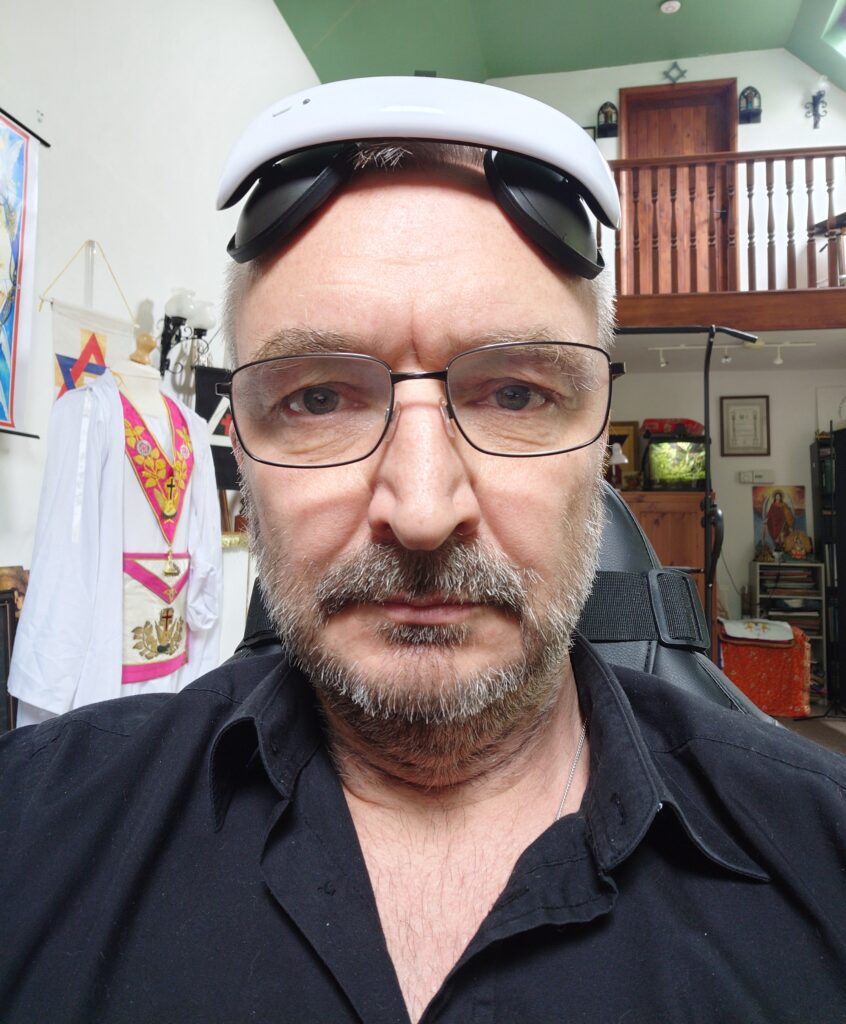
Andrew T. Austin with the Flow tDCS unit.
The core idea
Transcranial direct current stimulation (tDCS) is a form of non-invasive brain stimulation. A controlled device maintains a small direct current between two or more electrodes placed on the head. The complete arrangement, including every electrode and the route between them, is called a montage.
Much of the applied current travels through scalp and other tissues. A smaller portion produces a weak electric field in the brain. At conventional research intensities, this field is usually described as subthreshold: it tends to bias the probability and timing of activity rather than directly trigger an action potential.
tDCS does not “charge” the brain. It changes a weak electrical context within an active, adaptive and highly connected nervous system.
From device to tissue
1. Set the waveform
The stimulator controls a direct current and usually raises and lowers it gradually at the beginning and end.
2. Cross the interface
Electrodes and a conductive medium create contact with the scalp. Contact quality affects comfort and current distribution.
3. Distribute the field
Current spreads through scalp, skull, fluid and brain. The pattern is shaped by the entire montage and the person’s anatomy.
4. Meet an active brain
The field interacts with ongoing activity. Task, attention, sleep, medication and prior stimulation can all influence the response.
Every electrode participates in the circuit. Calling one electrode the “active” site and another the “reference” can obscure the fact that both help shape the electric field.
A family of technologies
Direct current is only one form of stimulation
| Method | What is applied | Key distinction |
|---|---|---|
| Conventional tDCS | Low-intensity direct current through two or more relatively broad electrodes. | Usually produces a distributed field rather than a sharply bounded target. |
| HD-tDCS | Direct current through an array of smaller electrodes. | Can shape the field more selectively, but still requires modelling and careful placement. |
| tACS | Alternating current at a selected frequency. | Uses an oscillating waveform and asks different questions about timing and rhythm. |
| tRNS | Rapidly varying current across a range of frequencies. | Uses electrical noise rather than a constant polarity. |
| TMS | Brief magnetic pulses that induce electric fields in tissue. | Can directly evoke neural firing at sufficient intensity and has different clinical evidence. |
| ECT | A carefully controlled electrical stimulus under anaesthesia. | Intentionally produces a “therapeutic” seizure. It is not a stronger version of tDCS. |
| DBS | Electrical stimulation through surgically implanted electrodes. | Invasive, anatomically different and used for selected severe disorders. |

tDCS administration at National Center of Neurology and Psychiatry Hospital. A researcher (behind) controls the tDCS device (a). In this picture, anodal (b) and cathodal (c) electrodes with 35-cm2 size are put on F3 and right supraorbital region, respectively. A head strap (d) for convenience and reproducibility, and also use a rubber band (e) for reducing resistance
Date 19 August 2015
https://npepjournal.biomedcentral.com/articles/10.1186/s40810-015-0012-x
Author: Yokoi and Sumiyoshi. 2015
Where does the current go?
The current does not travel in a straight line from an electrode to the brain area directly beneath it. It spreads through tissues with different electrical conductivities. Skull thickness, cerebrospinal fluid, folds of cortex, electrode size and the position of every electrode help determine the resulting field.
Computer models can estimate this distribution, and intracranial recordings and current-density imaging have confirmed that measurable fields reach the brain. The model remains an estimate, however. Two people receiving the same external settings can have different field strengths and orientations in the intended tissue.
Targeting is a field problem, not a pin-on-a-map problem. Electrode location matters, but so do current direction, anatomy, tissue conductivity and the return path.
Does the anode excite and the cathode inhibit?
Early studies over the motor cortex found that anodal stimulation could increase, and cathodal stimulation could decrease, a measure of corticospinal excitability. This became a useful teaching rule. It is not a universal law of brain function.
What the shorthand captures
- Electric-field orientation can polarise neuronal membranes.
- Polarity can matter under a defined montage and measurement.
- Motor-evoked potentials provide a tractable experimental readout.
What the shorthand hides
- Effects differ across cell orientation, layers, networks and tasks.
- Increasing current does not guarantee a larger effect in the same direction.
- A 2 mA cathodal motor-cortex protocol has produced facilitation rather than inhibition.
- Both electrodes and the whole field matter.
A more accurate statement is that polarity, field orientation and dose can bias neural excitability under particular conditions. Behavioural and clinical outcomes then depend on how that bias interacts with a network and a person.
What a clinical or research session may involve
Protocols vary by indication and study. The following describes professional practice without providing a home-use recipe.
Screening and consent
A clinician or researcher reviews the aim, health history, medication, skin, implanted devices, previous reactions and possible alternatives.
Montage selection
The team defines electrode positions, size, polarity, waveform and intended field on the basis of a specific protocol.
Contact preparation
The scalp and electrodes are checked so that contact is consistent and local current concentration is avoided.
Gradual start and monitoring
Current is usually ramped while the person reports sensations. The operator checks comfort, device readings and electrode contact.
Rest or concurrent training
Stimulation may occur at rest or alongside rehabilitation, a cognitive task or psychotherapy. That activity is part of the intervention.
Review across sessions
Symptoms, function, adverse effects and adherence are assessed. Repeated sessions are common in clinical trials, so durability matters.
Many studies use currents in the low milliamp range for tens of minutes, often across repeated sessions. Those broad descriptors are not interchangeable protocols and are not instructions for self-administration.
“Dose” is more than the number on the device
Two protocols can use the same current amplitude and still expose the brain, skin and participant to meaningfully different conditions.
| Part of the dose | Why it matters |
|---|---|
| Current amplitude | Changes field strength, scalp sensation and possible biological response, but effects need not increase linearly. |
| Electrode area and shape | Influence current density at the contact and the spatial distribution of the field. |
| Montage and return path | Determine direction and distribution throughout the head, not only beneath one electrode. |
| Duration and ramping | Affect exposure, tolerability, blinding and the possibility of after-effects. |
| Number and spacing of sessions | Repeated exposure can interact with learning, recovery and prior stimulation. |
| Anatomy | Skull, fluid spaces, lesions and cortical folding alter the field that reaches tissue. |
| Brain state and task | Rest, attention, fatigue, practice and concurrent therapy can change the response. |
| Medication and physiology | Drugs, sleep, illness and individual neurobiology may alter plasticity and tolerability. |
The metaphor and its limit
A dimmer switch for the brain?
The dimmer-switch metaphor captures one useful point: tDCS is usually modulatory rather than an abrupt trigger. It may make some patterns of activity a little more or less likely while the brain is already engaged.
The metaphor fails if it implies one labelled circuit, one direction and a predictable output. A brain is not a row of independent lamps. It is a changing network with feedback, compensation and history. Turning up the device does not necessarily turn up the desired function.

Brain stimulation methods to reduce the seizure symptoms.
A. Transcranial magnetic stimulation
B. Transcranial direct-current stimulation
C. Transcranial focused ultrasound stimulation
How did modern tDCS develop?
18th and 19th centuries
Electricity inspired experiments, public demonstrations and electrotherapies long before modern neuroscience. Methods and claims were highly uneven.
1960s
Animal work showed that weak polarising currents could alter cortical activity during stimulation and leave after-effects.
2000 onward
Human motor-cortex studies helped revive the method by showing polarity-linked changes in motor-evoked potentials and short-lived after-effects.
Clinical and consumer expansion
Portable devices enabled trials across many conditions, remotely supervised programmes and a consumer market that often moved faster than the evidence.
What mechanisms are being investigated?
Membrane polarisation
Weak fields can slightly shift membrane voltage. The effect depends on a cell’s shape and orientation relative to the field.
Synaptic plasticity
After-effects may involve NMDA-receptor-dependent processes and other changes in synaptic efficacy. These are not automatically beneficial.
Network interaction
Changing one part of a connected system may redistribute activity across distant regions rather than alter only the intended site.
State dependence
The same field can meet different patterns of ongoing activity. What the person is doing during stimulation may change the outcome.
Peripheral co-stimulation
Skin nerves and, with some montages, the visual system can also be stimulated. Sensation is not merely an inconvenience because it may affect blinding and physiology.
Learning and rehabilitation
When tDCS is paired with training, the behavioural practice may provide the structured activity that any modulation acts upon.
What does the clinical evidence show?
“tDCS works” is too broad a question. Evidence belongs to a defined condition, montage, schedule, comparison, outcome and follow-up period.
| Area | Current reading of the evidence | Important qualification |
|---|---|---|
| Major depression | The most developed psychiatric application. Meta-analyses and some trials find a modest advantage over sham. | Results vary across trials. Remission, durability and who benefits remain uncertain. |
| Stroke rehabilitation | Many small studies have reported signals in motor or language rehabilitation. | A 2024 multicentre motor-recovery trial was neutral, and pooled certainty varies by outcome and protocol. |
| Chronic pain and fibromyalgia | Some reviews report small or short-term reductions in pain. | Studies are heterogeneous, effects may not be clinically important, and disability outcomes are less convincing. |
| Schizophrenia and voice-hearing | Some small trials and meta-analyses suggest symptom changes. | Other reviews find insufficient efficacy, with inconsistent montages and limited long-term evidence. |
| ADHD | Selected attention and inhibition outcomes have shown small signals. | Clinical utility is not established, especially in children and adolescents. |
| Parkinson’s disease and other motor disorders | Exploratory studies continue, often paired with training. | Benefits are inconsistent and generally not a substitute for established treatment or rehabilitation. |
| Migraine, tinnitus and epilepsy | Condition-specific trials and reviews report mixed findings. | These disorders require medical assessment. A stimulation experiment must not delay effective care. |
| Cognition in healthy adults | Individual studies sometimes report changes in memory, attention or learning. | Effects are small, variable and sensitive to analytic choices; broad “brain boosting” claims are unsupported. |
An umbrella review can identify statistically positive outcomes while still rating parts of the evidence from very low to high certainty. A positive pooled result does not mean every protocol is effective or that an average change is large enough to matter to a patient.
Depression: promise, variability and supervision
Depression is the area in which tDCS has moved furthest from laboratory method toward a possible clinical intervention. A 2026 individual-participant meta-analysis found a modest average improvement and a higher response rate with active stimulation, but no statistically clear difference in remission. Larger trials tended to show smaller between-group differences.
A phase 2 randomised trial of a ten-week, home-based programme reported better outcomes with active stimulation than sham. Participants used a purpose-built system within a defined protocol and received remote supervision. This is evidence about a supervised clinical model, not about improvised devices or self-selected montages.
What NICE says
Current NICE interventional-procedures guidance states that tDCS for depression raises no major safety concerns and that there is some evidence of efficacy, but response is variable. NICE recommends special arrangements for clinical governance, consent and audit or research.
Anyone considering tDCS for depression needs a proper clinical assessment, including review of bipolar-spectrum symptoms, suicidality, medication and established treatment options. tDCS should not be used as a reason to stop prescribed treatment without the prescribing clinician.
Why do studies disagree?
Different electric fields
The same external dose can produce different fields because heads and brains differ.
Different brain states
Rest, task difficulty, fatigue, expectations and baseline performance can alter responsiveness.
Different protocols
Electrodes, intensity, duration, session count and concurrent therapy vary widely.
Small samples
Small studies are more vulnerable to unstable estimates, chance findings and publication bias.
Many outcomes
Selecting among many tasks, time points and analyses increases the chance of a persuasive positive result.
Limited follow-up
A change measured immediately after stimulation may not survive or improve daily function.
Sham stimulation is not a perfect absence
A common sham briefly ramps current up and down so that participants feel an initial tingling without receiving the full active exposure. This can help blinding, but people may distinguish active from sham when sensation persists, electrode sites redden or they have previous experience.
Brief current is also not necessarily biologically inert, and expectations can affect symptoms and task performance. Strong studies therefore test blinding, report sensations, pre-specify outcomes and use controls suited to the question.
Safety, unwanted effects and clinical limits
Within studied low-intensity protocols, tDCS has generally had a favourable safety record. The 2026 international safety guideline reviewed more than 300,000 sessions and reported no serious adverse event judged causally related to low-intensity transcranial electrical stimulation. This record belongs to controlled equipment, defined protocols, screening and reporting. It should not be transferred automatically to improvised or unrestricted use.
Common or expected
- Tingling, itching, warmth or burning sensation beneath an electrode
- Temporary redness at the contact site
- Headache, fatigue or discomfort
- A brief flash of light with some montages or transitions
- Anxiety or distraction caused by the procedure
Needs specific assessment
- Broken, inflamed or unusually sensitive skin at electrode sites
- Metal or electronic implants and cranial surgery
- Epilepsy, neurological illness or recent brain injury
- Pregnancy, childhood or other populations requiring tailored evidence
- Bipolar disorder, recent mania, severe depression or suicide risk
- Medication or substance use that may affect seizure threshold or plasticity
Stop and seek advice
Pain, blistering, a burn, fainting, seizure, new neurological symptoms, marked agitation, an unusually elevated or irritable mood, worsening depression or suicidal thoughts require prompt clinical attention. A provider should have a clear adverse-event and escalation procedure.
Home devices, remote care and DIY stimulation
Portability is one reason tDCS attracts interest. It also collapses distinctions that matter. A remotely supervised clinical programme can include a locked device, prescribed montage, identity checks, contact monitoring, symptom review, adherence data and an emergency pathway. That is not the same as choosing a consumer headset, copying a montage from a forum or building a circuit.
What supervision can add
- A diagnosis-specific rationale and consent process
- Screening for medical and psychiatric risk
- Protocol controls that limit unintended changes
- Checks for electrode contact and adverse effects
- Outcome review and coordination with other care
What this page does not provide
- Electrode-placement instructions
- A current, duration or session recipe
- Advice to build a stimulator or use household batteries
- A way to diagnose or treat yourself
- Advice to replace medication, psychotherapy or medical care
Popular claims and more accurate wording
| Claim | More accurate wording |
|---|---|
| “It charges the brain.” | It produces a weak electric field that can bias activity in tissue already operating. |
| “The anode turns an area on.” | Anodal effects are context-dependent and cannot be reduced to switching a labelled region on. |
| “It precisely targets the prefrontal cortex.” | A montage may be designed to influence a region, but current spreads and individual anatomy changes the field. |
| “It rewires the brain.” | Some protocols can produce short-term physiological or behavioural after-effects; durable therapeutic plasticity must be demonstrated. |
| “It is clinically proven.” | Evidence must be stated for a named condition, protocol, comparison and outcome. |
| “It is safe because the current is weak.” | Studied protocols generally have a favourable safety record, but weak does not mean risk-free or suitable for everyone. |
| “A regulated device proves the treatment claim.” | Device conformity, clearance or registration does not validate every marketed indication or montage. |
| “Home use is supported by a home trial.” | A supervised, locked and diagnosis-specific remote protocol does not validate unsupervised consumer or DIY use. |
| “More current means more benefit.” | Field strength rises with applied current, but biological and behavioural responses can be non-linear or reverse direction. |
Questions to ask a provider or research team
- What condition and outcome is this protocol intended to address?
- What independent randomised evidence supports this exact use?
- Is this treatment, research or off-label practice?
- Who is medically responsible for screening and follow-up?
- How are bipolar symptoms, seizure history and suicide risk assessed?
- How is the full montage defined and reproduced?
- Is electric-field modelling used, and is it individualised or generic?
- What device and electrode system is used?
- How are contact quality and skin safety monitored?
- What sensations and adverse events are recorded?
- What happens if symptoms worsen or mood becomes unusually elevated?
- What is the comparator, and has blinding been tested?
- Which outcome is primary, and how long is follow-up?
- What other treatment continues, and how will benefit be distinguished?
Research and further reading
Direct links are provided so that protocol, population, outcome and limitations can be checked rather than inferred from a headline.
- Nitsche & Paulus (2000): foundational human motor-cortex excitability study
- Nitsche & Paulus (2001): duration of motor-cortex after-effects
- Batsikadze et al. (2013): non-linear, intensity-dependent cathodal effects
- Esmaeilpour et al. (2018): incomplete evidence for a simple intensity-response rule
- Opitz et al. (2015): anatomical determinants of electric-field distribution
- Huang et al. (2017): intracranial measurements and models of induced fields
- Kasinadhuni et al. (2017): in-vivo imaging of current density in the human head
- Antal et al. (2017): earlier safety, ethics and application guideline
- Antal et al. (2026): updated low-intensity transcranial electrical stimulation safety guideline
- Lefaucheur et al. (2017): evidence-based therapeutic-use guideline
- NICE: tDCS for depression guidance
- Moffa et al. (2020): individual-participant meta-analysis for major depression
- Razza et al. (2026): updated individual-participant meta-analysis for depression
- Woodham et al. (2025): remotely supervised home-based depression trial
- Charvet et al. (2020): guidelines for remotely supervised tDCS
- NETS Trial Collaboration Group (2024): multicentre subacute-stroke trial
- Cochrane Review (2020): tDCS after stroke
- Cochrane Review (2018): non-invasive brain stimulation for chronic pain
- Guttesen et al. (2021): resistant auditory verbal hallucinations
- Salehinejad et al. (2020): systematic review of tDCS in ADHD
- Horvath et al. (2015): single-session cognitive effects in healthy adults
- Kang et al. (2024): umbrella review across health outcomes
A final perspective
tDCS is scientifically interesting because a weak field can interact with an active brain. That same sensitivity makes simple claims unreliable. The meaningful unit is not “electricity plus a brain”; it is a defined montage, person, task, clinical question, comparison and time course.
This page is for education and historical interest. It does not provide medical advice, diagnosis, a treatment recommendation or instructions for self-stimulation. If you are considering tDCS for a health condition, discuss it with an appropriately qualified clinician who can review the evidence, your circumstances and established alternatives.