Psyche and Plasticity
Robert Anton Wilson
Reality tunnels, model agnosticism and the art of intelligent uncertainty
Robert Anton Wilson was an American writer, philosopher and cultural provocateur whose work crossed psychology, linguistics, conspiracy fiction, futurism, mysticism and comedy. He encouraged readers to examine the mental filters through which they construct reality, while resisting the temptation to treat any single explanation as absolute truth.
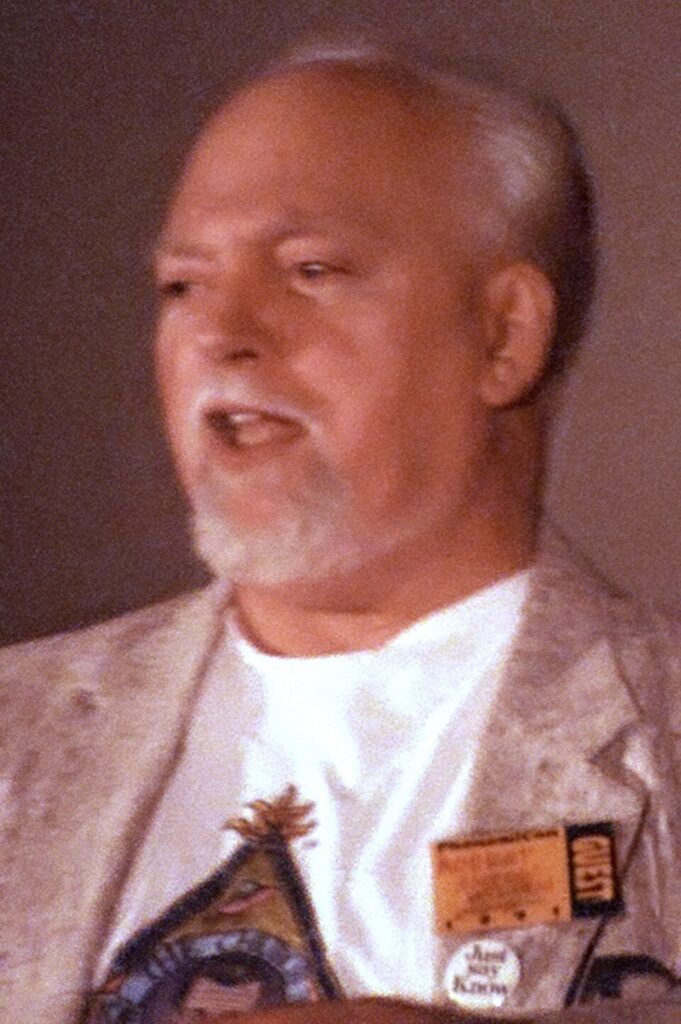
Born
18 January 1932
Birthplace
Brooklyn, New York
Known for
Reality tunnels
Died
11 January 2007
An introduction
A writer of multiple realities
Robert Anton Wilson wrote about a central human problem: we rarely experience the world without interpretation. Perception is shaped by biology, memory, language, culture, expectation and belief. What feels like reality is therefore partly a model assembled by the nervous system.
Wilson called these interpretive structures reality tunnels. His aim was not to persuade readers to adopt his particular tunnel. He wanted them to recognise that many tunnels are possible, that each reveals some things while concealing others, and that certainty can become a prison.
Across approximately 35 books, he mixed philosophy with science fiction, psychology with satire, and autobiography with experiments in consciousness. His writing could be playful, unsettling and intentionally ambiguous. The uncertainty was part of the method.
Early formation
Wilson was born Robert Edward Wilson in Brooklyn, New York. He was raised in a working-class Roman Catholic family and contracted polio as a child. The experience of illness, authority and religious certainty helped shape his later suspicion of rigid systems.
He studied engineering and mathematics at New York University but did not follow a conventional academic career. His education continued through independent reading, experimentation and contact with a wide range of intellectual traditions.
Important influences included Alfred Korzybski’s general semantics, James Joyce, Friedrich Nietzsche, Aleister Crowley, Buckminster Fuller, Wilhelm Reich, Timothy Leary, Zen, cybernetics, libertarian politics and the emerging study of consciousness.
Playboy, letters and conspiracy culture
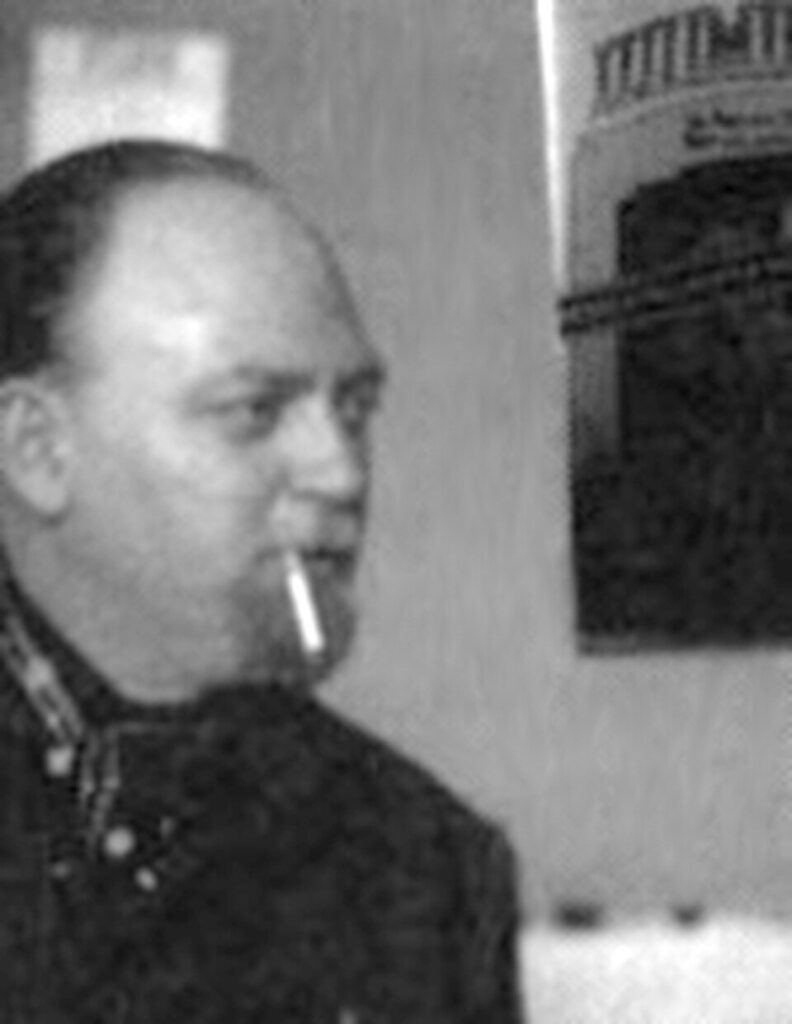
From 1965 to 1971, Wilson worked as an editor at Playboy. Part of his work involved handling correspondence from readers. The letters offered a remarkable catalogue of political fears, secret histories, alleged conspiracies and competing explanations of world events.
Wilson worked alongside Robert Shea, who shared his interest in how conspiracy narratives reproduce and collide. Instead of deciding which grand theory was correct, they imagined what would happen if many contradictory conspiracies were operating simultaneously.
Wilson treated conspiracy theories as material for studying belief, power and pattern recognition, not simply as hidden truths waiting to be revealed.
This experience became one of the foundations of The Illuminatus! Trilogy. It also anticipated a major problem of internet culture: when information is abundant, people can construct self-reinforcing worlds from selected evidence.
Fiction as an instrument
The Illuminatus! Trilogy
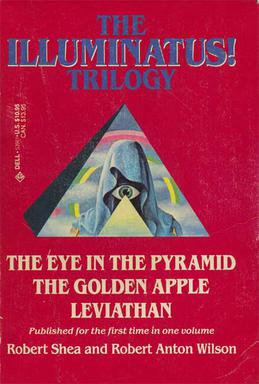
Written with Robert Shea and published in 1975, The Illuminatus! Trilogy combines conspiracy fiction, political satire, science fiction, occult references, anarchism, sexuality, psychedelia and absurd comedy.
Its three volumes are The Eye in the Pyramid, The Golden Apple and Leviathan. Narrators shift, identities blur, and explanations repeatedly undermine one another. Readers are denied the comfort of a single reliable account.
The trilogy is not best understood as an endorsement of conspiracy thinking. It is closer to a simulation of competing belief systems. The reader experiences how easily evidence can be reorganised to support whichever story currently occupies the mind.
British theatre director Ken Campbell later created an ambitious stage adaptation, helping the work acquire a lasting place in alternative theatre and countercultural history.
Discordianism and creative disorder
Wilson used humour and contradiction to loosen the grip of fixed ideas.
Order and disorder
Discordianism is a satirical religion centred on Eris, the Greek goddess of chaos. It questions the assumption that order is always good and disorder is always bad.
Humour as method
Jokes, paradoxes and elaborate hoaxes can expose the machinery of belief. Wilson used laughter to create enough distance for a person to examine an assumption.
The creative outsider
Discordian practice gives the individual permission to question official classifications and generate alternative interpretations without immediately mistaking them for final truth.
Reality tunnels
A reality tunnel is the world as it appears after experience has been filtered through a particular nervous system, language, culture and set of expectations.
Selection
The brain cannot process every available signal. Attention selects a small proportion of what is present.
Interpretation
Selected information is interpreted using existing concepts, memories, emotional associations and beliefs.
Confirmation
People often notice information that supports their existing model while discounting information that threatens it.
Wilson’s concept resembles modern discussions of predictive processing, cognitive framing and confirmation bias, although it should not be presented as a formal neuroscientific theory. Its value is practical. It reminds us that perception is active, partial and capable of revision.
The goal is not to escape every reality tunnel. It is to become more aware of the tunnel currently being used and more able to change perspective.
A practice of uncertainty
Model agnosticism
Wilson described his approach as model agnosticism. A model may be useful, elegant or strongly supported without becoming the complete identity of reality itself.
Rather than asking only whether an idea is absolutely true or false, Wilson encouraged additional questions:
- What does this model help us notice?
- What does it cause us to ignore?
- Under which conditions is it useful?
- What would the same situation look like through another model?
- What evidence might change our position?
This does not require treating all claims as equally credible. Evidence, logic and testability still matter. Model agnosticism is best used to resist dogmatism, not to erase the distinction between careful research and unsupported assertion.

Cosmic Trigger and Chapel Perilous
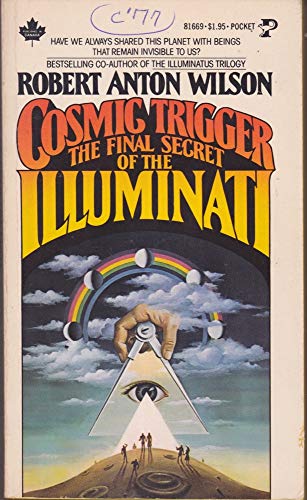
Published in 1977, Cosmic Trigger I combines memoir, philosophy, synchronicity, occult practice, psychedelic experience and speculation about intelligence associated with the star Sirius.
Wilson did not demand that readers accept one literal explanation for these experiences. He moved between psychological, neurological, symbolic, extraterrestrial and synchronistic models, allowing the uncertainty to remain visible.
He used the term Chapel Perilous for a condition in which unusual experiences become difficult to classify. A person may feel that everything is connected, yet cannot determine whether those connections arise from revelation, coincidence, imagination, altered perception or psychological distress.
The book also contains personal grief. Wilson’s daughter Luna was killed in 1976. Her death became part of a work already concerned with mortality, meaning and the limits of explanation.
The eight-circuit model
Wilson helped popularise Timothy Leary’s eight-circuit model of consciousness through Cosmic Trigger and Prometheus Rising. The model describes human behaviour through eight proposed neurological and psychological circuits.
The first four circuits concern survival, emotion, symbolic thought and social behaviour. The later circuits concern altered states, somatic awareness, genetic or evolutionary consciousness and experiences interpreted as nonlocal or cosmic.
Scientific context
The eight-circuit model is not an accepted model in contemporary neuroscience. Its circuits should not be confused with anatomically established brain networks. It is better approached as a speculative map, historical artefact and framework for personal reflection.
Wilson’s treatment was often more practical and humorous than Leary’s. Prometheus Rising includes exercises intended to make habitual beliefs and behavioural patterns easier to notice.
Language, thought and E-Prime
The map is not the territory
Influenced by Alfred Korzybski, Wilson emphasised that words and concepts are representations. A description of an event is not identical to the event itself.
Language can turn temporary observations into apparently permanent qualities. Saying “this idea seems mistaken to me under these conditions” communicates something different from declaring “this idea is false.”
E-Prime
Wilson promoted E-Prime, a form of English that avoids forms of the verb “to be.” The practice was developed by D. David Bourland as an extension of general semantics.
E-Prime encourages speakers to identify the observer, circumstances and evidence behind a statement. Wilson valued it as an exercise in precision and reduced dogmatism, not as a guaranteed solution to mistaken thinking.
Quantum psychology
In works such as Quantum Psychology, Wilson used ideas associated with relativity, uncertainty and observer-dependent measurement to discuss human perception. His primary concern was epistemological: how do we know what we think we know?
The approach can be stimulating when treated as an analogy and a philosophical exercise. It becomes misleading if metaphors from quantum physics are presented as proof of paranormal claims or direct explanations of everyday psychology.
A useful distinction
Quantum physics is a mathematical and experimental science describing physical systems. Wilson’s quantum psychology uses selected concepts as prompts for examining certainty, language and observation. The two should not be treated as interchangeable.
Selected works
Fiction
- The Illuminatus! Trilogy, with Robert Shea
- Schrödinger’s Cat Trilogy
- Masks of the Illuminati
- The Historical Illuminatus Chronicles
Consciousness and psychology
- Cosmic Trigger I
- Prometheus Rising
- Quantum Psychology
- Right Where You Are Sitting Now
Culture and criticism
- The New Inquisition
- Coincidance
- Everything Is Under Control
- Wilhelm Reich in Hell
A brief chronology
1932
Born in Brooklyn, New York.
1965 to 1971
Works as an editor at Playboy and collaborates with Robert Shea.
1975
The Illuminatus! Trilogy is published.
1977
Cosmic Trigger I appears, and Ken Campbell’s stage production of Illuminatus! reaches London.
1983
Prometheus Rising is published, developing the eight-circuit model through commentary and exercises.
2007
Dies in Capitola, California, shortly before his seventy-fifth birthday.
Influence and cultural legacy
Literature
Wilson’s mixture of conspiracy, metafiction and philosophy helped shape later speculative fiction and experimental storytelling.
Alternative culture
His work became important within Discordianism, chaos magic, psychedelic culture, cyberculture and experimental theatre.
Media literacy
Reality tunnels and model agnosticism remain useful concepts for discussing polarisation, misinformation and algorithmically reinforced belief.
Wilson’s strongest legacy may be methodological rather than doctrinal. He taught readers to test perspectives, watch language, question certainty and retain a sense of humour while doing so.
How should Wilson’s work be assessed?
Wilson moved freely between established knowledge, speculative models, personal experiences and deliberate fiction. This mobility is part of his appeal, but it also requires careful reading.
- His psychological concepts can be useful without being accepted as formal science.
- His scientific metaphors should be distinguished from experimental scientific findings.
- His discussion of conspiracy is often satirical and exploratory, not straightforward advocacy.
- His exercises encourage flexibility, but flexibility should remain accountable to evidence.
- His willingness to suspend judgement can support curiosity, provided it does not become indifference to accuracy.
Read this way, Wilson offers a distinctive toolkit for examining perception and belief. His work asks us to hold our interpretations lightly enough to revise them, while taking the consequences of our beliefs seriously.
Sources and further reading
- Penguin Random House: Robert Anton Wilson author profile
- The Guardian: Robert Anton Wilson obituary
- Los Angeles Times: Robert Anton Wilson obituary
- Robert Anton Wilson and Robert Shea, The Illuminatus! Trilogy
- Robert Anton Wilson, Cosmic Trigger I: Final Secret of the Illuminati
- Robert Anton Wilson, Prometheus Rising
- Robert Anton Wilson, Quantum Psychology
This page distinguishes Wilson’s philosophical and speculative models from established scientific findings. It is intended as an introduction to his life, writing and influence rather than an endorsement of every claim or interpretation associated with his work.