Learning, measurement and the promise of self-regulation
Neurofeedback
Can people learn to alter aspects of their own brain activity when a machine turns that activity into a sound, image or reward? Neurofeedback makes this possibility visible, but the display is always a selective translation rather than a transparent view of the mind.

The core idea
Neurofeedback is a form of biofeedback where a recording system measures some feature related to neural activity. Software processes the signal and returns information to the participant through a changing picture, tone, game, video, vibration or numerical display. The feedback is arranged so that particular changes in the selected signal are noticed or rewarded.
With repetition, the participant may learn to increase, decrease or stabilise that feature. Learning can be deliberate, using a mental strategy, or partly implicit, with the person unable to say exactly how control was achieved.
Neurofeedback does not show the brain to itself directly. It creates a chosen representation of a measured signal and asks whether the person can learn from that representation.
A closed feedback loop
1. Record
EEG electrodes, an MRI scanner or optical sensors detect a changing physiological signal.
2. Select
Software filters artefact and calculates a chosen frequency, amplitude, region, connection or pattern.
3. Translate
The selected value controls an immediate cue, such as the brightness of a screen or movement of a game.
4. Adapt
The participant experiments, receives the consequence and may gradually gain more reliable control.
The loop must be fast enough (i.e. immediate) for the consequence to remain meaningfully connected to the event. Delay, noisy measurement, badly chosen thresholds and reward that is too easy or too difficult can all change what is learned.
A family of technologies
“Neurofeedback” is not one intervention
| Approach | Signal returned | Important limit |
|---|---|---|
| EEG frequency-band training | Power or ratios within bands labelled delta, theta, alpha, sensorimotor rhythm, beta or gamma. | Band boundaries and targets vary. A scalp rhythm is not a single mental state. |
| Slow cortical potential training | Very slow positive or negative shifts in scalp electrical potential. | Requires careful recording and many trials. It is different from frequency-band training. |
| Z-score or database-guided EEG | Distance between current measurements and values in a normative database. | Results depend on the database, montage, reference, artefact handling and definition of “normal”. |
| Infra-low or infraslow training | Very slow fluctuations below conventional EEG bands. | Protocols and rationales differ, some systems are proprietary, and controlled evidence remains limited. |
| Source-estimated EEG | A mathematically inferred cortical source or network derived from scalp measurements. | The source is a model-dependent estimate, not a direct recording from that location. |
| Real-time fMRI | Blood-oxygen-level-dependent activity from a selected region or network. | The signal is indirect, delayed, horribly expensive and sensitive to movement and analysis choices. |
| fNIRS or optical feedback | Changes in oxygenated and deoxygenated blood near the cortical surface. | It has limited depth and spatial coverage, and physiological changes outside the brain can affect it. |

A NeuroCatch Platform™ by Health Tech Connex
What does an EEG electrode actually record?
Scalp EEG detects tiny voltage differences produced mainly by the summed activity of large populations of cortical neurons. It has excellent timing but limited ability to locate a signal precisely. Activity spreads through brain tissue, fluid, skull and scalp before reaching an electrode.
Eye movements, blinking, jaw tension, forehead muscles, heartbeat, movement, poor electrode contact and electrical equipment can all add larger signals. Real-time systems must decide what to reject, what to keep and how quickly to do so. If artefact is rewarded, a participant may learn to tense a muscle or alter gaze rather than regulate the intended neural feature.
Recording is not stimulation. In conventional EEG neurofeedback, scalp electrodes detect activity. They do not send an electrical current into the brain. Neurofeedback should therefore be distinguished from transcranial electrical stimulation, magnetic stimulation and other methods that apply energy to the nervous system.
What a session may involve
There is no universal neurofeedback session, but most programmes combine measurement, repeated training and some form of outcome review.
Assessment and target choice
The provider identifies the problem, reviews health and medication, records baseline measures and chooses a signal. Some use a standard protocol; others use a quantitative EEG or an individual peak frequency.
Sensor preparation
One or more scalp sites are prepared, sensors are attached and signal quality is checked. Wet electrodes usually need gel or paste; consumer headsets often use fewer dry sensors.
Training blocks
The person completes repeated periods of feedback and rest. A video may sharpen, music may continue or a game object may move whenever the criterion is met.
Threshold adjustment
The system may adapt the difficulty to keep reward frequent enough to guide learning without making success automatic. Manual adjustment can introduce practitioner judgement.
Transfer practice
Good research tests whether control continues when feedback is removed. Clinical programmes may ask the person to practise a state or strategy in ordinary situations.
Review and repetition
Signal change, symptoms, functioning and unwanted effects should be reviewed. Commercial courses commonly involve many sessions, making time and cost part of the decision.
The metaphor inside the machine
A mirror that edits
Neurofeedback is often described (badly) as a mirror for the brain. The metaphor is useful because behaviour can change when hidden consequences become visible. A mirror, however, reflects whatever stands before it. Neurofeedback software selects, filters, averages, delays, colours and rewards. It is closer to a dashboard built from one or two instruments.
The dashboard can still be useful. A speedometer does not show the whole car, yet it can guide driving. The critical questions are who chose the instrument, what it actually measures, why movement in one direction is called improvement and whether changing the dial changes life beyond the screen.
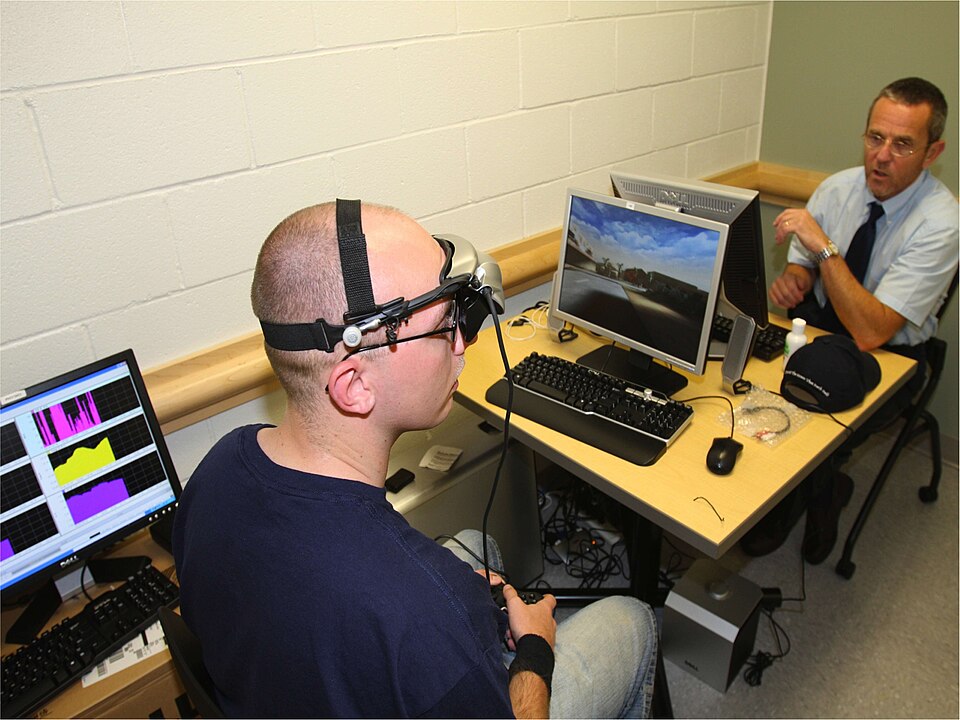
Through a DoD grant, Dr. Carmen Russoniello of East Carolina University is working toward a portable biofeedback training program that could prevent or reduce post-traumatic stress symptoms. (Photo by Dr. Carmen Russoniello)
How did neurofeedback develop?
1920s: human EEG
Hans Berger recorded electrical activity from the human scalp and described the alpha rhythm. The ability to measure a fluctuating signal made later feedback possible.
1960s: alpha awareness
Joe Kamiya reported that some participants could learn to recognise and influence periods of alpha activity when given a tone as feedback.
1960s and 1970s: SMR
Barry Sterman and colleagues trained sensorimotor rhythm in cats, then explored similar training in people with difficult-to-treat epilepsy. The studies were influential but small by modern clinical standards.
1970s onward: clinical expansion
Joel Lubar and others applied EEG feedback to attention problems. Later computing enabled multichannel EEG, database comparison, games, home systems, fMRI and optical feedback.
Historical importance does not settle present clinical effectiveness. Early demonstrations showed that aspects of neural activity could sometimes be conditioned. Modern treatment claims require larger, well-controlled trials with credible sham feedback, blinded outcome assessment and meaningful follow-up.
Four different meanings of “it worked”
A convincing neurofeedback study should separate neural learning from clinical improvement. One can occur without the other.
Signal regulation
Did the targeted feature change across trials or sessions in the intended direction?
Feedback specificity
Was change greater with genuine contingent feedback than with credible sham or alternative feedback?
Transfer
Could the participant reproduce the regulation when the display and rewards were removed?
Clinical benefit
Did symptoms and everyday functioning improve more than with an appropriate comparison?
A participant may feel better without learning the target signal. A participant may learn the signal without feeling better. Neither result should be silently rewritten as the other.
Common EEG protocols
Theta/beta ratio
Usually aims to reduce slower theta relative to faster beta activity. It became a prominent ADHD protocol, although not everyone with ADHD has an elevated ratio and the ratio can combine rhythmic and non-rhythmic features of the spectrum.
Sensorimotor rhythm
Often targets activity around 12 to 15 Hz over sensorimotor cortex. It has been explored for seizures, attention, sleep and motor regulation, but evidence for one use cannot be transferred automatically to another.
Alpha training
May reward an individual alpha peak, upper alpha or alpha suppression. Alpha changes with eyes open or closed, attention, drowsiness and task demands, so context and direction matter.
Alpha/theta training
Often delivered with eyes closed in a relaxed state and historically promoted for addiction, trauma, creativity and emotional work. The clinical literature contains influential reports but substantial methodological limitations.
Slow cortical potentials
Participants learn to produce slow negative or positive shifts associated with changes in cortical excitability. Training often alternates direction and may include transfer trials without feedback.
Connectivity and coherence
Rewards a relationship between sites rather than power at one site. Volume conduction, common reference and analysis choices can create apparent connections, so interpretation requires particular care.
Quantitative EEG and the appeal of personalisation
A quantitative EEG converts a recording into numerical features and may compare them with a normative database. A coloured “brain map” can make individual differences look precise and clinically decisive. It may help generate hypotheses or select a protocol, but it is not a photograph of health, personality or diagnosis.
Age, sleep, alertness, medication, recent caffeine, recording reference, electrode placement, eyes-open or eyes-closed condition, artefact rejection and the comparison sample can all affect the result. A value that differs from a database average is not automatically abnormal, causal or a treatment target.
Personalised does not mean validated
A tailored target can be scientifically sensible, especially when individual peak frequencies differ. It can also multiply researcher and practitioner choices. Personalisation must show better learning and better outcomes than a credible standard protocol or sham, not merely sound more exact.
What does the clinical evidence show?
Evidence differs by condition, signal, protocol, age group and control design. “There are studies” is not enough to establish a treatment no matter what the wellness guru tells you n his podcast.
| Area | What has been reported | Present caution |
|---|---|---|
| ADHD | Many trials and some positive unblinded ratings, with work on theta/beta, SMR and slow cortical potentials. | A 2025 meta-analysis of 38 randomised trials found no meaningful group-level clinical or neuropsychological benefit overall. A 2026 double-blind personalised upper-alpha trial achieved EEG learning but not greater core-symptom improvement than sham. |
| PTSD | Small EEG trials and newer studies report symptom and network changes. Recent pooled results appear encouraging, particularly against passive controls. | Samples and protocols remain heterogeneous. Sham-controlled evidence is limited, and durability, comparative effectiveness and adverse effects require larger independent trials. |
| Depression | EEG and real-time fMRI studies have reported symptom improvement and learned modulation of emotion-related regions. | Several studies are small or proof-of-concept. Active and sham groups can both improve, and the best target, dose and clinical role are not established. |
| Insomnia | Some participants report better sleep after repeated EEG feedback. | A double-blind placebo-controlled study found genuine and placebo feedback equally effective for subjective complaints, without a specific neurofeedback advantage. |
| Epilepsy | Historical SMR studies and later reviews report seizure reductions in some people, including difficult cases. | Much of the evidence comes from small, older or uncontrolled studies. Neurofeedback should not replace neurological assessment or anti-seizure treatment. |
| Chronic pain and migraine | Small studies report changes in pain, fatigue, mood and sleep. | Protocols, diagnoses and outcomes vary, with limited double-blind sham-controlled evidence and incomplete reporting of side effects. |
| Autism, anxiety and other conditions | Feasibility studies and small trials explore attention, social processing, anxiety and regulation. | The evidence is not sufficient to treat broad promotional lists of conditions as established indications. |
| Healthy performance and meditation | Some studies report improved attention, working memory, music or sport performance, and consumer devices can support engaging meditation practice. | Effects are inconsistent, tasks are vulnerable to expectancy and practice, and a 2025 consumer-device meta-analysis found only a modest reduction in distress with mostly small trials. |
This table is an evidence map, not a verdict on every protocol. A positive finding for real-time fMRI cannot validate an EEG headset, and an SMR study cannot validate infra-low training. Each claim must remain attached to the signal, population, comparison and outcome actually studied.
A revealing test case
ADHD: learning the signal is not the same as treating the disorder
ADHD has the largest and most contested clinical neurofeedback literature. Earlier trials often reported improvements, especially when parents or teachers knew which treatment a child received. More rigorous studies introduced active controls, credible sham feedback and blinded ratings.
The 2025 European ADHD Guidelines Group review combined 38 randomised clinical trials. At group level, neurofeedback did not produce meaningful improvement in core symptoms or neuropsychological measures when the full evidence was considered. This does not mean that no participant ever benefited. It means the controlled literature does not support presenting neurofeedback as a reliably effective front-line ADHD treatment.
A 2026 double-blind trial tested an individually adjusted upper-alpha protocol in 48 children. Most children in the neurofeedback group learned to modulate the EEG target, and some processing-speed measures improved. Core ADHD symptoms, however, improved similarly with genuine and sham feedback. The result is theoretically valuable because it separates successful neuromodulation from the clinical outcome that families were seeking.
A scientifically successful manipulation can still be a clinically unsuccessful treatment. That is not a contradiction. It is the reason both outcomes must be measured.
Why is neurofeedback difficult to test?
A believable sham
Random, replayed or yoked feedback must look responsive without accidentally training another useful feature. Participants may guess their allocation if one display behaves more naturally.
Blinding the provider
The practitioner may see the live signal, adjust thresholds and coach strategies. Knowledge of allocation can affect encouragement, interpretation and the participant’s expectation.
Learners and non-learners
Not every participant gains control. Defining a “responder” after results are known can exaggerate success by excluding those for whom the method did not work.
Many moving parts
Electrode sites, references, filters, frequency limits, thresholds, reward schedules, instructions, session number and artefact rules can all differ.
Subjective outcomes
Attention, sleep, pain and anxiety are affected by expectation, repeated measurement, support, practice and natural fluctuation. Blinded ratings and objective function matter.
Researcher flexibility
Many signals, sessions, regions and outcomes create opportunities to highlight a favourable result. Preregistration and the CRED-nf reporting checklist reduce ambiguity.
Sham feedback is not “nothing”
A sham session can still contain a plausible machine, focused attention, repeated practice, a calm setting, hope, reward, contact with a practitioner and a convincing story about self-regulation. These factors can alter symptoms and behaviour even when feedback is not contingent on the chosen brain signal.
If genuine and sham neurofeedback produce similar clinical improvement, the improvement is real but cannot be attributed confidently to training that specific neural target. The next question becomes practical: could a simpler, cheaper or better-established intervention provide the same benefit with less burden?
“No advantage over sham” does not mean that participants imagined improvement. It means the proposed active ingredient was not shown to be necessary.
Safety, unwanted effects and clinical limits
EEG recording itself is non-invasive and serious harms appear uncommon in published neurofeedback trials. Reported short-term problems include fatigue, headache, dizziness, nausea, agitation, anxiety, low mood, difficulty concentrating, sleep disturbance and symptom worsening. The true frequency is uncertain because many studies do not collect or report adverse events systematically.
Long sessions, flickering displays, immersive games and repeated frustration may create additional difficulties. People with epilepsy, significant neurological illness, psychosis, bipolar disorder, severe depression, suicidality or complex medication needs require appropriate clinical assessment. A neurofeedback operator should not diagnose outside their competence or advise medication changes without the prescriber.
A clinical caution
Neurofeedback should not delay diagnosis, safeguarding action or treatment with stronger evidence. Do not stop anti-seizure medication, ADHD medication, antidepressants or other prescribed treatment because a provider says the brain has been “retrained”. Changes should be agreed with the clinician responsible for prescribing.
Professional certificates in neurofeedback show a form of training, but they are not the same as competence to assess and treat every condition named in advertising. For clinical problems, verify the provider’s underlying professional qualification, registration, scope of practice, supervision, insurance and route for complaints.
Home headsets and consumer neurofeedback
Consumer headsets make feedback cheaper and more accessible. They can turn meditation, breathing or sustained attention into an engaging practice. Fewer dry electrodes, limited scalp contact and automated artefact handling also reduce what can be measured reliably, especially during movement.
A proprietary “calm”, “focus” or “readiness” score may combine several signals through an undisclosed algorithm. Improvement in the score can show growing familiarity with the device rather than a general change in mental health or performance. Data privacy also matters when raw or processed neural data are stored in an account or cloud service.
Reasonable use
- Use it as an optional practice aid rather than a diagnostic authority.
- Choose products that explain what is measured and how data are handled.
- Compare benefit with a timer, meditation app or ordinary attention exercise.
- Stop if it repeatedly worsens sleep, mood, anxiety, headache or concentration.
Warning signs
- The score is described as a diagnosis of trauma, ADHD or brain injury.
- One headset is claimed to treat a long list of unrelated conditions.
- The algorithm and feedback target cannot be explained in plain language.
- Marketing encourages replacement of medication or professional care.
Language under inspection
Popular claims and more accurate wording
| Popular claim | More accurate wording |
|---|---|
| “The brain sees itself and corrects its dysregulation.” | The system returns a selected signal and rewards a chosen change. Whether that change is corrective must be demonstrated. |
| “This brain map shows the cause of the symptoms.” | The recording differs from a comparison value. Difference, diagnosis and causation are separate questions. |
| “The protocol rewires the brain.” | Repeated learning can alter neural activity. That general fact does not establish a specific mechanism or clinical benefit. |
| “The treatment works below conscious awareness.” | Some learning may be implicit, but reduced awareness also makes it harder to describe the active strategy and verify transfer. |
| “It is drug-free, so it has no side effects.” | No drug is used, but fatigue, headache, sleep change, anxiety, agitation and worsening symptoms have been reported. |
| “It is personalised to your unique brain.” | The target was chosen from individual measurements. Personalisation still requires validation against appropriate controls. |
| “The FDA or device regulator cleared the equipment.” | Device status concerns a particular product and intended use. It does not prove every condition-specific claim made by a clinic. |
| “Thousands of sessions prove that it works.” | Popularity and accumulated experience can identify feasibility and possible harms, but effectiveness requires controlled outcomes. |
Questions to ask a provider
- Which exact form of neurofeedback are you proposing?
- What signal, site, frequency or network will be trained, and in which direction?
- Why is that target relevant to my problem rather than merely different from an average?
- What controlled evidence supports this protocol for people like me?
- Was the evidence compared with sham feedback, an active treatment or only a waiting list?
- How will you establish that I learned the neural target rather than an eye or muscle artefact?
- How will transfer be tested without feedback?
- Which symptoms and areas of everyday functioning will be measured before and after treatment?
- How many sessions are proposed, what is the total likely cost and when will lack of progress be reviewed?
- What unwanted effects do you record, and what is the plan if symptoms worsen?
- What is your underlying clinical qualification, registration, supervision and scope of practice?
- Will you communicate with my GP, psychiatrist, neurologist or other treating professional when needed?
- Who owns the raw recording, where are data stored and can I request deletion?
- Do you have a written complaints procedure and appropriate professional insurance?
Research and further reading
These direct links include general scientific reviews, methodological standards, controlled trials and examples of both positive and null findings.
- Sitaram and colleagues, 2017: Closed-loop brain training, the science of neurofeedback, a broad review of mechanisms, technologies and clinical challenges.
- Ros and colleagues, 2020: CRED-nf checklist, consensus standards for neurofeedback study design and reporting.
- NCBI Bookshelf: Introduction to electroencephalography, including the origin of scalp EEG and common physiological artefacts.
- Thibault, Lifshitz and Raz, 2016: The self-regulating brain and neurofeedback, a critical review of experimental science and clinical promise.
- Westwood and colleagues, 2025: Neurofeedback for ADHD, a systematic review and meta-analysis of 38 randomised clinical trials.
- Wang and colleagues, 2026: personalised upper-alpha neurofeedback in children with ADHD, a double-blind randomised sham-controlled trial.
- Neurofeedback Collaborative Group, 2021: double-blind placebo-controlled ADHD trial with 13-month follow-up.
- Schabus and colleagues, 2017: Better than sham?, a double-blind placebo-controlled study of neurofeedback for primary insomnia.
- Nicholson and colleagues, 2021: alpha-rhythm EEG neurofeedback for PTSD, a double-blind sham-controlled randomised trial.
- Nicholson and colleagues, 2023: alpha-rhythm normalisation and PTSD symptoms, neural results from the randomised trial.
- Berman and colleagues, 2025: EEG neurofeedback for PTSD, a systematic review and meta-analysis that also identifies the need for stronger active-control evidence.
- Mehler and colleagues, 2018: fMRI neurofeedback targeting the affective brain in depression, a randomised controlled trial.
- Young and colleagues, 2017: real-time fMRI amygdala neurofeedback in major depression.
- Kohl and colleagues, 2020: the potential of fNIRS-based neurofeedback, reviewing feasibility, heterogeneity and limits to clinical conclusions.
- Nigro, 2019: neurofeedback for paediatric epilepsy, concluding that the evidence was insufficient to establish efficacy.
- Patel and colleagues, 2020: neurofeedback in chronic pain, a systematic review reporting possible benefits, methodological limits and side effects.
- Consumer-grade neurofeedback with mindfulness meditation, 2025, a systematic review and meta-analysis of randomised studies.
- Tursic and colleagues, 2020: reporting quality in real-time fMRI neurofeedback studies.
A final perspective
Neurofeedback gives a person access to consequences that would otherwise remain hidden. That is a genuine scientific achievement and, in some settings, a promising route to learning. Its clinical value depends on something more demanding: showing that the chosen signal matters, that real feedback adds more than ritual and expectation, that learning transfers, and that the person’s life improves enough to justify the time, cost and risk.
This page is for education and critical discussion. It does not provide medical advice or recommend a particular device, protocol or practitioner. Neurological and mental-health symptoms should be assessed by appropriately qualified professionals, and prescribed treatment should not be changed without the responsible clinician.