When brain injury changes the dreaming mind
Mark Solms and the Neuropsychology of Dreams
Mark Solms challenged the assumption that dreaming is simply the psychological face of REM sleep. By studying neurological patients, he argued that dream experience depends on forebrain systems for motivation and perceptual construction.
A clinic-anatomical approach
How to approach Solms on dreams
Mark Solms is a South African neuropsychologist and psychoanalyst. His dream research began with a clinical question: when a specific part of the brain is damaged, which qualities of dreaming disappear, remain or change?
This approach differs from studying healthy sleepers with electroencephalography or brain imaging. A focal lesion can reveal whether a region or pathway is necessary for a capacity. Solms used reports and neurological records from hundreds of patients to map disorders of dreaming.
REM sleep can occur without a remembered dream, and dream experience can occur outside REM sleep. Correlation is not identity.
The central dissociation
REM sleep
A measurable physiological state involving rapid eye movements, characteristic brain activity, sensory disconnection and muscular atonia. Brainstem networks are central to its generation.
Dreaming
A subjective conscious experience during sleep, reconstructed through a report after awakening. It can occur in REM and non-REM sleep and depends on forebrain networks.
REM strongly favours vivid dream reports, but it is neither necessary nor sufficient for every instance of dreaming. Solms proposed that REM activation is one trigger capable of engaging a separate forebrain system that generates dream experience.
A challenge to the prevailing model
From a REM-on switch to a dream-on network
Earlier activation-synthesis accounts placed the initiating mechanism for dreams in brainstem systems controlling REM sleep. Solms accepted that REM physiology powerfully shapes many dreams, but rejected the idea that the REM generator is the dream generator itself.
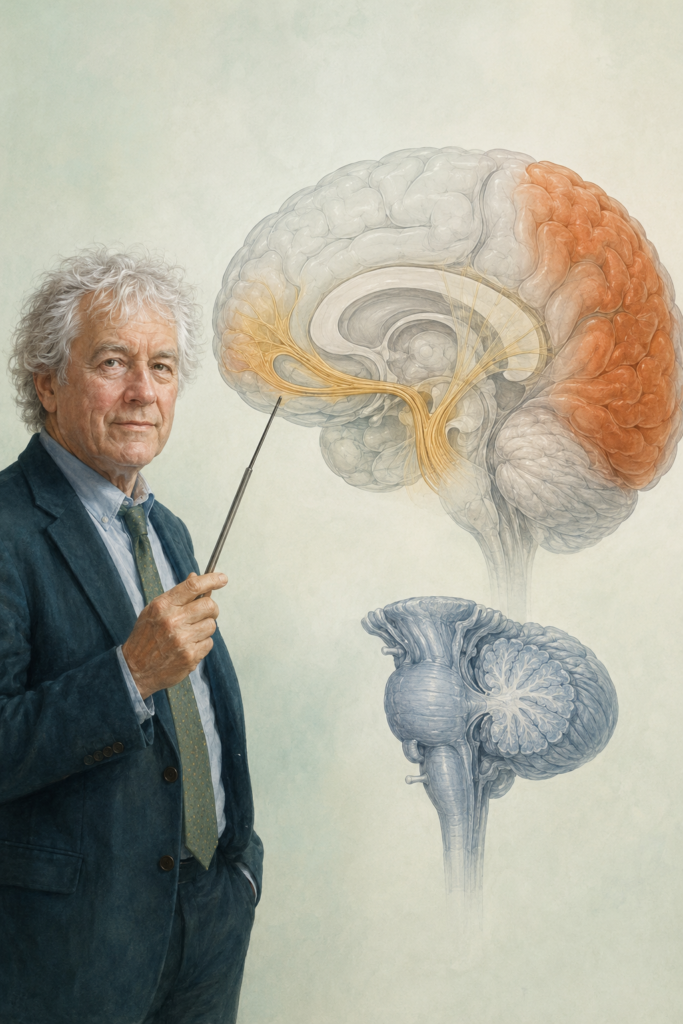
His alternative was a final common path in the forebrain. REM activation, sleep-onset processes, late-morning activation, seizures or chemical changes might each stimulate that path. Once engaged, motivational and perceptual systems construct a conscious dream world.
The brainstem may ring the bell, but the experience of dreaming depends on systems elsewhere in the brain.
Two routes to loss of dreaming
Solms found reports of global loss of dreaming, sometimes called anoneiria, after bilateral damage in two broad locations. One involved posterior parietal, temporal and occipital association regions. The other involved ventromesial frontal white-matter pathways.
The posterior region was linked with constructing complex perceptual and spatial experience. The frontal pathway was interpreted as carrying motivational activation from subcortical systems into the forebrain. REM sleep could remain physiologically present despite loss of reported dreams.
What different lesions can alter
Dream frequency
Some bilateral lesions were associated with a marked reduction or reported cessation of dreaming.
Specific contents
More restricted damage can selectively affect faces, movement, colour, spatial organisation or other dream qualities.
Dream recall
A patient may experience dreams but fail to retain or report them, creating a major interpretive difficulty.
Lesion research rarely identifies a single dream centre. It reveals components and networks required for motivation, imagery, spatial construction, memory and report.
The double dissociation
A double dissociation occurs when damage to system A impairs one function but spares another, while damage to system B produces the reverse pattern. It is powerful evidence that two processes are not the same.
Forebrain damage
Dream reports may cease while physiological REM sleep remains.
Brainstem damage
REM sleep can be severely disrupted while dream experience is still reported.
The clinical literature is uneven, and complete pontine lesions compatible with detailed testing are rare. Even so, non-REM dreams and preserved REM after loss of dreaming independently support the broader dissociation.
Why non-REM dreams matter
People awakened from non-REM sleep frequently report conscious experience. Such reports are often shorter, more thought-like or less vivid than typical REM dreams, but some are indistinguishable from them.
Dreaming is especially common near sleep onset and during the late-morning rise towards waking. Neither period can be reduced to one uniform REM mechanism. This supports the idea that several forms of activation can engage a common capacity for dream consciousness.
Modern high-density EEG studies likewise find dream reports in both REM and non-REM sleep, associated with local changes in posterior cortical activity.
A dream as motivated perception
A dreamer moves through an unfamiliar station, urgently searching for someone whose face is never clear. Every corridor opens into another platform. The dream contains perception, action and a persistent direction of concern.
A Solms-inspired account asks what motivational system keeps the search active and what posterior systems construct its spatial, visual world. It does not establish who the absent person represents or prove that the dream fulfils a disguised wish.

The motivational hypothesis
Dopamine and the SEEKING system
Solms connected one route into dreaming with the mesocortical-mesolimbic dopamine system. In Jaak Panksepp’s affective neuroscience, related circuitry contributes to SEEKING: exploratory, anticipatory engagement with the world.
Dopamine-enhancing drugs have sometimes increased vivid dreaming, while dopamine-blocking interventions can reduce dream reports without corresponding changes in REM measures. Frontal white-matter lesions that interrupt related pathways were also associated with loss of dreaming.
Dopamine is not a chemical translation of desire. It contributes to learning, salience, effort, exploration and motivation through complex, distributed circuits.
Does this make dreams wish fulfilments?
Solms argued that a motivational route to dreaming makes Freud’s emphasis on wishes biologically plausible. Dreams are not motivationally neutral displays. They often involve wanting, avoiding, searching, fearing, pursuing and trying to resolve a need.
That conclusion is narrower than Freud’s full theory. Evidence that motivation helps initiate dreaming does not show that every dream disguises an unacceptable wish, that censorship creates dream distortion or that interpretation can recover one latent meaning.
Supported possibility
Dreaming draws on systems concerned with motivation, salience and goal-directed engagement.
Unsupported leap
Neuroscience has verified Freud’s universal theory of disguised wish fulfilment.
Two forms of knowledge
What is neuropsychoanalysis?
Solms helped establish neuropsychoanalysis, an attempt to connect the subjective study of mind with the objective study of the brain. A patient can describe what an experience feels like, while neurological examination shows which capacities have changed after injury.
Dreaming is particularly suited to this approach because the phenomenon is private. Brain activity alone cannot tell a researcher exactly what was experienced, while a report alone cannot reveal the mechanisms that made it possible.
The field remains controversial. Psychoanalytic concepts can be difficult to operationalise, and neuroscientific findings do not automatically validate a psychological theory that uses similar language.
The posterior hot zone
Later high-density EEG research identified a posterior cortical hot zone in which reduced slow-wave activity was associated with reports of experience during both REM and non-REM sleep. Higher-frequency activity within parts of this region also related to reported faces, movement, speech and spatial settings.
This converges with Solms’s emphasis on posterior association areas while adding temporal information unavailable from lesions. It also raises a question: does the region generate dream experience, permit dream recall, construct its perceptual contents, or perform several of these functions?
A neural correlate marks activity associated with an experience. It is not automatically the sole cause or location of that experience.
What does the evidence support?
| Claim | Assessment | Reason |
|---|---|---|
| Dreaming and REM sleep are dissociable | Well supported | Dreams occur in non-REM sleep, REM can occur without recall, and lesion findings separate the processes. |
| Forebrain systems are necessary for normal dreaming | Well supported | Bilateral posterior and ventromedial frontal damage can abolish or severely alter dream reports. |
| Posterior cortical activity is important for dream experience | Strong converging evidence | Lesions and high-density EEG implicate posterior association regions across sleep stages. |
| Mesolimbic dopamine is the exclusive dream generator | Not established | Pharmacological and lesion findings suggest a role, but dreaming depends on distributed networks and the evidence has confounds. |
| Dreams are inherently motivated experiences | Plausible and partly supported | Goal pursuit and affect are common, and motivational pathways influence dreaming, but not every dream has an obvious goal. |
| Neuroscience has confirmed Freudian wish fulfilment | Not supported | The motivational findings do not test censorship, disguise, latent content or universal wish fulfilment. |
Limits of lesion evidence
Reports are indirect
No report may mean no experience, poor memory, language difficulty, reduced insight or weak motivation to describe it.
Lesions affect networks
Natural injuries vary in size and interrupt fibres that connect distant regions, so a visible site is not the full functional explanation.
Cases are heterogeneous
Cause, medication, recovery, sleep quality and other cognitive impairments differ between patients.
The strongest conclusions come from convergence among lesion studies, sleep-stage awakenings, pharmacology, imaging and electrophysiology rather than from one method alone.
Dreaming, affect and consciousness
Solms’s later work places affect at the foundation of consciousness. On this view, bodily needs and homeostatic pressures are felt as states such as wanting, fear, discomfort or relief. These feelings guide learning and action.
Dreams are therefore useful examples of consciousness without normal sensory contact or effective action. The brain generates a world in which affective concerns can be represented as perception and movement.
This larger theory is disputed philosophically and scientifically. The dream findings do not by themselves prove that affect is the elemental form or anatomical source of all consciousness.
Using Solms’s ideas responsibly
Useful questions
- What does the dreamer seek, avoid or try to resolve?
- How is motivation converted into a perceptual world?
- Which parts of the dream depend on space, faces or movement?
- Where is reflective control reduced or restored?
Claims to avoid
- Dopamine is the meaning of a dream.
- Every search scene conceals the same wish.
- A lack of recall shows neurological damage.
- One dream can identify a brain disorder.
Dream exploration is not diagnosis. A persistent new loss of dream recall is usually benign and can reflect attention, sleep or medication, but neurological symptoms, major changes in cognition or recurrent dream enactment require appropriate clinical assessment.
Solms among other dream theories
| Theorist | Starting point | Dreaming chiefly understood as |
|---|---|---|
| Sigmund Freud | Wish and conflict | A disguised attempt at wish fulfilment |
| J. Allan Hobson | REM brain state | Forebrain synthesis of internally generated activation |
| Rosalind Cartwright | Emotion across the night | Associative integration and possible mood regulation |
| Antti Revonsuo | Evolutionary simulation | Possible rehearsal of threatening events |
| Mark Solms | Lesions, motivation and consciousness | Motivated perceptual experience generated by forebrain networks |
Questions for examining a motivated dream
- What direction does the dreamer’s action take?
- What is wanted, feared, pursued, protected or avoided?
- Does the goal remain stable while settings and characters change?
- How does the dream construct space, movement and other people?
- Which impossibilities pass without reflective correction?
- What personal concern might organise the search without determining one fixed interpretation?
These questions explore form and motivation. They cannot locate brain activity or verify a hidden wish from dream content alone.
Research and further reading
These sources include Solms’s principal paper, reviews, critical commentaries and later studies of the neural correlates of dreaming. Some articles may require institutional access.
- Solms (2000), Dreaming and REM sleep are controlled by different brain mechanisms
- The 2000 target article with peer commentary
- Nir and Tononi (2010), Dreaming and the brain
- Ruby (2011), Experimental research on dreaming
- Siclari and colleagues (2018), Dreaming in NREM sleep
- Siclari and colleagues (2017), The neural correlates of dreaming
- Ruby (2020), The neural correlates of dreaming have not been identified yet
- Doricchi and Violani (2000), cautions about mesolimbic dopamine
- Boag (2017), On dreams and motivation
- Solms, Freudian dream theory today
- Converging theories on dreaming, Freud and predictive processing
- Solms (2019), The hard problem of consciousness and the free energy principle
- Bréchet and colleagues (2020), EEG microstates of dreams
- Working on dreams, from neuroscience to psychotherapy
- Royal Institution lecture with Mark Solms
A final perspective
Solms changed dream science by showing why sleep stage and subjective experience must be studied separately. His lesion findings helped return motivation and personal experience to a field dominated by REM physiology. The dopamine and Freudian extensions remain more contested, but the central distinction between REM sleep and dreaming has endured.