Rhythmic light, pulsed sound and the promise of brainwave entrainment
Light-and-Sound Machines
Can repeating flashes and tones guide the brain towards relaxation, focus or an altered state? Light-and-sound machines turn a genuine sensory response into a much larger claim. The interesting question is where measurement ends and metaphor begins.
The essential distinction
A measured response is not a programmed state of mind
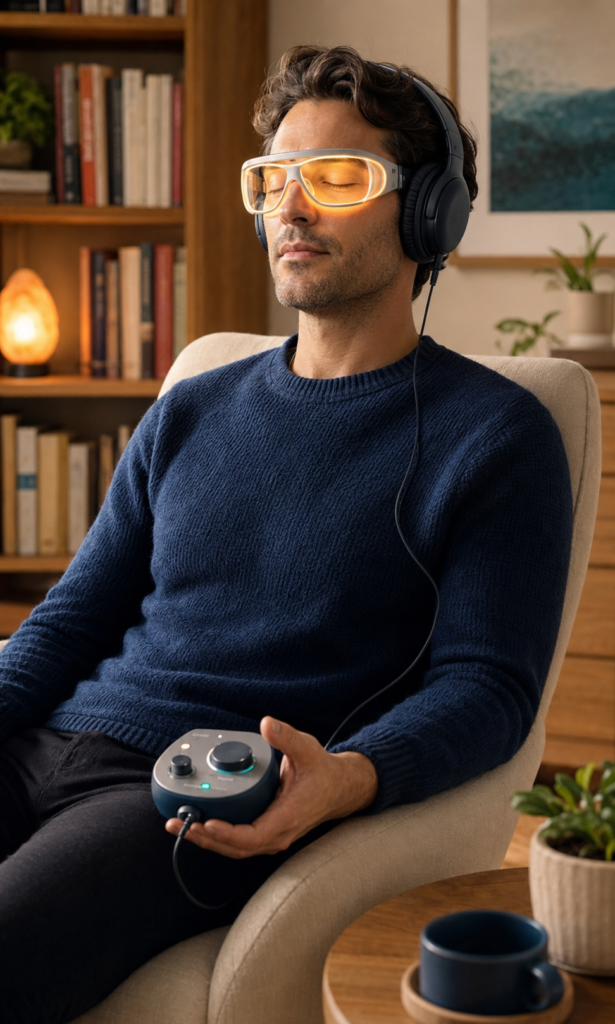
A light-and-sound machine, sometimes called an audiovisual stimulation or audiovisual entrainment device, presents rhythmic flashes together with clicks, tones or music. The visual and auditory systems can produce electrical responses related to the timing of those stimuli. In EEG research these are often described as steady-state responses or photic driving.
That physiological effect is real. It does not mean that the whole brain has locked to one frequency, that a named mental state has been installed, or that a lasting therapeutic change has occurred. A response at 10 Hz, for example, is evidence that the nervous system is responding to a 10 Hz stimulus. It is not, by itself, proof of meditation, creativity or healing.
Entrainment is a useful description of a time-locked sensory response. It becomes misleading when it is used as shorthand for control of consciousness.
The signal path
From a pulse generator to a human experience
1. Pattern
Software sets the timing, brightness, waveform and relationship between the light and audio channels.
2. Delivery
LED glasses or a lamp stimulate the visual system. Headphones or speakers deliver pulses, beats or a modulated soundscape.
3. Response
Retinal, visual-cortical and auditory pathways produce evoked activity that may be visible in an EEG recording.
4. Experience
Attention, expectation, comfort, music, setting and individual sensitivity help shape what the session feels like.
Laboratory studies of steady-state visual evoked responses show that visual flicker can produce frequency-specific activity in the visual system. For example, a human imaging study presented flicker from 5 to 60 Hz and mapped frequency-dependent responses. This is a robust research technique, but the existence of a response does not validate every commercial programme built around it. See the 2003 human study of steady-state visual responses.

What entrainment means
The brain responds in harmonics, networks and context
Photic driving refers to EEG activity related to a repeating visual stimulus. Responses may appear at the stimulation frequency, at harmonics, or at subharmonics. Their strength varies across people, frequencies, visual-field coverage and recording sites.
Auditory steady-state responses are time-locked neural responses to regular acoustic modulation or rapid tones. They are useful in hearing and neuroscience research. They are not the same thing as binaural beats, although commercial programmes often combine both.
Subjective effects are another level of analysis. A person may relax, become alert, see geometric patterns, feel absorbed, become uncomfortable, or notice little. No single EEG band maps neatly onto one experience. Alpha activity, for instance, varies with eye closure, attention and sensory processing as well as relaxation.
Do not confuse the categories
Six technologies that are often blurred together
Audiovisual stimulation
Visible light pulses and audible rhythms are presented together, sometimes in matched frequency and phase relationships.
Binaural beats
Slightly different tones are sent to the two ears through stereo headphones. The listener perceives a beat related to their frequency difference.
Isochronic and monaural beats
The sound itself rises and falls or pulses at a regular rate. Stereo separation is not required.
Clinical photic stimulation
Controlled flashes are used during an EEG to investigate photosensitivity and brain responses. This is a supervised diagnostic procedure.
Photobiomodulation
Red or near-infrared light is used for proposed cellular effects. Its central idea is light energy and wavelength, not a visible flicker programme.
tDCS, tACS and TMS
These apply electrical or magnetic stimulation. They have different mechanisms, doses, risks and research literatures from sensory flicker and sound.
Historical timeline
From flicker phenomena to digital “mind machines”
1819
Jan Evangelista Purkinje describes visual phenomena produced by flickering light. His observations of colours and geometric forms show that flicker-induced imagery long predates electronic wellness devices.
1929
Hans Berger publishes the first human EEG recordings. The new technique makes repeating electrical rhythms visible and supplies the vocabulary later used to market “alpha”, “theta” and other frequency-based experiences.
1949
V. J. Walter and W. Grey Walter publish “The Central Effects of Rhythmic Sensory Stimulation”. Their EEG work becomes a landmark in the scientific history of photic driving. Read the PubMed record for the 1949 paper.
1959
Brion Gysin creates the Dreamachine with Ian Sommerville. A perforated rotating cylinder produces flicker when placed around a light. It brings the visual effects of rhythmic stimulation into Beat culture, art and self-experiment. Tate’s Electric Dreams exhibition guide places the work in its artistic context.
1961
Andrew Neher reports auditory driving recorded with scalp electrodes. Rhythmic sound enters the scientific discussion, although later consumer descriptions often extend far beyond what an evoked response can establish.
1980s to 1990s
Portable electronic “mind machines” reach the consumer market. LED spectacles, stereo headphones and preset programmes make rhythmic stimulation easy to use at home. Claims expand to learning, meditation, stress, sleep and personal growth, usually faster than controlled evidence accumulates.
2008
A broad review finds preliminary psychological evidence but calls for better research. The paper helped consolidate the phrase “brainwave entrainment”, while also documenting a heterogeneous literature of binaural beats, photic stimulation and combined methods. Read the Huang and Charyton review.
2015
A systematic review of light-and-sound interventions in mental health finds only four eligible studies. Although its conclusion is cautiously positive, the authors describe the method as among the least clinically tested approaches and acknowledge that the review itself may be premature because so little research was available. See the 2015 systematic review.
2016 to 2019
40 Hz sensory stimulation becomes a distinct Alzheimer’s research programme. Mouse studies report changes in amyloid-related pathology, immune activity and behaviour after visual or multisensory stimulation. These findings are important, but they are preclinical and do not turn consumer devices into Alzheimer’s treatments.
2020s
Controlled AVS experiments and early human 40 Hz trials expand the evidence base. Larger experiments improve on parts of the older literature, but devices, outcomes and control conditions remain diverse. Short-term changes in mood or task performance should not be translated into disease-treatment claims.
The phenomenology
What a session may feel like
With the eyes closed, bright flicker can generate moving colours, lattices, spirals, tunnels and other geometric forms. These perceptions arise within the visual system. They do not require light patterns to be projected as pictures, and they are not evidence that the device has accessed hidden memories or supernatural imagery.
Some users describe absorption, time distortion, relaxation, alertness or dream-like imagery. Others report eyestrain, headache, nausea, agitation or very little. The same programme can feel different on another day because sleep, stress, caffeine, medication, expectation and the surrounding environment all matter.
- Visual intensity: brightness, colour, field coverage and distance all change the stimulus.
- Temporal structure: frequency, pulse shape, duty cycle and transitions may alter both EEG and experience.
- Audio design: clicks, music, isochronic pulses and binaural beats are not interchangeable.
- Context: closing the eyes, sitting quietly and expecting relaxation are active ingredients too.

What the evidence can support
A real sensory effect, an unsettled therapeutic literature
The best answer depends on the outcome being claimed. Evidence that a stimulus produces an EEG response is much stronger than evidence that a consumer programme treats a clinical condition.
Relatively well established
Sensory evoked responses
Regular visual and auditory stimulation can produce measurable time-locked neural activity. The response is often strongest in sensory networks and differs by frequency and individual.
Promising but specific
Short-term mood effects
A 2024 randomised experiment with 262 adults found acute improvements in several self-reported mood measures and some mood-sensitive tasks. The result concerns one experimental system and one session, not treatment of depression or anxiety disorders.
Mixed
Attention and cognition
Small studies have reported benefits on selected tasks, while others find null or inconsistent results. Task choice, practice effects, stimulation design and inadequate controls make broad conclusions difficult.
Inconsistent
Binaural beats
A 2023 systematic review found diverse and contradictory EEG findings across 14 studies. Most effects in the 2024 AVS experiment were similar with or without binaural beats, which argues against treating them as the essential active ingredient.
Insufficient for treatment claims
Clinical conditions
Research on anxiety, depression, attention problems, sleep, pain and cognitive decline uses varied devices and small samples. It does not justify presenting a general consumer machine as a treatment or replacement for clinical care.
Important non-specific effects
Rest, expectation and absorption
Sitting still, reducing external demands, closing the eyes and listening to an immersive soundscape may change mood without a frequency-specific mechanism. Good active controls are therefore essential.
Read the studies directly: the 2024 randomised AVS experiment, the 2023 systematic review of binaural-beat EEG studies, and a 2022 study of individual differences in photic driving.
The 40 Hz question
Promising Alzheimer’s research is not a home-treatment protocol
2016, mice
Visual flicker and amyloid
Iaccarino and colleagues reported that 40 Hz visual stimulation altered gamma activity, amyloid-related measures and microglia in an Alzheimer’s mouse model. The work was influential and later corrected in part, but it remained an animal study.
2019, mice
Light plus sound
Martorell and colleagues extended the approach to 40 Hz sound and combined stimulation. They reported effects on pathology and behaviour in mouse models across a wider set of brain regions.
2022 onward, humans
Early feasibility
Small early-stage studies suggest that supervised 40 Hz sensory stimulation can be feasible and can produce measurable entrainment. They are not definitive evidence of clinical benefit.
The careful translation is: 40 Hz sensory stimulation is a legitimate experimental research approach. Its mechanism, optimal dose, durability and clinical value in humans remain under investigation. A generic consumer light-and-sound machine has not automatically reproduced the hardware, calibration, screening, monitoring or population used in a research protocol.
Primary sources: Iaccarino et al., 2016, Martorell et al., 2019, and the 2022 early human study. The ongoing development programme can also be followed through the ClinicalTrials.gov record.
Translating the sales language
What popular claims can and cannot mean
Popular claim
“Your brain follows the frequency.”
More accurate translation
Sensory networks may show time-locked activity at the stimulus frequency and related harmonics. The response is not uniform across the whole brain.
Popular claim
“10 Hz creates relaxation.”
More accurate translation
A 10 Hz stimulus may evoke an alpha-range response. Alpha activity has several functions and does not represent one universal psychological state.
Popular claim
“Binaural beats synchronise the hemispheres.”
More accurate translation
Binaural beats are a real auditory percept. Evidence that they reliably produce the advertised EEG or psychological effect is inconsistent.
Popular claim
“40 Hz clears amyloid.”
More accurate translation
Influential results came from particular Alzheimer’s mouse models. Human clinical benefit remains under study and cannot be assumed for an off-the-shelf device.
Popular claim
“Meditation at the push of a button.”
More accurate translation
A session may be absorbing or relaxing. It does not reproduce the skills, attitudes, learning history or wider practice involved in meditation.
Popular claim
“Drug-free means risk-free.”
More accurate translation
Flashing light can trigger seizures in susceptible people and can cause discomfort in others. Sound level, visual intensity and individual history matter.
Evaluating a product
What a responsible device should tell you
- Exact outputs: frequency range, pulse shape, light colour, maximum brightness and audio level.
- Independent controls: separate, accessible controls for brightness and volume, including a genuinely low starting point.
- Clear screening: prominent warnings about photosensitive epilepsy, seizures, migraine and other relevant vulnerabilities.
- Study matching: evidence for the same device, programme, population and outcome, not just a paper that happened to use the same frequency.
- Calibrated claims: no suggestion that “FDA registered”, “CE marked”, patented or clinically tested automatically means clinically effective.
- No disease shortcuts: wellness language should not slide into claims to treat Alzheimer’s disease, depression, ADHD, insomnia or another diagnosis.
- Usable stop controls: the user should be able to end the light immediately without navigating an app while disorientated.
- After-sales transparency: a readable manual, adverse-event contact, realistic return policy and no pressure to ignore unpleasant symptoms.
A frequency label is not a dose. Two products set to “10 Hz” may differ greatly in brightness, pulse duration, waveform, colour, visual-field coverage, phase relationship, sound pressure and programme transitions.
Safety comes first
Flashing light can provoke seizures
Do not treat an immersive consumer device as harmless because it is non-drug and non-invasive.
Do not use without clinical advice if:
- You have epilepsy, a seizure history, unexplained blackouts, or a family or personal concern about photosensitivity.
- You have migraine with visual sensitivity, a significant eye condition, recent eye surgery or severe light sensitivity.
- You have tinnitus, hearing loss or another condition that makes headphone exposure a concern.
- You are currently experiencing mania, psychosis, severe dissociation or panic that an intense sensory experience could aggravate.
- The intended user is a child or cannot reliably understand and operate the stop control.
Stop immediately if you develop:
- Jerking, loss of awareness, unusual visual symptoms, confusion or any seizure-like event.
- Headache, eye pain, marked dizziness, nausea, disorientation or worsening tinnitus.
- Panic, agitation, derealisation, distressing imagery or a sense that you cannot reorient yourself.
Never use rhythmic light while driving, operating machinery, near open water, in a bath, on stairs or anywhere a sudden loss of awareness would create additional danger. Do not improvise high-intensity strobe sessions.
The Epilepsy Society notes that flashing or flickering between 3 and 60 Hz can be a trigger for susceptible people, with 16 to 25 flashes per second most likely. Epilepsy Action also stresses that brightness, visual-field coverage and duration affect risk. These ranges overlap directly with frequencies marketed for “brainwave entrainment”.
For audio, keep levels comfortable and conservative. The World Health Organization’s safe-listening guidance explains that both level and duration contribute to hearing risk.
Medical note: this page is educational and does not provide diagnosis, treatment or an individual safety assessment. Seek qualified clinical advice for symptoms or medical decisions.
Research reading list
Selected evidence and context
- Walter and Walter, 1949: early EEG study of rhythmic sensory stimulation.
- Pastor and colleagues, 2003: human cerebral activation during steady-state visual responses.
- Huang and Charyton, 2008: broad review of psychological effects attributed to brainwave entrainment.
- da Silva and colleagues, 2015 review: limited clinical evidence for light-and-sound interventions at that time.
- 2022 photic-driving study: individual response and resting alpha frequency.
- 2023 binaural-beat systematic review: inconsistent EEG evidence across heterogeneous studies.
- Johnson and colleagues, 2024: randomised controlled AVS study of acute mood and cognitive outcomes.
- Iaccarino and colleagues, 2016: 40 Hz visual stimulation in an Alzheimer’s mouse model.
- Martorell and colleagues, 2019: multisensory gamma stimulation in mouse models.
- Chan and colleagues, 2022: early human 40 Hz feasibility and pilot data.
Final perspective
Rhythm can organise attention without becoming a remote control for the mind
Light-and-sound machines sit at a revealing boundary. They can create vivid, measurable and sometimes valuable experiences. They also invite a seductive mistake: turning correlations between rhythms and mental states into a simple frequency code. The science is more local, variable and interesting than that.