The brain constructs a dreaming world
J. Allan Hobson and the Activation-Synthesis Hypothesis
J. Allan Hobson helped move dream theory from hidden wishes towards changing brain states. His account begins with internally generated activation during sleep, then asks how the forebrain makes a coherent experience from it.

A biological turning point
How to approach Hobson on dreams
J. Allan Hobson was an American psychiatrist and sleep researcher. With the psychiatrist Robert W. McCarley, he published the activation-synthesis hypothesis in 1977. Their proposal connected the characteristic experience of dreaming to the physiology of rapid eye movement sleep, usually called REM sleep.
This was not simply a new interpretation of dream symbols. It changed the starting question. Instead of asking first what motive had produced a dream, Hobson and McCarley asked what kind of brain state makes vivid, emotional and frequently illogical experience possible during sleep.
A brain mechanism can help explain why a dream has its unusual form without exhausting what that dream may mean to the dreamer.
Activation and synthesis
Stage one
Activation
During REM sleep, internally generated signals activate the sleeping brain. Sensory input from the outside world is reduced, while visual, emotional and motor systems can be strongly engaged.
Stage two
Synthesis
The forebrain attempts to organise this activity into an intelligible world. It draws on memory, expectation and learned models to create people, places, actions and a provisional narrative.
The two parts matter equally. Activation supplies unusual constraints and fragments. Synthesis is an active act of construction. The resulting dream is neither a photographic record nor a passive display of neural sparks.
The original 1977 proposal
A dream state generated from below
Hobson and McCarley argued that the physiological conditions for dreaming were initiated by brainstem mechanisms. In their historical model, cholinergic REM-on cells and aminergic REM-off cells interacted to regulate the transition into REM sleep.
Signals then travelled forward into the brain. Studies in animals have identified waves of activity involving the pons, the lateral geniculate region, and the occipital cortex, known as PGO waves. These offered a possible route by which internally generated activity could engage systems involved in vision.
The proposal linked the formal qualities of a dream to the state of the sleeping brain: vivid perception, unstable narrative, strong emotion and weak critical reflection.
A later refinement
The AIM model
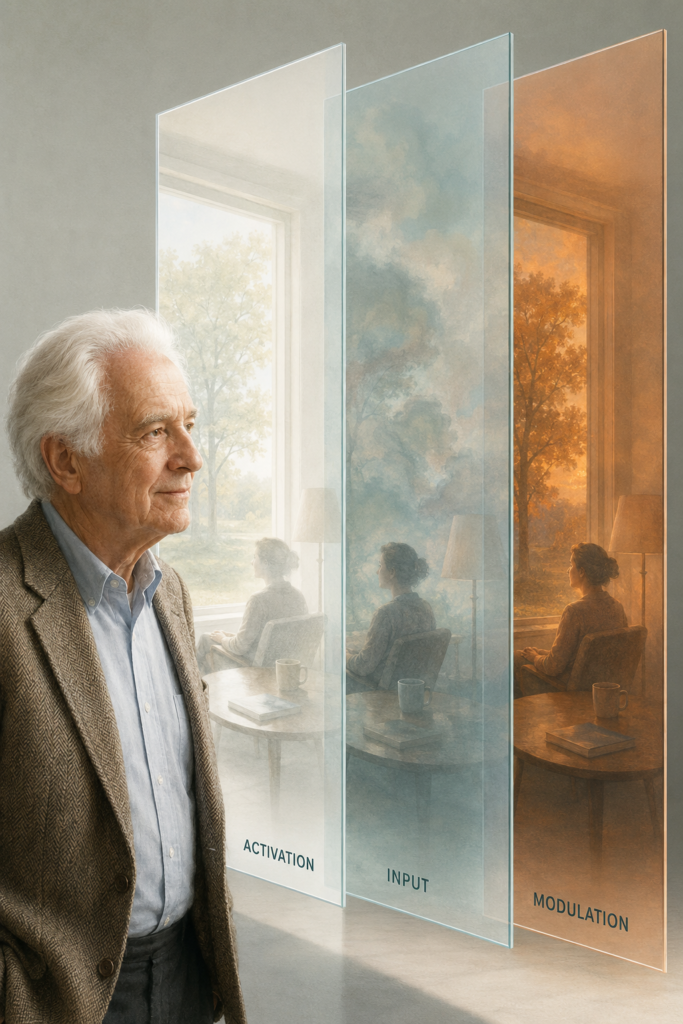
Hobson later described conscious states within a three-dimensional space. The AIM model placed waking, REM dreaming, non-REM dreaming and altered states at different positions rather than treating consciousness as simply on or off.
This was a significant broadening of the original hypothesis. Dreaming became one family of conscious states shaped by the level of activation, the source of information, and the chemical mode.
Three dimensions of a conscious state
A: Activation
How active is the brain? REM can be highly activated even while the sleeper is behaviourally disconnected from the room.
I: Input source
Is information mainly external or internal? In dreaming, outside input is attenuated, and the brain relies more heavily on internally generated material.
M: Modulation
Which chemical systems dominate? REM has a different neuromodulatory balance from waking, affecting memory, attention and reasoning.
The AIM model encourages comparison. A lucid dream, ordinary REM dream and waking reverie may differ by degree along these dimensions, even when all contain imagery and self-experience.
Why dreams feel the way they do
Neuroimaging has often found REM sleep to involve activity in visual association, limbic and paralimbic regions, together with relative reduction in some executive prefrontal regions. The precise pattern varies across studies and stages, but the broad contrast helps frame recurring dream qualities.
- Vivid perceptual imagery
- Strong and rapidly changing emotion
- A felt body moving through space
- Weak access to external reality
- Acceptance of impossible events
- Unstable time, place and identity
- Reduced self-reflection
- Fragile recall after waking
These are tendencies rather than rules. Some dreams are coherent, reflective and mundane. Lucid dreamers can recognise that they are dreaming, and non-REM reports can also contain elaborate experience.
A widespread misunderstanding
Did Hobson say dreams are meaningless noise?
No simple version of that claim does justice to the theory. Hobson challenged the idea that every dream begins with a disguised psychological wish. He argued that neural activation can initiate dreaming without a hidden motive supplying the first cause.
Yet synthesis depends on the dreamer’s brain, memories and models of the world. The signals may be physiologically generated, but the constructed scene is not independent of personal history. A mechanism that creates dream imagery does not demonstrate that the finished experience lacks emotional or autobiographical significance.
Internally generated does not mean psychologically empty. Constructed does not mean arbitrary.
A small example of synthesis
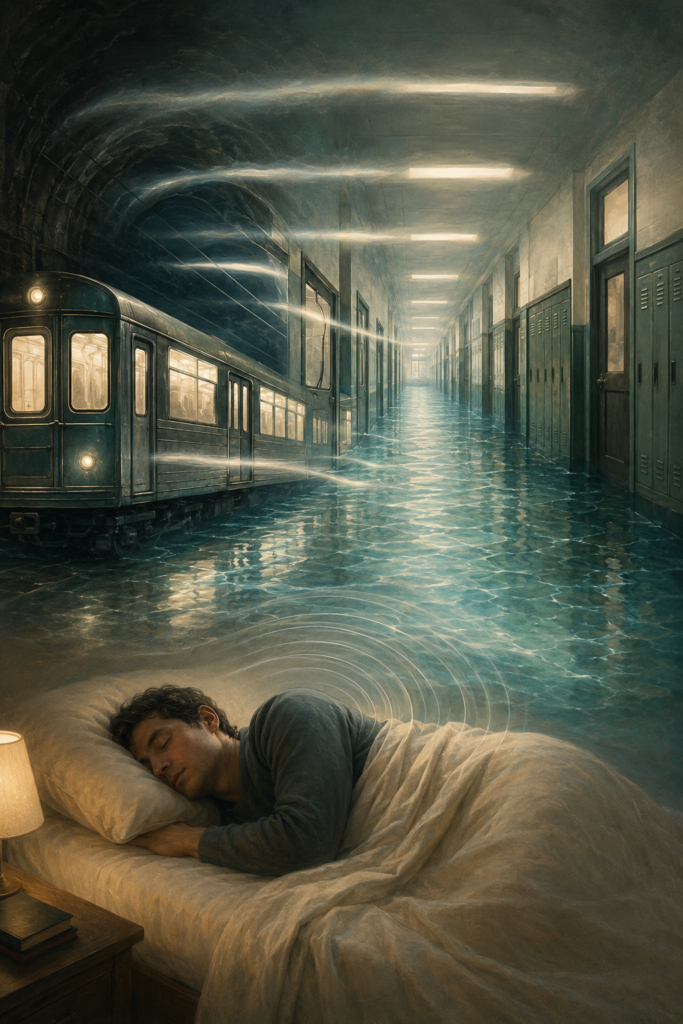
A dreamer feels sudden movement and sees bands of light. Almost at once, she is standing in a train that has entered a flooded tunnel. The carriage becomes a school corridor, and the water rises through the floor.
An activation-synthesis reading asks how sensations, visual activation and memory fragments became a navigable scene. It need not assign a fixed meaning to water, trains or schools. A personal inquiry might separately ask why those settings and feelings were available to this dreamer now.
REM sleep is not the same thing as dreaming
Vivid, story-like reports are especially common after awakening from REM sleep. That association was crucial to Hobson’s programme. It does not establish an identity between REM physiology and dreaming.
Dream experiences are also reported from non-REM sleep. Conversely, a person can show REM sleep without later reporting a dream. The likelihood, length and qualities of reports vary with sleep stage, time of night, awakening method and the definition used by researchers.
This evidence weakened any simple claim that one brainstem switch produces all dreaming. It favours distributed models in which brainstem regulation, forebrain networks and local patterns of cortical activity all contribute.
The lesion evidence
Neuropsychologist Mark Solms drew on cases in which forebrain damage altered or abolished dreaming while REM sleep remained. Damage in posterior cortical regions or pathways involving motivation could affect dream experience without simply eliminating the physiological signs of REM.
These dissociations challenged strong brainstem-first accounts. They suggested that the capacity to generate REM sleep and the capacity to generate a dream are controlled by overlapping but distinguishable mechanisms.
The most durable conclusion is not that the brainstem is irrelevant, but that dreaming cannot be located in one trigger or one sleep stage.
What does the evidence support?
| Claim | Assessment | Reason |
|---|---|---|
| REM is an internally activated and externally gated brain state | Well supported | Physiology and imaging show distinctive activation, sensory disconnection and motor inhibition. |
| REM conditions help explain common formal features of dreams | Broadly supported | Regional activity and chemical mode plausibly relate to vivid imagery, emotion and reduced reflective control. |
| Dreaming is produced only by brainstem REM mechanisms | Not supported | Non-REM dreams and lesion dissociations show that dreaming and REM are not identical. |
| PGO waves directly create human visual dream imagery | Uncertain | Animal findings are important, but a direct one-to-one mapping in human dreaming has not been established. |
| Dreams have no personal meaning because activation is biological | Does not follow | Synthesis uses memory, emotion and learned models even when activation begins physiologically. |
| REM dreaming trains a virtual model for waking consciousness | Interesting but speculative | The idea is theoretically productive, but direct evidence for the proposed function remains limited. |
What changed after 1977?
From switch to network
Current accounts of REM regulation involve more distributed and interacting neural populations than the original reciprocal-interaction model.
From REM to sleep
Researchers now study conscious experience across REM, non-REM and transitions, including local cortical activity linked to whether experience is reported.
From story to state
Hobson’s lasting contribution was to treat dreams as conscious states with measurable biological correlates, not merely as texts awaiting interpretation.
Hobson’s later theory
Dreaming as protoconsciousness
In 2009, Hobson proposed that REM sleep supplies a form of protoconsciousness. On this account, the sleeping brain constructs an immersive virtual world that helps develop and maintain the neural capacities required for waking consciousness.
The proposal connected dreaming with sensorimotor prediction, body models and the brain’s capacity to generate a world from within. Hobson later explored related ideas with Karl Friston, placing dreaming within theories of inference and internally generated models.
This is a functional hypothesis, not a settled finding. Showing that dreaming resembles virtual reality is different from showing that REM dreams are necessary training for consciousness.
Mechanism, content and function
Arguments about Hobson often become confused because three different kinds of explanation are treated as competitors.
Mechanism
What neural conditions allow dream experience to arise?
Content
Why did this person, place, feeling or metaphor appear?
Function
What, if anything, does dreaming contribute to mind or behaviour?
Evidence for a mechanism does not automatically answer questions about content or function. Several levels of explanation may be valid at the same time.
Using activation-synthesis responsibly
Useful questions
- Which sensory fragments does the dream organise?
- Where does the scene change without explanation?
- What does the dreaming mind treat as normal?
- Which memories may have supplied its materials?
Claims to avoid
- Every dream is only random firing.
- Every image corresponds to a specific neural pulse.
- REM physiology explains all dream content.
- A strange dream reveals neurological illness.
Dream exploration is not diagnosis. Recurrent nightmares, sudden changes in sleep behaviour, acting out dreams or severe daytime impairment may justify discussion with an appropriately qualified clinician. The content of one dream cannot establish a medical or psychological condition.
Hobson among other dream theories
| Theorist | Starting point | Dreaming chiefly understood as |
|---|---|---|
| Sigmund Freud | Conflict and desire | Disguised wish fulfilment shaped by dreamwork |
| Calvin Hall | Thought and personal conceptions | A cognitive representation of the dreamer’s world |
| Ernest Hartmann | Emotion and associative boundaries | Contextualisation through a central image |
| Antti Revonsuo | Evolution and simulation | Possible rehearsal of threatening events |
| J. Allan Hobson | Brain state and conscious construction | Synthesis under internally activated sleep conditions |
These positions ask different questions and need not be accepted as complete packages. A biological account can constrain psychological interpretation, while continuity with waking concerns can help explain the materials that synthesis recruits.
Questions for examining a dream
- What kind of world did the dreaming brain construct?
- Which sensations, emotions or movements seem to organise the scene?
- Where does the dream make an abrupt transition but preserve a feeling of continuity?
- What personal memories may have supplied characters and settings?
- Which impossible event did the dream self accept without criticism?
- Does the dream become more understandable when form and personal context are considered together?
These prompts are exploratory. They do not provide a symbolic code, and they should not be used to diagnose the dreamer.
Research and further reading
The links below lead to primary papers and substantial scientific reviews. Some articles may require institutional access.
- Hobson and McCarley (1977), The brain as a dream state generator
- Hobson, Pace-Schott and Stickgold (2000), Dreaming and the brain
- The 2000 AIM model article and peer commentaries
- Hobson (2009), REM sleep and dreaming: towards a theory of protoconsciousness
- Hobson and Friston (2012), Waking and dreaming consciousness
- Nir and Tononi (2010), Dreaming and the brain: from phenomenology to neurophysiology
- Solms (2000), Dreaming and REM sleep are controlled by different brain mechanisms
- Siclari and colleagues (2018), Dreaming in NREM sleep
- Martin and colleagues (2020), Structural differences between REM and non-REM dream reports
- Oudiette and colleagues (2012), Dreaming without REM sleep
- Siclari and colleagues (2017), The neural correlates of dreaming
- Maquet and colleagues, functional neuroanatomy of human REM sleep
- Scarpelli and colleagues, neurobiological and phenomenological features of dreaming
- A contemporary review of REM sleep regulation and function
A final perspective
Hobson’s strongest legacy is methodological. Dreams are experiences produced by a changing brain, and their biology places real constraints on any account of them. The original model was too closely tied to REM and too simple in its circuitry, yet its emphasis on construction, state and testable mechanism remains central to dream science.