Psyche and Plasticity
Gregory Bateson
Communication, cybernetics and the pattern which connects
Gregory Bateson was an English anthropologist, social scientist and systems thinker whose work connected culture, communication, learning, psychiatry, cybernetics, animal behaviour and ecology. He asked how living systems create meaning, maintain patterns and respond to change.

Born
9 May 1904
Birthplace
Grantchester, England
Known for
Systems and communication
Died
4 July 1980
An introduction
Thinking in relationships
Bateson resisted explanations that isolated a person, organism or event from its surrounding relationships. He argued that the significant unit of understanding was often not the individual object, but the pattern connecting several parts of a system.
A person communicates within relationships. A species develops within an ecosystem. A behaviour is shaped by feedback. A message acquires meaning from its context. Change in one part of a system can alter conditions elsewhere, which may then feed back into the original process.
This relational approach allowed Bateson to move between anthropology, psychotherapy, animal communication and ecology. The subject matter changed, but his central question remained: what pattern of relationships makes this event understandable?
A family of naturalists
Gregory Bateson was born in Grantchester, near Cambridge. His father, William Bateson, was a prominent biologist who helped establish genetics as a field of study in Britain and popularised the word “genetics.”
The family environment combined scientific inquiry, natural history, literature and intense intellectual expectations. Gregory was named after Gregor Mendel, whose work on inheritance his father strongly supported.
Bateson studied natural sciences at St John’s College, Cambridge, before turning to anthropology. His biological education remained important throughout his life, particularly in his later attempts to describe mind as a feature of living systems rather than as something confined inside an individual skull.
Anthropology and Naven
Bateson conducted anthropological fieldwork in New Guinea. His best-known early study focused on the Iatmul people and a complex ceremonial practice called naven.
Naven, published in 1936, did more than describe a ritual. Bateson used it to examine relationships between culture, personality, gender, emotion and social organisation.
He recognised that one event could be interpreted through several analytical frames. A ceremony might simultaneously express emotion, reinforce relationships, regulate competition and reproduce a wider cultural pattern.
Schismogenesis
Bateson coined schismogenesis for processes in which repeated interaction increases differentiation between people or groups. Each response stimulates a stronger counter-response, creating an escalating pattern.
Symmetrical escalation
Similar behaviours intensify one another. Competition produces more competition, hostility produces more hostility, and boasting produces greater boasting.
Complementary escalation
Different behaviours intensify one another. Greater dominance evokes greater submission, which may then encourage even more dominance.

Culture, character and visual anthropology
Research in Bali
Bateson married American anthropologist Margaret Mead in 1936. Together they conducted extensive research in Bali, using written observation, photography and film to study culture and behaviour.
They produced approximately 25,000 photographs and thousands of feet of film. Their work was among the earliest large-scale uses of photography and moving images as primary anthropological research materials.
Balinese Character: A Photographic Analysis, published in 1942, arranged photographs into sequences intended to reveal recurring patterns of posture, interaction, emotion and learning.
Later scholars have valued the methodological innovation while also questioning how much the researchers’ categories shaped their representation of Balinese life.
Cybernetics and circular causation
During the 1940s and 1950s, Bateson participated in the Macy conferences, which brought together researchers interested in communication, control, computation, neurology, anthropology and systems theory.
Cybernetics studies how systems regulate themselves through information and feedback. A thermostat offers a simple example: it detects a difference between actual and desired temperature and acts to reduce that difference.
Bateson applied circular thinking to relationships and living systems. Instead of saying that A simply causes B, he examined patterns in which A affects B, B affects A, and the interaction continues through time.
Negative feedback
Feedback reduces deviation and helps maintain stability. The system corrects movement away from an acceptable range.
Positive feedback
Feedback increases deviation. A change generates further change and may produce escalation or rapid transformation.

NLPers will recognise this as a TOTE loop. They need to read Bateson.
Information and difference
Bateson described information as “a difference which makes a difference.”
Not every physical difference becomes information for every system. A difference becomes informative when the receiving system can detect it and when that detection alters what happens next.
A sound has different significance depending on the organism hearing it. The same words have different meanings in different relationships. A change in temperature matters to a thermostat only if it crosses a threshold the device is capable of detecting.
Difference
There must be some contrast, change or distinction capable of being detected.
Detection
A system must possess the means to register that difference.
Consequence
Detection must alter the state or future activity of the system.
Communication and metacommunication
A message communicates more than its literal content. Tone, posture, timing, setting and relationship provide information about how the message should be interpreted.
Metacommunication is communication about communication. It frames the meaning of what is happening. A smile may indicate that an insult is playful. A formal setting may indicate that ordinary remarks should be treated as instructions.
“This is play”
Bateson observed animals engaging in play fighting. Their actions resembled combat, yet accompanying signals indicated that they should not be interpreted as an actual attack.
The playful nip refers to a bite but does not mean what an actual bite would mean. Play therefore requires the capacity to understand multiple levels of communication at once.
Meaning depends not only on what is communicated, but on the frame that tells the receiver what kind of communication it is.
The double bind
In 1956, Bateson, Don D. Jackson, Jay Haley and John Weakland published “Toward a Theory of Schizophrenia.” The paper introduced the double bind as a recurring communication pattern in which a person receives conflicting messages at different logical levels.
In a severe double bind, responding to one message violates another. The contradiction cannot be discussed safely, and the person cannot easily leave the relationship.
- An important relationship exists.
- A primary instruction or demand is communicated.
- A second message conflicts with the first at another level.
- The contradiction cannot be openly named or questioned.
- Withdrawal from the situation is difficult or punished.
- The pattern is repeated until it becomes expected.

Scientific and clinical context
The original proposal that family double binds cause schizophrenia was not supported as a sufficient explanation and is not accepted by contemporary psychiatry. Schizophrenia involves complex genetic, neurodevelopmental, psychological and environmental factors. Double binds remain useful for describing certain communication dilemmas, but families should not be blamed for causing psychotic illness.
Influence on family therapy
Although its original schizophrenia hypothesis was not confirmed, the Bateson group changed the direction of psychotherapy. It encouraged clinicians to examine interaction, context and feedback rather than locating every problem entirely inside one individual.
A symptom could be studied as part of a sequence. One person’s behaviour might respond to another person’s behaviour while simultaneously shaping what that person did next.
These ideas influenced the development of systemic family therapy, strategic therapy, brief therapy and communication-oriented approaches. Don Jackson, Jay Haley and John Weakland later became significant figures in these fields.
A systemic view does not deny individual biology or personal responsibility. It adds the observation that behaviour also develops and acquires meaning within relationships, institutions and environments.
Levels of learning
Learning 0
A specific response occurs without correction or change through experience.
Learning I
Behaviour changes through correction, reinforcement or experience within a stable set of alternatives.
Learning II
A person learns patterns about how to learn, what contexts mean and which kinds of response are expected.
Learning III
A rare reorganisation changes the higher-order assumptions through which identity and experience are structured.
Learning II is sometimes called deutero-learning or learning to learn. It includes the often unspoken lessons through which people form expectations about trust, authority, failure, intimacy, and the kind of world they inhabit.
Logical types and category errors
Bateson drew upon Bertrand Russell and Alfred North Whitehead’s theory of logical types. A class is not the same kind of thing as one of its members, and a statement about a message belongs to a different level from the message itself.
Confusion can arise when levels are mixed. “This statement is false” creates a paradox because the statement refers to itself. Interpersonal confusion can arise when a verbal message is contradicted by a nonverbal message about how the words should be interpreted.
For Bateson, humour, play, metaphor, art and psychotherapy all involve movement between levels of communication. The ability to recognise the frame makes flexible interpretation possible.

Mind beyond the human
Animal communication
Bateson studied communication in dolphins, octopuses and other animals. This work supported his broader interest in how living systems recognise patterns and respond to context.
He was particularly interested in play because it requires metacommunication. The animal must distinguish between an action and an action that represents another action.
At the Oceanic Institute in Hawaii, Bateson examined dolphin interactions, and the challenges posed when humans attempted to impose experimental tasks on another intelligent species.
His animal research encouraged a less human-centred account of mind. Communication, learning and relationship existed throughout the living world.
Mind as an ecological process
Bateson did not treat mind as a separate substance sealed inside the brain. He described mental processes through relationships involving difference, information, feedback, pattern and correction.
The relevant mental system may extend through the brain, body, tools, relationships and environment. A person cutting down a tree forms part of a circuit that includes eyes, nervous system, axe, muscles, tree and repeated sensory correction.
Removing one part from that circuit may make the action impossible to understand. The unit of mind is therefore not necessarily identical to the biological boundary of the individual.
Bateson’s ecological account of mind anticipated later interest in embodied cognition, distributed cognition, enactivism and the extended mind, although these fields do not simply reproduce his theory.
The pattern which connects
Bateson asked what pattern connects the crab to the lobster, the orchid to the primrose and all four to the human being. He was looking for relationships of form, development and organisation rather than a list of isolated similarities.
Living systems repeatedly transform patterns. A limb, leaf or wing may differ in appearance while sharing relationships that reveal common processes of growth and evolution.
For Bateson, beauty was connected with recognition of these relationships. Art, science and ecology could each reveal forms of organisation that remained invisible when attention was limited to separate objects.
The pattern which connects is a relationship of relationships. It is discovered by comparing organisation rather than merely comparing objects.
Ecology and conscious purpose
Bateson became increasingly concerned with environmental destruction. He argued that human beings often pursue narrow goals while ignoring the wider systems upon which those goals depend.
Conscious purpose tends to simplify. It selects a desired outcome and removes whatever appears to obstruct it. Ecological systems contain feedback loops, delays and interdependencies that the simplified plan may fail to perceive.
The narrow goal
Increase production, remove a pest, maximise growth or solve one immediate problem.
The ignored system
Soil, water, predators, communities, energy, waste and future generations remain outside the calculation.
The returned consequence
The intervention alters the wider system, which eventually feeds consequences back to the decision-maker.
For Bateson, the environmental crisis was also an epistemological crisis. Destructive action reflected a mistaken way of thinking about the relationship between humanity and nature.
Selected works
Anthropology
- Naven
- Balinese Character, with Margaret Mead
- Trance and Dance in Bali, with Margaret Mead
Mind and systems
- Steps to an Ecology of Mind
- Mind and Nature
- Angels Fear, with Mary Catherine Bateson
Communication
- “A Theory of Play and Fantasy”
- “Toward a Theory of Schizophrenia,” with colleagues
- “The Cybernetics of Self”
A brief chronology
1904
Born in Grantchester, Cambridgeshire.
1920s and 1930s
Studies natural sciences and anthropology and conducts fieldwork in New Guinea.
1936
Publishes Naven and marries Margaret Mead.
1936 to 1938
Conducts visual anthropological research in Bali with Mead.
1940s and 1950s
Participates in the Macy conferences on cybernetics and communication.
1956
Publishes “Toward a Theory of Schizophrenia” with Jackson, Haley and Weakland.
1960s
Studies animal communication, including dolphin behaviour in Hawaii.
1972
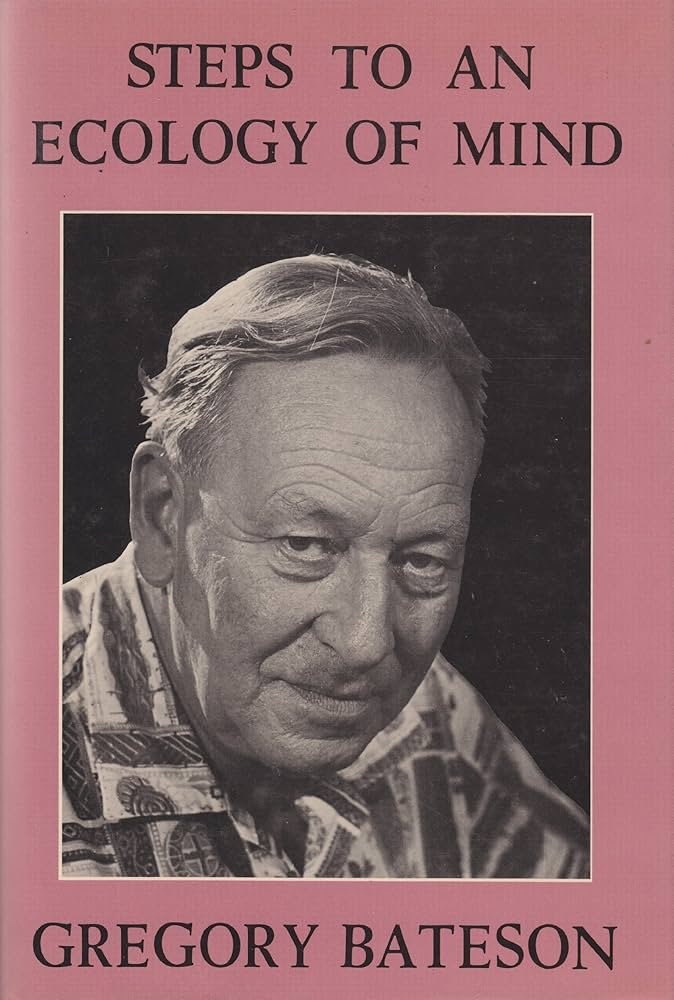
Publishes Steps to an Ecology of Mind and begins teaching at the University of California, Santa Cruz.
1979
Publishes Mind and Nature: A Necessary Unity.
1980
Dies in San Francisco aged 76.
Influence and legacy
Systemic therapy
His emphasis on interaction, context and feedback helped redirect psychotherapy towards relational systems.
Communication
His work on framing and metacommunication influenced research into language, humour, play and relationships.
Ecological thought
He connected environmental crisis with habitual errors in how people understand mind, purpose and nature.
A balanced assessment
Bateson’s work is influential partly because it crosses disciplinary boundaries. This breadth also makes his writing difficult to translate into simple, testable propositions.
- His concepts of feedback, context and relationship remain central to systems thinking.
- Schismogenesis offers a useful model of interpersonal and political escalation.
- Metacommunication remains valuable for understanding play, humour and relational conflict.
- The double bind remains a useful communication concept but is not an accepted primary cause of schizophrenia.
- His levels of learning are conceptual distinctions rather than separately identified brain mechanisms.
- His ecological account of mind influenced later thinking but should not be treated as identical to modern cognitive science.
- His anthropological work should be read alongside later scholarship and the perspectives of the communities represented.
Bateson’s enduring contribution was a discipline of attention. He asked us to notice relationship before isolating objects, context before assigning meaning, and feedback before assuming a simple chain of cause and effect.
Sources and further reading
- California Museum: Gregory Bateson
- Bateson, Jackson, Haley and Weakland: Toward a Theory of Schizophrenia
- Bateson and colleagues: A Note on the Double Bind
- Gregory Bateson, Naven
- Gregory Bateson and Margaret Mead, Balinese Character
- Gregory Bateson, Steps to an Ecology of Mind
- Gregory Bateson, Mind and Nature: A Necessary Unity
- Gregory Bateson and Mary Catherine Bateson, Angels Fear
This page provides historical and educational information. Bateson’s double-bind hypothesis should not be used to blame families for schizophrenia or to replace contemporary psychiatric assessment and treatment. His concepts are presented as contributions to systems thinking, communication theory and intellectual history.