Sleep laboratory 10 · When threat returns at night
Dreams, Trauma and Post-Traumatic Nightmares
After trauma, sleep can become a place where threat returns. Post-traumatic nightmares may replay parts of an event, transform them into new danger scenarios, or preserve the same helplessness without reproducing the original scene.

Three core signals
At a glance
SIGNAL 01
Repetition
Nightmares may reproduce sensory fragments, themes or emotional structure from trauma.
SIGNAL 02
Arousal
Hypervigilance and disrupted sleep can strengthen a cycle of fear, awakening and anticipatory anxiety.
SIGNAL 03
Treatment
Evidence-based approaches can reduce nightmare frequency and distress without requiring literal reliving.
Research note 01
What makes a nightmare post-traumatic
Trauma-related nightmares occur after exposure to overwhelming threat and may form part of post-traumatic stress disorder. Some closely replay the event; many are only thematically related.
The defining clinical issue is not symbolic content but repeated dysphoric dreaming, awakening, distress and effects on sleep and daytime functioning.
Research note 02
Why the cycle persists
Trauma can alter arousal, fear learning and the sense of safety. Poor sleep then reduces emotional regulation and increases sensitivity to threat, while fear of sleep promotes avoidance and irregularity.
Nightmares may become partly autonomous from the original event, maintained by expectation, rehearsal, insomnia and conditioned arousal.
Research note 03
Treatment and imagery rehearsal
Imagery Rehearsal Therapy asks a person to create a less distressing version of a recurrent nightmare and rehearse it while awake. Meta-analyses and clinical reviews support reductions in nightmare frequency and distress for many patients.
Other approaches include cognitive behavioural treatment for insomnia, exposure and rescripting methods, and trauma-focused therapies. Medication decisions require a qualified prescriber and individual assessment.
Research note 04
Interpretation without intrusion
A clinician should not impose symbolic claims on trauma dreams or pressure the person for graphic detail. Safety, consent, pacing and current functioning take priority.
Dream content can be explored when useful, but a nightmare does not need to be decoded before it can be treated.
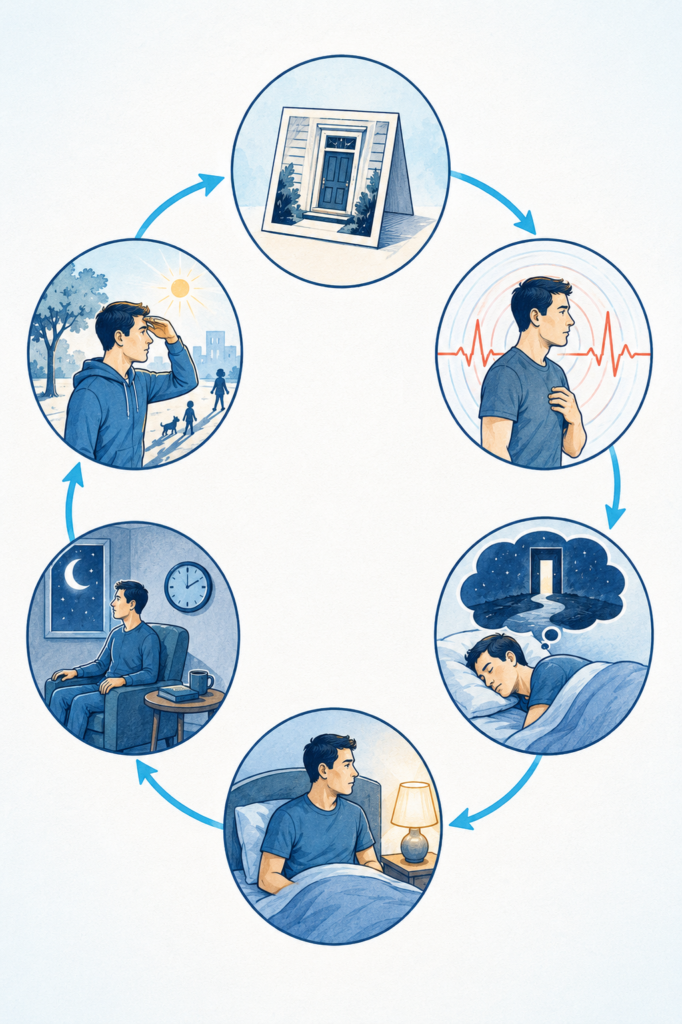
A process, not a single switch
Dream research becomes clearer when experience is treated as a changing process. Sleep stage, local brain activity, memory, emotion, bodily state, awakening and the wording of the report can all influence what is observed.
A brain correlate is evidence about the conditions of a dream. It is not automatically an interpretation of the dream.
What the evidence supports
| Claim | Current standing | Reason |
|---|---|---|
| Trauma increases risk of recurrent nightmares | Well supported | Nightmares are common in PTSD and can worsen sleep and distress. |
| Post-traumatic nightmares always replay the event exactly | False | Many preserve themes or affect rather than literal details. |
| Imagery rehearsal can reduce nightmares | Supported | Trials and reviews show clinically useful effects, with variation between individuals. |
| Every trauma dream reveals a repressed memory | Not supported | Dreams are reconstructive and cannot verify historical events. |
Interpretive boundaries
Dream neuroscience is most informative when it states clearly what a method measures and where inference begins. The following boundaries prevent an interesting finding from becoming an exaggerated claim.
- This page is educational and not a substitute for individual clinical care.
- Recurrent nightmares with significant distress warrant professional assessment.
- Avoid forced disclosure and confident memory claims.
- Consider sleep disorders, medication, substance use and physical health as well as trauma.

Source desk
Key research and further reading
- El-Solh, Management of Nightmares in PTSD.
- Casement and Swanson, Meta-analysis of Imagery Rehearsal for Post-trauma Nightmares.
- Gill et al., Psychosocial Treatments for Nightmares.
- Goldstein and Walker, The Role of Sleep in Emotional Brain Function.
- Scarpelli et al., The Functional Role of Dreaming in Emotional Processes.
Research changes as methods improve. Links are provided so that readers can distinguish direct findings, reviews and theoretical interpretation.
The measured night
In summary
Post-traumatic nightmares are real sleep symptoms, not puzzles a person has failed to solve. They can be approached with care, evidence-based treatment and respect for the difference between a remembered dream and a verified event.