Sleep laboratory 11 · How dream evidence is made
Current Methods Used in Dream Research
Dreams cannot be observed directly by another person. Research advances by coordinating a private report with precisely timed measurements of sleep, brain activity, behaviour and experimental stimulation.

Three core signals
At a glance
SIGNAL 01
Timing
Researchers wake participants at known moments and collect reports immediately.
SIGNAL 02
Triangulation
Physiology, first-person reports and behavioural tasks answer different parts of the question.
SIGNAL 03
Transparency
Open databases, preregistration and blinded analysis help test fragile findings.
Research note 01
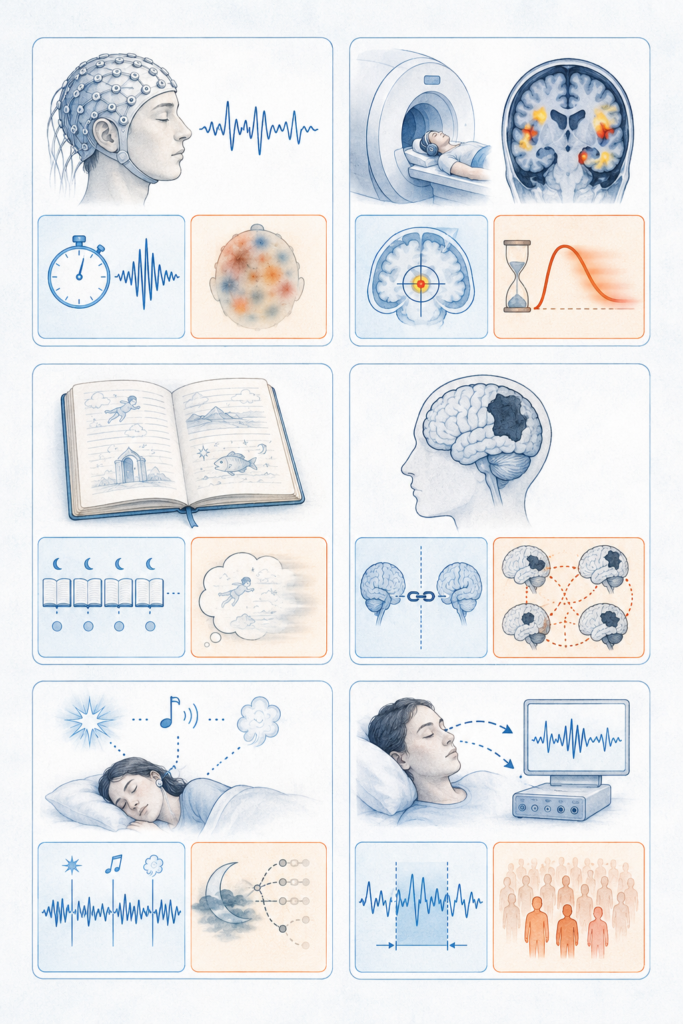
Polysomnography and awakenings
Polysomnography records EEG, eye movements and muscle tone to classify sleep stages. In a serial-awakening study, the researcher wakes a participant from selected moments and asks for an immediate report using standardised prompts.
This remains the foundation because it links experience to a defined physiological interval. It is labour-intensive, and the awakening itself can affect recall.[1], [2]
Research note 02
Reports and content analysis
Reports may be spoken, written or collected through diaries. Researchers code length, characters, emotions, actions, sensory qualities, bizarreness and incorporations using explicit scoring systems.
Blind raters and inter-rater reliability reduce interpretive bias. Automated language models can assist with large datasets, but their categories and training assumptions must be validated.
The wording of the prompt matters. “What was going through your mind?” is broader than “Were you dreaming?” Neutral follow-up questions help distinguish a visual scene, a thought, an emotion and a sense of having experienced something that can no longer be recalled. Researchers should decide these categories before analysing the data rather than inventing them after seeing the reports.
Research note 03
EEG, imaging and lesions
EEG measures electrical activity with high temporal resolution; high-density EEG improves spatial estimation. fMRI and PET offer different views of regional activation but are noisy, restrictive and temporally slower.
Lesion studies reveal which regions may be necessary for dreaming. No method alone identifies both the full experience and its causal mechanism.[1], [3]
Research note 04
Experimental intervention
Researchers use pre-sleep learning, sounds, odours, touch, transcranial stimulation and pharmacology to test causal influence. Lucid dreamers can sometimes send pre-agreed eye signals or answer simple questions while asleep.[4]
Modern work increasingly combines these methods with preregistration, blinded prediction and shared datasets because small samples and analytical flexibility have limited earlier claims.
Interactive dreaming changes the clock
Most dream evidence is retrospective: the physiological recording comes first and the description follows after awakening. Lucid-dream communication can shorten that gap. A participant who realises that they are dreaming may signal with a distinctive left-right eye sequence that is visible in the electro-oculogram. Researchers can then present a question and look for a pre-agreed response while polysomnography still verifies REM sleep.
In a study conducted by four independent laboratory groups, 36 participants were tested using spoken questions, flashing lights or tactile signals. Correct answers were recorded on 29 occasions across six participants.[4] One dreamer heard an arithmetic problem as if it came through a radio; another perceived flashing light as an event inside the dream. These examples are scientifically useful precisely because the external signal and the dream report can be tied to a known time.
The method is not yet routine. Many attempts receive no response, lucidity is uncommon, signals can be ambiguous and participants may awaken. It also samples a special form of dreaming rather than ordinary dreams. Its value lies in adding a narrow real-time channel to the usual post-awakening report, not in replacing that report.
From single laboratories to shared datasets
Dream experiments often include few participants but many observations per person. That structure can exaggerate apparent accuracy if repeated awakenings from the same participant appear in both training and test data. A model may recognise an individual’s EEG or reporting style instead of a general feature of dream experience.
The DREAM database was designed to support larger, standardised analyses. Its initial release assembled 20 datasets, 505 participants and 2,643 awakenings, each paired with pre-awakening M/EEG and a minimum classification of reported experience.[5] The scale is unusual for dream neuroscience and allows questions that no single laboratory could easily answer.
Open data do not automatically make measurements comparable. Laboratories may use different prompts, sleep-stage procedures, electrode layouts and definitions of “no experience.” Harmonisation therefore requires transparent metadata and sensitivity analyses. The database is most valuable when researchers test whether a result survives those differences.
Machine learning illustrates the point. A 2025 analysis of a public dataset involving 28 participants reported accuracies above 0.85 for classifying dream and dreamless reports with selected EEG channels, but performance was harder to generalise to participants excluded from training.[6] High performance within one dataset is promising; independent-person validation determines whether it travels.
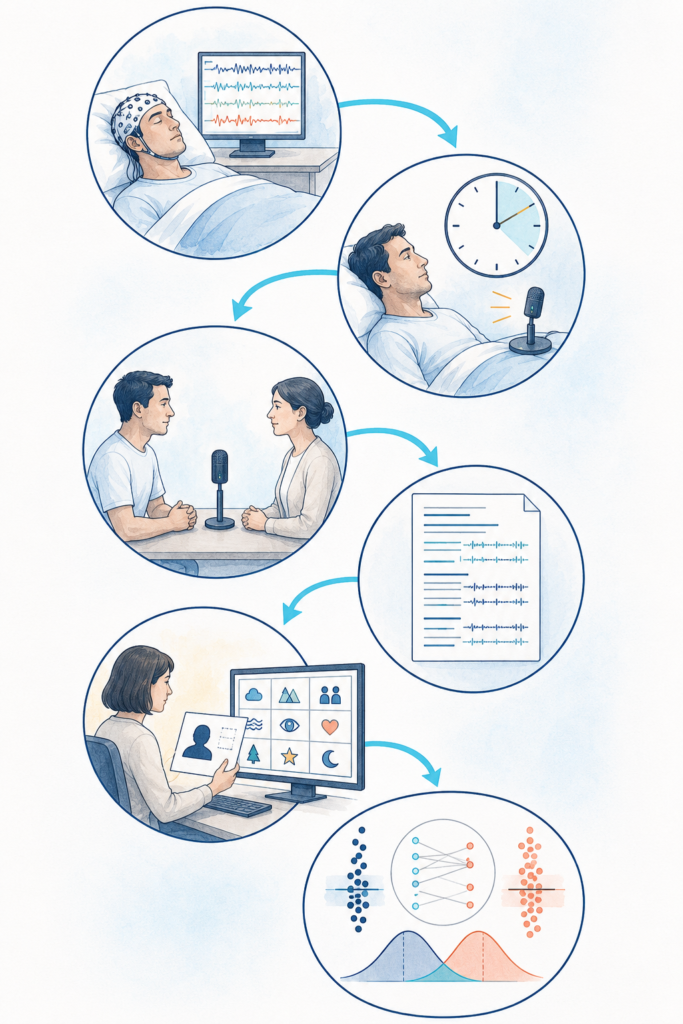
A process, not a single switch
Dream research becomes clearer when experience is treated as a changing process. Sleep stage, local brain activity, memory, emotion, bodily state, awakening and the wording of the report can all influence what is observed.
A brain correlate is evidence about the conditions of a dream. It is not automatically an interpretation of the dream.
What the evidence supports
| Claim | Current standing | Reason |
|---|---|---|
| Immediate awakening reports are a central measure | Well established | They minimise delay and can be tied to recorded sleep. |
| EEG directly displays dream content | False | EEG measures electrical patterns that must be related statistically to reports. |
| Blinded analysis always detects dreaming | Not established | Prominent classifiers may lose performance under stringent or cross-participant tests.[6] |
| Combining methods improves inference | Strong methodological principle | Different measures constrain different sources of error.[1], [2] |
Interpretive boundaries
Dream neuroscience is most informative when it states clearly what a method measures and where inference begins. The following boundaries prevent an interesting finding from becoming an exaggerated claim.
- A dream report is data, but it is retrospective and reconstructed.
- Small samples and many analytical choices increase false-positive risk.
- Sleep-stage activity is not the same as dream-specific activity.
- Machine learning performance must be tested on genuinely independent data.
Source desk
Key research and further reading
- Mallett et al., New Strategies for the Cognitive Science of Dreaming.
- Ruby, Experimental Research on Dreaming.
- Siclari et al., The Neural Correlates of Dreaming.
- Wong et al., A Dream EEG and Mentation Database.
- Konkoly et al., Real-Time Dialogue Between Experimenters and Dreamers During REM Sleep.
- Scarpelli et al., What About Dreams? State of the Art and Open Questions.
Research changes as methods improve. Links are provided so that readers can distinguish direct findings, reviews and theoretical interpretation.
References
- Mallett R, Konkoly KR, Nielsen T, Carr M, Paller KA. New strategies for the cognitive science of dreaming. Trends Cogn Sci. 2024;28(12):1105-1117. doi:10.1016/j.tics.2024.10.004. PMID: 39500684.
- Ruby PM. Experimental research on dreaming: state of the art and neuropsychoanalytic perspectives. Front Psychol. 2011;2:286. doi:10.3389/fpsyg.2011.00286. PMID: 22121353.
- Siclari F, Baird B, Perogamvros L, et al. The neural correlates of dreaming. Nat Neurosci. 2017;20(6):872-878. doi:10.1038/nn.4545. PMID: 28394322.
- Konkoly KR, Appel K, Chabani E, et al. Real-time dialogue between experimenters and dreamers during REM sleep. Curr Biol. 2021;31(7):1417-1427.e6. doi:10.1016/j.cub.2021.01.026. PMID: 33607035.
- Wong W, Herzog R, Andrade KC, et al. A dream EEG and mentation database. Nat Commun. 2025;16(1):7495. doi:10.1038/s41467-025-61945-1. PMID: 40804039.
- Moctezuma LA, Molinas M, Abe T. Unlocking dreams and dreamless sleep: machine learning classification with optimal EEG channels. Biomed Res Int. 2025;2025:3585125. doi:10.1155/bmri/3585125. PMID: 39963589.
- Scarpelli S, Alfonsi V, Gorgoni M, De Gennaro L. What about dreams? State of the art and open questions. J Sleep Res. 2022;31(4):e13609. doi:10.1111/jsr.13609. PMID: 35417930.
The measured night
In summary
Dream research is strongest when it treats neither brain data nor personal report as sufficient by itself. The science grows through carefully timed convergence between them.