Sleep laboratory 12 · Reading patterns, not private films
Can Dream Content Be Decoded from Brain Activity?
Experiments can sometimes predict broad features of reported dream imagery from brain activity better than chance. That achievement is scientifically important, but it is far from recording or replaying a dream.

Three core signals
At a glance
SIGNAL 01
Training
Decoders learn statistical relations from examples collected from the same participant or a defined dataset.
SIGNAL 02
Categories
Successful studies usually classify broad objects or experiential features, not exact scenes.
SIGNAL 03
Uncertainty
Above-chance accuracy still includes many errors and depends on restricted conditions.
Research note 01
The landmark visual-decoding experiment
Horikawa and colleagues used fMRI as participants fell asleep, woke them repeatedly for reports, and identified broad visual categories in their descriptions. Classifiers trained on waking responses to images predicted some reported categories from pre-awakening activity above chance.[1]
The decoder did not view the dream. It linked distributed activity patterns to labels such as people, buildings or vehicles after extensive participant-specific training.
What the machine actually learns
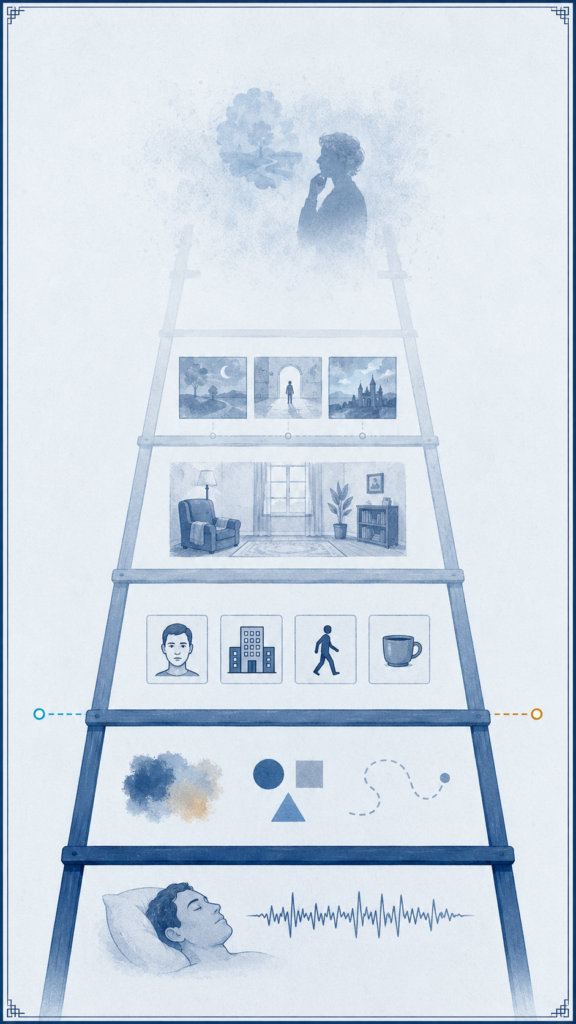
A decoder begins with paired examples: a measured brain pattern and a label assigned to it. During waking training, a participant may view many images while fMRI records changes in blood oxygenation. The model learns which distributed patterns tend to accompany broad classes of visual features. During sleep, researchers then ask whether a newly measured pattern resembles any of those learned relations.
This procedure explains both the achievement and the limit. If the candidate labels are “person,” “building” and “vehicle,” the model may choose among those categories. It has not learned every object the dreamer could encounter, and it has not recovered colour, dialogue, emotion, movement or narrative continuity. The verbal report used as ground truth is also produced after awakening, when content may already have been forgotten or reorganised.
A later analysis used features from a deep neural network trained for object recognition. Mid- to high-level features decoded from dream fMRI patterns corresponded above chance with the reported object categories.[2] This suggests that dreamed and perceived objects can share hierarchical visual representations. It does not show that the model reconstructed the exact dreamed object. The analysis matched neural patterns to category-level features drawn from an image database.
Research note 02
Presence, qualities and content
Other work asks simpler questions: was there any experience, was it visual, did it contain movement, or did the dreamer recognise a face? These targets may be more tractable than reconstructing a full narrative.
High-density EEG can relate local frequency patterns to subsequent reports, but reliable generalisation remains difficult. EEG-based models may perform well within a selected dataset and then lose accuracy when tested on a person not represented during training.[3], [4]
The ground-truth problem
Dream decoding has an unusual measurement problem: the experience and the report are not identical. Researchers cannot pause the dream, inspect it independently and compare it with the participant’s description. They must treat a later verbal report as the best available label.
Even a careful immediate report leaves uncertainty. A dreamer may remember a station but forget the train, describe a stranger as a friend because that identity felt obvious, or use the word “house” for a structure that changed throughout the scene. Automated text analysis adds another layer of decisions about synonyms, categories and context.
This is why successful decoding requires strict separation of training and test data, blinded analysis and transparent reporting of all candidate categories. A model should not be evaluated on examples that helped to tune it. It should also be tested on new awakenings and, ideally, new participants. Recent machine-learning studies using public EEG data have reported classification accuracies above 0.85 within their analyses, yet explicitly note poorer generalisation to unseen individuals.[4] That limitation is central, not a technical footnote.
Research note 03
Why reconstruction headlines overreach
Brain decoding is an inference problem: a model chooses among predefined possibilities using noisy signals and training data. A plausible picture generated from a category is not a recovered image from the dream.
fMRI is slow relative to rapid changes in dream scenes, dream reports are incomplete, and training sets contain assumptions about how words map to images and neural patterns.
The distinction is easy to lose in a striking illustration. If a decoder predicts “building” and a separate image generator produces a detailed castle, only the category prediction came from the neural data. The towers, windows, weather and artistic style were supplied by the generator unless the experiment measured evidence for them.
Research note 04
Future possibilities and ethics
Larger shared datasets, improved sensors and better models may increase prediction of broad features. Interactive lucid-dream experiments could provide tighter timing labels.
Progress also raises questions about consent, neural privacy and sensational claims – anyone fancy a bit of future-crime? Current systems cannot secretly read an ordinary person’s dreams, and it would be misleading to market them as doing so.
The legal history of brain-based evidence is worth examining, including controversial attempts to use brain scans in criminal investigations. Such cases do not validate dream reading and should not be treated as proof that neural data can reveal guilt, intention or private meaning.
From tiny samples to shared data
Dream studies are expensive because each usable observation may require an overnight recording, a precisely timed awakening and a report. Small datasets make it easy for a model to learn individual quirks or laboratory-specific noise rather than a general marker of dreaming.
The DREAM database was created to address part of this problem. Its initial release combined 20 datasets, 505 participants and 2,643 awakenings with at least 20 seconds of pre-awakening M/EEG and standardised report classifications.[5] Analyses showed that objective EEG features could predict reported conscious experience in both REM and non-REM sleep.
This is a step towards reproducibility, not a library of decoded dream films. The outcome label is commonly experience versus no experience, or another broad report category. Shared data allow independent teams to test whether a marker survives changes in equipment, procedures and participants. They also make negative findings more informative by revealing where a promising classifier fails.
The most credible future progress will probably come in layers: first detecting whether experience is likely, then estimating broad qualities such as visual imagery or movement, and only later attempting more detailed content. Each layer needs its own error rate and validation. Combining them into a polished narrative would conceal uncertainty rather than solve it.

A process, not a single switch
Dream research becomes clearer when experience is treated as a changing process. Sleep stage, local brain activity, memory, emotion, bodily state, awakening and the wording of the report can all influence what is observed.
A brain correlate is evidence about the conditions of a dream. It is not automatically an interpretation of the dream.
What the evidence supports
| Claim | Current standing | Reason |
|---|---|---|
| Broad visual categories have been decoded above chance | Demonstrated in restricted studies | Participant-specific fMRI classifiers predicted categories associated with later reports.[1], [2] |
| EEG can always identify whether someone is dreaming | Not established | Results vary, and cross-participant generalisation remains difficult.[3], [4] |
| Scientists can reconstruct a dream as a faithful video | False | No present method recovers continuous, exact dream content. |
| Decoded content reveals personal meaning | Not supported | Classification and interpretation are different tasks. |
Interpretive boundaries
Dream neuroscience is most informative when it states clearly what a method measures and where inference begins. The following boundaries prevent an interesting finding from becoming an exaggerated claim.
- Above chance does not mean highly accurate.
- Training and test data must be independent.
- Generated illustrations are not neural reconstructions unless the method genuinely supports that claim.
- Ethical reporting should distinguish category prediction from mind reading.
Source desk
Key research and further reading
- Horikawa et al., Neural Decoding of Visual Imagery During Sleep.
- Horikawa and Kamitani, Hierarchical Neural Representation of Dreamed Objects.
- Siclari et al., The Neural Correlates of Dreaming.
- Wong et al., A Dream EEG and Mentation Database.
- Mallett et al., New Strategies for the Cognitive Science of Dreaming.
Research changes as methods improve. Links are provided so that readers can distinguish direct findings, reviews and theoretical interpretation.
References
- Horikawa T, Tamaki M, Miyawaki Y, Kamitani Y. Neural decoding of visual imagery during sleep. Science. 2013;340(6132):639-642. doi:10.1126/science.1234330. PMID: 23558170.
- Horikawa T, Kamitani Y. Hierarchical neural representation of dreamed objects revealed by brain decoding with deep neural network features. Front Comput Neurosci. 2017;11:4. doi:10.3389/fncom.2017.00004. PMID: 28197089.
- Siclari F, Baird B, Perogamvros L, et al. The neural correlates of dreaming. Nat Neurosci. 2017;20(6):872-878. doi:10.1038/nn.4545. PMID: 28394322.
- Moctezuma LA, Molinas M. Unlocking dreams and dreamless sleep: machine learning classification with optimal EEG channels. Biomed Res Int. 2025;2025:3585125. doi:10.1155/bmri/3585125. PMID: 39963589.
- Wong W, Herzog R, Andrade KC, et al. A dream EEG and mentation database. Nat Commun. 2025;16(1):7495. doi:10.1038/s41467-025-61945-1. PMID: 40804039.
- Mallett R, Konkoly KR, Nielsen T, Carr M, Paller KA. New strategies for the cognitive science of dreaming. Trends Cogn Sci. 2024;28(12):1105-1117. doi:10.1016/j.tics.2024.10.004. PMID: 39500684.
The measured night
In summary
Dream decoding has moved from science fiction to limited experimental classification. What can be read is a statistical pattern tied to broad reported features, not a private film and not the meaning of the dream.