EARLY INTERNET COUNTERCULTURE · MAPS, DRIFT & EVERYDAY LIFE
Psychogeography explores how streets, buildings and routes shape feeling and behaviour. From Situationist dérives to algorithmic walks and New York’s Psy-Geo-Conflux, its history turns movement through a city into an experiment in attention, encounter and the uses of public space.
At a glance
- Roots
- Lettrist and Situationist experiments in the 1950s
- Key texts
- Debord on urban geography and the dérive
- Practice
- Walking, comparison, mapping and deliberate changes of attention
- Later settings
- Algorithmic walks and events such as Psy-Geo-Conflux
Contents — jump to a section
A short timeline
- 1955Debord publishes his critique of urban geography. Source
- 1956 / 1958“Theory of the Dérive” first appears in 1956; the cited Situationist version is from 1958. Source
- 1957The Situationist International is formed. Source
- 2003Psy-Geo-Conflux brings urban experiments together in New York. Source
Selected milestones, not a complete chronology. Later recollections and contemporary records are distinguished in the source notes.
A history that starts before the web
Psychogeography belongs here as an earlier practice and a useful point of comparison, not as an invention of internet culture. Guy Debord’s “Theory of the Dérive” first appeared in 1956 and was reprinted in Internationale Situationniste in 1958. It describes a practice of passing through changing urban ambiences while suspending ordinary reasons for moving from one place to another. Read Ken Knabb’s translation.
A dérive, or drift, is not simply an aimless walk. In Debord’s account, attention to the attractions and resistances of a place accompanies the departure from habitual purposes. A commercial centre, an underpass and an overlooked courtyard do not offer interchangeable experiences. The question is how those differences shape conduct.
The map and the lived place
An ordinary route map answers certain questions very well: where a road leads, where to change trains, how to reach an address. It may say little about where someone feels welcome, exposed, hurried or tempted to linger. The absence is not a defect in every map; it reveals that a map is made for particular purposes.
A psychogeographical reading makes that selection noticeable. What is represented as empty space might be a place of memory. What looks like the shortest route might carry an emotional cost. What appears to be a natural gathering place might owe its appeal to a carefully arranged combination of shelter, light, visibility and commerce.
VISUAL NOTE · THE CITY AS A LEGIBLE SYSTEM

Eugène Andriveau-Goujon, 1860; Geographicus Rare Antique Maps / Wikimedia Commons; public domain. Source and rights.
THE STREET AT WALKING PACE
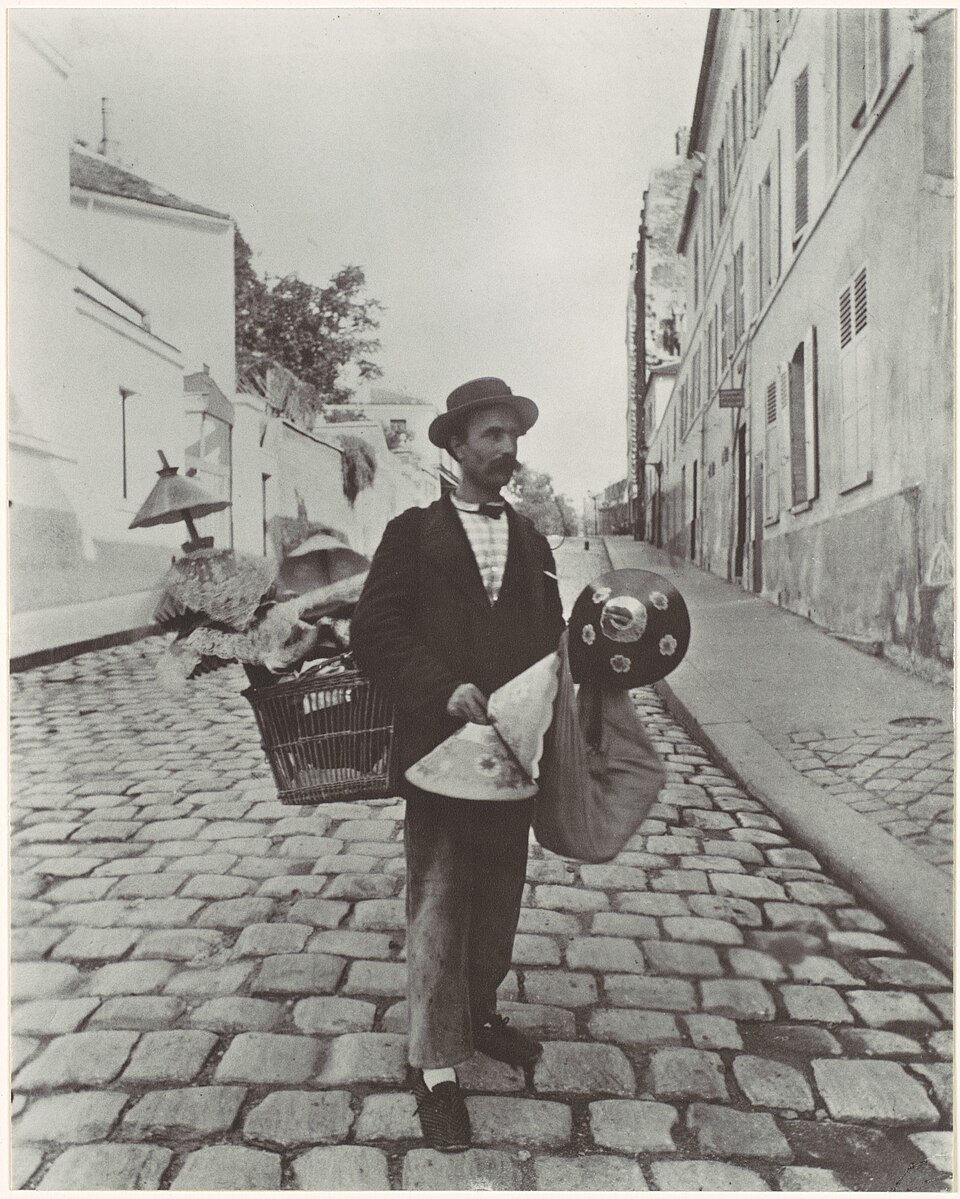
Eugène Atget; Metropolitan Museum of Art, via Wikimedia Commons. Public domain. Source and rights. View full size.

From urban experiments to the Situationist International
Debord’s 1955 “Introduction to a Critique of Urban Geography” places psychogeography within an argument about everyday life. Streets, districts and transport arrangements were not neutral containers for activity. Their organisation affected what people felt able to do, whom they encountered and how they spent their time. The essay connected observation to the possibility of changing those conditions.
The essay’s publication date is not the date at which the word was invented. Debord attributes the term to an unnamed Kabyle acquaintance in 1953. Karen O’Rourke’s historical account for MIT Press places its early use within the Lettrist International and a longer history of urban wandering. This makes Debord a major theorist and organiser of the practice, while keeping its collective setting and earlier experiments visible.
This setting matters. The early project was more ambitious than finding picturesque corners of a city. Debord criticised urban arrangements dominated by traffic and established ideas of usefulness. Studying atmosphere was part of questioning whose purposes the built environment served. A pleasant walk might become a starting point, but enjoyment alone did not exhaust the political claim.
The Situationist International was founded at Cosio d’Arroscia in Italy in July 1957. The surviving chronology names participants from the Lettrist International and the International Movement for an Imaginist Bauhaus, together with Ralph Rumney representing a London psychogeographical grouping. Michèle Bernstein, Guy Debord, Asger Jorn and Giuseppe Pinot Gallizio were among those present. The archival chronology quotes the subsequent Potlatch notice recording the decision to unite.
The founding meeting linked experiments in art, writing and urban life. It should not be confused with a public walking club or with every later activity called psychogeography. The name now covers practices whose methods and politics differ considerably from those of that small historical organisation.
What did a dérive involve?
Debord’s “Theory of the Dérive” discusses the size of a group, the duration of an exploration and the value of comparing impressions. He favoured several small groups of two or three people rather than a large procession. Changing the composition of groups could help prevent one shared habit from hardening into the only way of reading a place.
The essay also describes a “possible rendezvous”: a person goes to an appointed place and time without an ordinary obligation to meet a known companion. The altered expectation encourages attention to surroundings and encounters. Elsewhere it distinguishes exploring a particular area from deliberately disorienting oneself. These are proposals within Debord’s practice, rather than universal rules followed by all later psychogeographers.
The collective element is easy to miss in photographs of a solitary walker. Comparing observations makes difference visible. Two people can cross the same square and describe very different attractions or barriers. That disagreement is material for enquiry, not necessarily a failure to perceive the place correctly.
A useful record might therefore preserve more than a line on a map: the time of day, the sounds, the points where people stopped, and the moments when members of the group disagreed about where to go. The resulting account makes the conditions of the encounter available to others instead of presenting one person’s mood as the city’s permanent character.
2001: walking with an algorithm
Wilfried Hou Je Bek’s account of “Algorithmic Psychogeography”, reproduced in a psychogeographical exploration kit, describes three experiments undertaken in summer 2001. Participants followed simple repeated turning instructions. The aim was to interrupt preference-driven route choices and discover what happened when a limited rule met the complexity of a real street network.
Hou Je Bek connected this approach to John Conway’s Game of Life: simple rules can generate developments that cannot be anticipated merely by looking at the rule. His criteria included the surprise of the walk and whether it added unfamiliar images and experiences to a participant’s mental map. This was a particular artistic experiment, not a claim that a human walk and a computer programme are identical.
The comparison gives the relationship with digital culture a more concrete form. An instruction can circulate as a small piece of text, while the result is produced bodily and locally. Different walkers can run the same instruction in different cities and generate different records. The shared material is a procedure; the lived results remain situated.
New York, 2003: Psy-Geo-Conflux
David Mandl’s contemporary announcement on nettime advertised the first Psy-Geo-Conflux for 8–11 May 2003. Produced by ABC No Rio, Glowlab and the Brooklyn Psychogeographical Association, it combined a festival with a conference. The opening reception was at ABC No Rio, with a closing music and video evening at Subtonic. Events were advertised as free and open to the public. Read the original announcement.
The programme brought walking, discussion, exhibition and performance together. Sharilyn Neidhardt’s Urban Chess proposed people moving as chess pieces through Lower East Side blocks, receiving moves by mobile phone. Karen O’Rourke’s New York Body ’n’ Soul Map invited ordinary itineraries, including commutes and errands. Other announced contributions included a surveillance-camera walk, algorithmic walking, talks and a noise parade.
The range is significant. Some projects altered navigation through rules; others collected everyday experience or drew attention to surveillance. The festival provided a meeting point for approaches that did not need to share one explanation of the city. It also made participation more varied than attending a lecture about a past avant-garde.
Mobile phones and web forms did not remove the street from these projects. They changed how people coordinated movement and exchanged records. A phone could connect the walker to instructions elsewhere; a form could collect routes from people who never met. The relationship between physical and electronic space was something participants tested, rather than an analogy imposed only afterwards.
Whose freedom to wander?
These histories also invite questions about access. Free time, mobility, familiarity and feeling safe in public affect the possibility of drifting. A route that feels playful to one walker may feel threatening or exhausting to another. An account becomes more informative when it names those conditions instead of assuming that every participant begins from the same position.
The same applies to the archive. A manifesto tells us what somebody proposed; a programme tells us what organisers planned; a participant’s record can show what happened on a particular occasion. Reading them together allows us to distinguish ambition, arrangement and experience. It is that combination which turns psychogeography from an evocative label into a history of practices.
Why the analogy with browsing is attractive
Early web browsing offers a suggestive comparison: following a personal page to a links list, then to an unfamiliar archive, could interrupt a planned journey. The vocabulary of “sites”, “home pages” and “navigation” already makes the screen sound like somewhere one can travel.
This is an interpretive analogy, not evidence that browsing was itself Situationist practice or that early web communities shared Debord’s politics. Clicking a link and walking through a city have different bodily, social and material conditions. Keeping the difference visible makes the comparison more useful.
It lets us ask how an interface establishes a route. Which destinations are displayed, which are buried, and where does the design ask us to pause? A link list arranged by an individual, a search-results page and a recommendation feed offer different invitations. “Getting lost” can be a pleasure, but someone still owns or maintains the paths.
Drift and détournement
Another nearby practice, détournement, redirects existing words or images into new relations. Debord and Gil J Wolman’s 1956 essay treats this as a political use of cultural material. It helps connect the investigation of urban environments to culture jamming: in both cases, a familiar arrangement becomes available for reconsideration. “A User’s Guide to Détournement”.
Yet a changed route or an ingenious collage does not by itself alter the ownership of a city or a communications system. The value of the exercise lies partly in the questions it makes possible, and partly in what people decide to do with them.
VOICES FROM THE ARCHIVE
Writing about the dérive long before the Web, Guy Debord gave description an intriguing limit:
“Written descriptions can be no more than passwords to this great game.”
Guy Debord, “Theory of the Dérive”, Les Lèvres Nues, no. 9 (November 1956); reprinted in Internationale Situationniste, no. 2 (December 1958). Translation by Ken Knabb. Read the source.
A password grants entry; it does not contain the experience it opens. The metaphor makes the essay an invitation to practise attention in a place. Its later resonance with network culture is a comparison we can explore while keeping Debord’s original urban setting in view.
A small enquiry
Compare two familiar journeys: one through a neighbourhood and one through a website. Record the points where you speed up, hesitate, turn away or stay. Distinguish a physical barrier from a suggestion, an unfamiliarity or a feeling. Then ask whose purposes the default route serves.
Reading the central metaphor
The city as a text
A route becomes an act of interpretation: names, sounds, barriers and memories can be read together. Comparing walks exposes the limits of the official map.
What the metaphor leaves out: Places are also inhabited and worked in. Treating a neighbourhood as material for an outsider’s story can erase residents’ knowledge or the unequal freedom to move through it.
An interpretive reading by this collection, to be tested against the historical material above.
Watch: walking London with Iain Sinclair
Filmmaker John Rogers walks through the City of London and towards Stepney with Iain Sinclair. Their conversation connects streets, literature and memory, offering a practical example of the later British walking culture discussed in relation to psychogeography.
Viewing guide
- 3:27 — Coffee as a route into the city’s history
- 10:49 — Plantation House and trade
- 12:38 — Discussing Charles Booth’s poverty maps
Discuss: What evidence does Sinclair use to connect a street to a distant history? What would another walker, at another time of day, notice differently?
English automatic captions and a transcript were available when checked. Automatic transcription can mishear names and specialist terms. Open the original YouTube video, expand its description and use “Show transcript” where available. Viewing notes checked 5 November 2026. Time links open the original recording.
About this edition
Prepared for The Metaphor Society with AI assistance; revised . Sources distinguish contemporary records, participant recollections and scholarship. Metaphor analysis is interpretation; this essay has not undergone scholarly peer review. Historical event notices do not establish that a meeting continues today.
Read the collection’s research approach. For corrections, include the article title, passage and supporting source.
Sources and further reading
References below identify the kind of evidence being used. Image provenance is credited beside each image; the video’s uploader and recording context appear beside the player. A source’s own claims are not independent verification of its effects.
Open the archive and source notes (9)
- Guy Debord, “Theory of the Dérive”. First published 1956; version in Internationale situationniste no. 2, December 1958; Ken Knabb translation.
- Guy Debord, “Introduction to a Critique of Urban Geography” (1955). Ken Knabb translation; theoretical primary text.
- Situationist International Online, chronology for 1957. Archival chronology of the movement’s formation.
- Guy Debord, “Theory of the Dérive”, Internationale situationniste no. 2, December 1958; first published 1956. Ken Knabb translation at the Bureau of Public Secrets.
- Wilfried Hou Je Bek, “Algorithmic Psychogeography”, reproduced in Sal Randolph, Bureau of Unknown Destinations: Psychogeographic Destination Kit, version 1.0 (2012), appendix 3, PDF p. 12. Participant account of summer 2001 experiments.
- David Mandl, Psy-Geo-Conflux announcement, 9 April 2003, circulated in Nettime’s “Events (13x)”, 20 April 2003. Contemporary programme for New York, 8–11 May.
- Guy Debord and Gil J Wolman, “A User’s Guide to Détournement” (1956). Ken Knabb translation; theoretical primary text.
- Guy Debord, “Report on the Construction of Situations” (1957). Ken Knabb translation; theoretical primary text.
- Karen O’Rourke, “Psychogeography: A Purposeful Drift Through the City”, The MIT Press Reader, adapted from Walking and Mapping: Artists as Cartographers. Historical analysis of Lettrist and Situationist practices, including Debord’s attribution of the term. O’Rourke also participated in later walking-art projects.