EARLY INTERNET COUNTERCULTURE · BULLETIN BOARDS, ZINES & HANDLES
Before the web, dial-up bulletin boards let people exchange messages, adopt handles and circulate small electronic publications. Their history connects the Chicago Computerized Bulletin Board, FidoNet, local meetings and hacker conventions, showing how a machine became a place to meet—and what kept that place running.
At a glance
- Starting point
- CBBS, Chicago, 1978
- Key people
- Ward Christensen and Randy Suess; later archivist Jason Scott
- Forms
- Dial-up messages, files, electronic zines and local gatherings
- Infrastructure
- Modems, telephone costs, computers and volunteer administration
Contents — jump to a section
A short timeline
- 1978Christensen and Suess describe their computerised bulletin board in BYTE. Source
- 1984FidoNet begins linking local bulletin boards. Source
- 1989FidoNet policy formalises responsibilities and dispute handling. Source
- 1994The first HOPE conference meets in New York. Source
Selected milestones, not a complete chronology. Later recollections and contemporary records are distinguished in the source notes.
Before everything became a website
Dial-up bulletin board systems, or BBSes, were places people could contact through a modem to exchange messages and files. They were not synonymous with the internet, and the World Wide Web was not another name for either. Treating all three as one technology makes it harder to see how habits and communities moved between them.
Archivist Jason Scott recalls collecting files from BBSes in the 1980s and later making them available through TEXTFILES.COM. In a Library of Congress interview, he describes how sections nominally intended for general information became homes for jokes, rants and informal instruction. His account provides a participant’s view of writing that was easy to overlook as disposable.
VISUAL NOTE · THE NETWORK HAD A PHYSICAL SOCKET

Joe “Lord Skitch” Jackson, 2006; public domain (photographer’s dedication). Source and rights.
A publication that could travel light
A small text file did not require the infrastructure of a printed magazine to be copied and passed on. It could retain a title, a handle, a date, a decorative heading and the voice of its author. Those modest elements could make a piece feel like part of a recurring publication or a scene with its own memory.
The comparison with a photocopied zine is useful as a question about form. Both can allow a writer to construct an audience without waiting for a large publisher. Both can combine personal address, argument, humour and practical information. Their costs and distribution systems differ, but each can make the reader feel close enough to reply.
Scott notes that files sometimes circulated in altered versions; his archive preserves variations rather than silently treating them as identical. That detail matters. A preface, signature or appended joke can record another participant’s response. The text is then evidence of a journey, not simply a message transmitted intact.
CONVERSATION AS A PLACE
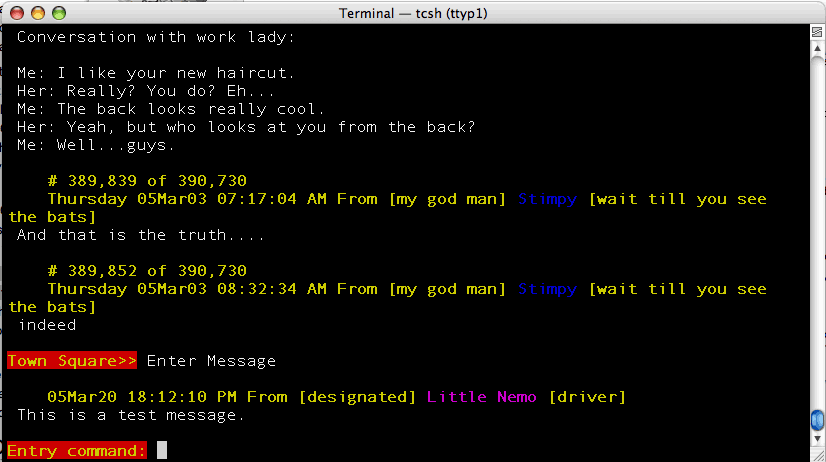
Screenshot by Litlnemo, 2005. Public domain (author’s dedication). Source and rights. View full size.

Handles and imagined rooms
A handle separates an online persona from the ordinary form of a legal name. It can enable imaginative freedom, a durable reputation or distance from everyday obligations. It can also make accountability and trust more complicated. The effects depend on the community and the circumstances, not on the name alone.
The language of a “board” makes public writing sound local and shared. “Posting” suggests an announcement placed where others may find it. “Lurking” gives quiet reading a suspicious or mysterious flavour. These spatial and bodily metaphors turn abstract communication into an imagined social setting—and quietly suggest what conduct belongs there.
A culture of rules as well as rebellion
The early network was not simply a place without conventions. S. Hambridge’s 1995 Netiquette Guidelines, RFC 1855, discusses how newcomers encounter local cultures, how tone becomes difficult in text, and how expectations differ across settings. It is an informational document, not a universal rulebook or a technical internet standard.
Read beside underground writing, it reveals a recurring problem: freedom to speak does not tell a community how to remain habitable. Etiquette can make participation easier, or become a test that insiders use to embarrass newcomers. Small communities can be generous and inventive while also becoming narrow and unforgiving.
VOICES FROM THE ARCHIVE
Looking back on the textfiles he collected from bulletin boards, archivist Jason Scott explained:
“Many were passed around and gained little additions and subtractions, so I kept all versions up”
Jason Scott, interviewed by Leslie Johnston, “Jason Scott, Rogue Archivist”, The Signal, Library of Congress, 28 February 2012. Excerpt from his answer about TEXTFILES.COM. Read the source.
The differences between copies are part of the cultural record. An added introduction, a changed signature or a local joke can show how a file became meaningful to a particular group. Scott’s later recollection helps us read circulation as a form of participation.
Chicago, 1978: a computer club acquires a message board
Ward Christensen and Randy Suess described their Computerized Hobbyist Bulletin Board in the November 1978 issue of BYTE. Their account dates its conception, construction and installation to the period from 16 January to 16 February that year. The initial purpose was modest: people with a terminal or computer and modem could leave and retrieve messages, extending the exchange associated with a computer club. Read their contemporary article.
The division of work was tangible. Suess assembled the hardware; Christensen developed the software, with callers trying an early version and suggesting improvements. The article lists equipment, donated resources and problems to be solved. A community space emerged from personal effort and material cooperation, not simply from an abstract invention called “online communication”.
A CBBS manual dated 20 September 1978 preserved by the Computer History Museum lists installations in Atlanta, Chicago, San Diego and the San Francisco Bay Area. It explains message entry, reading and help for inexperienced callers. Dave Caulkins’s manual is a useful early record of the effort to make a system understandable to somebody encountering it for the first time.
Historian Kevin Driscoll places these systems in a wider history of the “modem world”. Community bulletin boards developed largely alongside the university and government networks associated with ARPANET, rather than simply growing out of them. Computer clubs, local operators and callers paying their own telephone bills supplied another route into online life. Countercultural publishing was one part of this varied ecology, not a description of every BBS. Their later convergence with internet services should not erase those different beginnings.
The bulletin-board metaphor was practical before it became nostalgic. A visitor needed to discover what had been posted, decide whether to reply and leave something for a later caller. The interaction did not require everyone to be present at once. That difference from a telephone conversation helped a small shared machine become a continuing social place.
FidoNet: linking local communities
Local boards could develop their own character, but exchanging messages between them required another layer of cooperation. Randy Bush’s 1992–93 account describes FidoNet, developed in 1984, as a network that stored and forwarded messages over dial-up telephone connections. Its design reflected the fact that private individuals were paying the bills: reducing connection time and combining traffic mattered. Read Bush’s account of the network.
This arrangement allowed a local caller to participate in conversations extending beyond the board they dialled. Messages could travel through several systems rather than requiring every participant to make an expensive long-distance call. Locality and distance were combined: the point of entry might feel like a neighbourhood, while the discussion reached people elsewhere.
Coordination was visible in documents as well as software. FidoNet’s 1989 policy describes responsibilities for system operators, geographically organised networks and coordinators. It identifies FidoNews as a weekly electronic newsletter through which operators and users could contribute to the community’s conversation. The policy document is a reminder that a volunteer network still needed rules, maintenance and ways to handle disputes.
“Decentralised” therefore did not mean “without responsibility”. An operator could establish local expectations while also meeting obligations to the wider network. Decisions about telephone costs, message routing and acceptable conduct shaped who could participate and how reliably a conversation could continue.
Meeting the people behind the handles
Printed magazines and local meetings provided another connection between dispersed computer users. The 2600 meeting guidelines offer a particularly clear model: meetings take place in public, have no admission charge or dues, and welcome newcomers. The organisers establish a common first-Friday rhythm while allowing local groups to choose suitable places. Read the meeting guidelines.
These are the organisers’ published arrangements, not a claim that every BBS community met this way. They illustrate how an online interest could acquire a recurring physical setting. A newcomer could arrive without already belonging to a private club, and people who knew one another through writing could compare knowledge face to face.
The current meeting directory also shows the variety of ordinary places used for such encounters. It is a changing directory, so historical accounts should not silently treat today’s addresses or times as evidence of where a group met decades ago. The durable feature is the public invitation and repeated occasion.
HOPE, 1994: a larger temporary community
The first Hackers On Planet Earth conference took place at New York’s Hotel Pennsylvania in 1994. The organisers’ conference history describes a two-day gathering inspired by Dutch hacker events. It identifies Robert Steele as the first keynote speaker and records the move to the Puck Building for Beyond HOPE in 1997, held alongside the Dutch Hacking In Progress camp.
Such events expanded the scale of meeting. A local group might introduce a few people to one another; a conference could place publishing, technical projects, political arguments and international contacts in the same temporary setting. Talks were only part of the occasion. Corridors and informal conversation could connect people who ordinarily encountered one another through files and messages.
The relationship between a conference and a network ran in both directions. Existing contacts helped make a gathering possible. Afterwards, announcements, reports and recordings could carry parts of it back to people who had not travelled. The event was a concentrated episode within an ongoing conversation, not a separate world outside it.
Reading the surviving culture at different scales
These sources let us follow a sequence from a club-sized board to linked systems, recurring meetings and large conventions. It is not a universal evolutionary ladder. Some people used boards only to exchange practical information; others developed elaborate identities, publications or lasting friendships. There was no requirement that a local board become a political movement.
The differences matter to the history of counterculture. An outrageous textfile may survive because it was copied repeatedly, while a helpful everyday conversation may disappear with the machine that hosted it. Surviving archives can consequently exaggerate the loudest voices. Manuals, policies and meeting notices help restore the quieter activities that made participation possible.
Preserving the ordinary
Scott dates the start of TEXTFILES.COM to 1998 in his biographical account. The preservation effort reminds us that a culture is more than its celebrated manifestos. Instructions, arguments, jokes, file headers and failed experiments can show how people actually encountered one another.
For discussion, compare a surviving text file with a familiar social-media post. What tells you who is speaking? What gives the writing a date, an audience or a place? Which parts would become unintelligible if the surrounding community disappeared?
Reading the central metaphor
The bulletin board as a room
Messages appear as something left for other visitors. Handles, local conventions and a system operator help turn a machine into a social place.
What the metaphor leaves out: A welcoming room still has a door: equipment, telephone charges, technical confidence and rules affect who can enter. Informality should not be mistaken for universal access.
An interpretive reading by this collection, to be tested against the historical material above.
Watch: the beginnings of BBS culture
Jason Scott’s documentary episode “BAUD” brings together interviews and historical material about the beginnings of dial-up bulletin boards. Uploaded by the filmmaker himself, it introduces the people behind the systems and gives a human setting to the technical history outlined above.
Viewing guide
- 7:19 — The Chicago computer-club connection
- 10:04 — A snowstorm and the CBBS origin story
- 14:58 — Early participation and the scarcity of modems
Discuss: How do the interviews connect a technical invention to an existing club? What do the memories reveal about cost and access?
English automatic captions and a transcript were available when checked. Automatic transcription can mishear names and specialist terms. Open the original YouTube video, expand its description and use “Show transcript” where available. Viewing notes checked 5 November 2026. Time links open the original recording.
About this edition
Prepared for The Metaphor Society with AI assistance; revised . Sources distinguish contemporary records, participant recollections and scholarship. Metaphor analysis is interpretation; this essay has not undergone scholarly peer review. Historical event notices do not establish that a meeting continues today.
Read the collection’s research approach. For corrections, include the article title, passage and supporting source.
Sources and further reading
References below identify the kind of evidence being used. Image provenance is credited beside each image; the video’s uploader and recording context appear beside the player. A source’s own claims are not independent verification of its effects.
Open the archive and source notes (11)
- Leslie Johnston, “Jason Scott, Rogue Archivist”, Library of Congress, The Signal, 28 February 2012. Interview about preservation and textfiles.
- Sally Hambridge, Netiquette Guidelines, RFC 1855, October 1995. Informational guidance, not a census of actual behaviour.
- Ward Christensen and Randy Suess, “Hobbyist Computerized Bulletin Board”, BYTE, November 1978. Contemporary article; scanned PDF.
- Dave Caulkins, “A CBBS Manual”, 20 September 1978, reprinted in the 3rd West Coast Computer Faire proceedings (3–5 November 1978); Computer History Museum scan, PDF pp. 35–43. The manual’s date and the proceedings’ date are different.
- Randy Bush, “FidoNet: Technology, Use, Tools, and History” (1992). Participant’s technical and historical account.
- FidoNet Policy Document, version 4.07, 9 June 1989. Contemporary rules for network administration.
- 2600, meeting guidelines. Organisers’ guidance; living web document.
- 2600, meeting directory. Current listings; consult each entry before treating it as an upcoming event.
- Hackers on Planet Earth, “About”. Organisers’ retrospective conference history.
- Jason Scott, “About”. Archivist’s biographical self-account.
- Kevin Driscoll, “A Prehistory of Social Media”, Issues in Science and Technology 38(4), Summer 2022. Historian’s synthesis of community networking; see “Birth of the modem world” and “Feel free to leave a message”. Distinguishes grassroots PC networking from the ARPANET-centred origin story.