Dreams as pictures of thought
Calvin Hall and the Cognitive Theory of Dreams
Calvin Hall proposed that a dream is not primarily a disguised wish or a message from an autonomous unconscious. It is a form of thinking in images, revealing how the dreamer conceives of self, other people, conflict and the surrounding world.
A change in the question
How to approach Hall on dreams
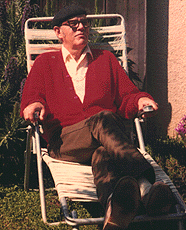
Calvin Springer Hall (1909 to 1985) was an American psychologist whose early career included influential work in behaviour genetics. From the 1940s onward, he assembled large collections of dream reports and sought a disciplined way to compare their contents. His cognitive theory appeared in two landmark papers in 1953.
Hall retained the idea that dreams disclose something about personality, but moved away from the assumption that their visible content had been distorted by censorship. Instead of asking what secret force produced a disguised symbol, he asked what conception had been pictured and whether the same pattern recurred across a series of dreams.
For Hall, the dream is less like an encrypted letter and more like a private picture of the dreamer’s current conceptual world.
The dream as cognitive activity
Conceiving
The mind forms ideas about who we are, how other people behave, what the world is like and which actions are possible or forbidden.
Picturing
During dreaming, conceptions become perceptible as characters, places, objects, actions, obstacles and outcomes.
Inferring
Meaning is inferred cautiously from the relationships within a dream and checked against other dreams and waking information.
Hall called dreams cognitive, but this should not be confused with the later family of cognitive behavioural therapies. He was offering a theory of what dream images represent, not a standard treatment protocol.
Five domains of subjective reality
What do dreams picture?
- Conceptions of self: capable or helpless, included or excluded, active or passive, admired or exposed.
- Conceptions of other people: caring, demanding, unreliable, seductive, competitive, protective or dangerous.
- Conceptions of the world: welcoming, barren, chaotic, restricted, beautiful, indifferent or hostile.
- Conceptions of impulses, prohibitions and penalties: what may be wanted, what blocks it and what appears likely to follow.
- Conceptions of problems and conflicts: the predicaments that organise action, hesitation, failure, success and repeated dead ends.
These conceptions describe subjective reality. A hostile father in a dream does not establish that the dreamer’s actual father is hostile. It may show that hostility is part of how the relationship is imagined, feared, remembered or currently organised.

Images make conceptions visible
A waking thought such as “I cannot reach them” may become a missed train, an unanswered telephone, a widening river or a person disappearing into a crowd. The image is not necessarily a disguise. It is a perceptible form of the conception.
Hall regarded this conversion between conception and image as a creative process. Dream interpretation reverses it by asking what pattern of thought is being represented. The answer remains an inference, to be checked rather than announced.
Symbols without a universal dream dictionary
Hall did write about dream symbols and drew upon parallels in idiom, slang, poetry, myth, art and word history. Yet his theory does not justify giving one fixed meaning to every snake, house, road or body of water. A symbol becomes more credible when its proposed meaning fits its actions and outcome, recurs in related forms, and agrees with other information about the dreamer.
Weak inference
“A locked door always means sexual repression.” The claim is fixed before the dreamer’s context is known.
Stronger inference
“Across several dreams, doors appear when approach is wanted but feared. Does that pattern fit anything in waking life?”
Patterns before pronouncements
Why a series matters more than one dream
A single dream can be unusual, poorly remembered or shaped by a recent event. Hall therefore favoured collections. Repeated roles, characters, interactions, settings and outcomes make it possible to ask whether a stable pattern is present or whether something has changed.
- Does the dreamer usually act, observe, flee, fail, succeed or wait for rescue?
- Which people recur, and are their interactions friendly, aggressive, sexual, distant or mixed?
- Are settings familiar or unfamiliar, enclosed or open, safe or obstructed?
- Which emotions are explicitly reported, and which outcomes repeatedly follow attempts to act?
- Do the patterns remain stable over months or alter alongside changed waking circumstances?
Methodological caution: reliable estimates of an individual’s characteristic content may require many reports. One striking dream should not be treated as a personality test.
The Hall and Van de Castle system
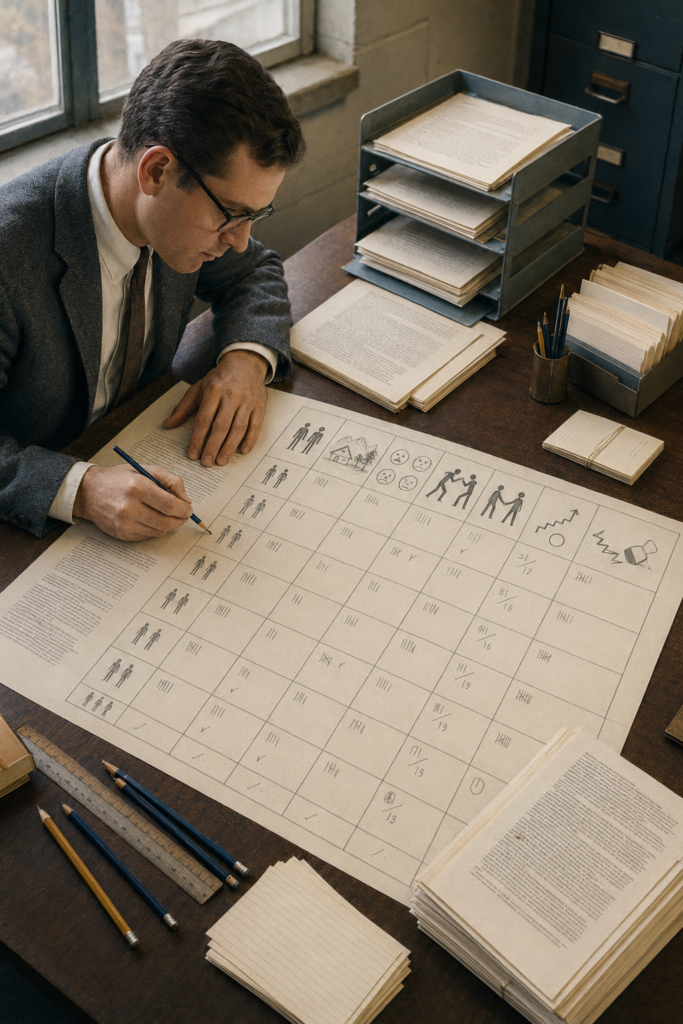
Hall and Robert Van de Castle published The Content Analysis of Dreams in 1966. Their system converts explicit features of written dream reports into defined categories. It codes what the report says, not what a judge imagines the dream secretly means.
Major categories include characters, social interactions, activities, striving, success and failure, misfortune and good fortune, emotions, settings, objects and descriptive elements. Percentages and ratios allow comparisons while reducing some effects of different report lengths.
What content analysis can and cannot do
It can
- Make coding rules explicit and open to checking.
- Estimate agreement between trained independent coders.
- Compare groups, periods and long individual series.
- Identify repeated patterns that casual reading may miss.
It cannot
- Recover dream experience that was forgotten or omitted.
- Make a dream report independent of memory and narration.
- Prove why the brain generated a particular dream.
- Turn statistical difference into a diagnosis of a person.
A worked example
The station that cannot be reached
I am carrying two heavy cases through an unfamiliar city. I can see the station clock, but every street bends away from it. People give me contradictory directions. When I finally arrive, the last train has gone.
A Hall-style reading begins with relations in the report. The dream self strives but is burdened, the environment is unfamiliar and obstructive, other people are unhelpful, and the outcome is failure. This may picture a conception such as “I try hard, but the world prevents timely arrival.”
That formulation remains provisional. If many dreams show missed departures, confusing advice and unsuccessful striving, it gains support as a recurring conceptual pattern. If this is the only such dream and the dreamer nearly missed a train yesterday, an ordinary recent-incorporation account may be sufficient.
Dreaming and waking life
The continuity hypothesis
Hall’s findings contributed to the view that dreams are broadly continuous with waking concerns, characteristic emotions and relationship patterns. Dreams rarely reproduce waking life as a literal recording. They select, combine and transform personally salient material into imagined situations.
Later research has refined this position. Emotional and personally significant experiences appear more likely to enter dreams than routine focused activities. Continuity can concern recurring themes or social patterns rather than direct copies of the previous day.
Continuity does not mean that everything in waking life enters dreams, or that everything in a dream has one identifiable waking source.
What does the research support?
| Claim | Current appraisal | Reason |
|---|---|---|
| Dream reports can be coded systematically | Well supported | Defined categories can produce high agreement when coders are adequately trained. |
| Dream content shows stable individual patterns | Supported with sufficient reports | Long dream series often show repeated characters, settings and interactions across time. |
| Dreams show continuity with waking concerns | Broadly supported | Diary and longitudinal studies link dream content with relationships, affect and personally significant experiences. |
| Every image directly represents a conception | Theoretical interpretation | The claim is difficult to test independently and may overlook memory fragments, sensory incorporation and narrative construction. |
| Dream content reveals objective facts about others | Not supported | Dreams provide evidence about represented experience, not independent verification of external events. |
| Content analysis diagnoses personality or disorder | Not justified | Group differences and recurring patterns are not clinical diagnoses and should not be used as such. |
Important methodological limits
- Dreams and reports are not identical: memory, wording, audience and the time of recording shape what can be coded.
- Length matters: longer reports provide more opportunities for characters, emotions and interactions to appear. Ratios help, but do not remove every effect.
- Training matters: coding is rule-governed, but dependable agreement requires practice and checking between coders.
- Sampling matters: Hall and Van de Castle’s original norms were drawn largely from mid-century American college students.
- Categories simplify: counting an explicitly named emotion is not the same as measuring its intensity or personal meaning.
- Continuity includes discontinuity: some waking concerns are absent, transformed or represented less often than expected.
A note on the original norms
The coding system produced separate normative indicators labelled male and female. These are historical statistical comparisons, not timeless psychological essences. They reflect the samples, reporting practices, social roles and binary classifications of their period.
Later studies in other countries have reproduced some differences and found others that do not match the original pattern. Contemporary use should describe the particular population studied, avoid treating group averages as rules for individuals, and include gender categories appropriate to the research question and participants.
Hall compared with earlier theorists
| Approach | Central question | Characteristic method |
|---|---|---|
| Freud | Which wish and conflict have been transformed by the dream-work? | Free association from manifest content towards latent thoughts. |
| Jung | How does the dream compensate for conscious attitude and express psyche-wide patterns? | Personal association, amplification and attention to a dream series. |
| Adler | How does the dream support a style of life and prepare feeling for a problem? | Relating dream movement to goals, discouragement and social context. |
| Perls | What becomes present when the dreamer embodies and dialogues with each element? | Present-tense enactment, role reversal and experiential dialogue. |
| Hall | Which conceptions of self, people, world and conflict are pictured repeatedly? | Inference from relations in dreams, supported by systematic analysis of a series. |
Using Hall’s ideas responsibly
- Record the dream before interpretation, including actions, interactions, settings, emotions and outcome.
- Ask what view of self, others or the situation is pictured, while keeping several formulations open.
- Look for recurrence across dreams rather than forcing significance onto a single vivid image.
- Compare dream patterns with the dreamer’s account of waking concerns, not with a universal symbol list.
- Notice exceptions and changes as carefully as repetitions.
- Keep statistical coding separate from diagnosis and from claims about objective events.
In therapy, these questions can support collaborative reflection, but Hall’s system was principally a research method. A client does not need to have dreams coded against population norms for their account to be heard and explored.
Why Hall matters to metaphor
A visual grammar of personal conceptions
Hall’s account places metaphor close to the ordinary work of cognition. Distance can picture emotional distance. Weight can picture burden. An obstructed journey can picture frustrated action. These correspondences are not decorative additions to an otherwise literal message. They are ways in which an abstract relation becomes imaginable.
At the same time, Hall’s quantitative work is a useful corrective to unrestricted interpretation. A compelling metaphorical reading still needs context, comparison and the possibility of being wrong.
Questions for exploring a dream series
- What roles does the dream self repeatedly occupy?
- How do other characters respond when the dream self approaches, refuses, asks or acts?
- What kind of world is pictured through the settings and obstacles?
- Which attempts tend to succeed, and which repeatedly fail?
- What is wanted, what prohibits it, and what consequence is anticipated?
- Which waking concerns fit the pattern, and what evidence does not fit?
- Has the pattern changed over time, or only its surface imagery?
Research and further reading
- Hall, 1953: A Cognitive Theory of Dreams, full text.
- Hall, 1953: journal record and DOI for A Cognitive Theory of Dreams.
- Hall, 1953: A Cognitive Theory of Dream Symbols, full text.
- Hall, 1953: journal record and DOI for A Cognitive Theory of Dream Symbols.
- Calvin Hall: biographical account and overview of his dream research.
- Domhoff, 1999: New Directions in the Study of Dream Content.
- Domhoff, 2000: Methods and Measures for the Study of Dream Content.
- Domhoff, 2001: A New Neurocognitive Theory of Dreams.
- Pesant and Zadra, 2006: longitudinal study of dream content and psychological wellbeing.
- Schredl and Reinhard, 2010: continuity between waking mood and dream emotions.
- Malinowski and Horton, 2014: emotional waking experiences and dream incorporation.
- Skancke, Holsen and Schredl, 2014: continuity and discontinuity in psychiatric patients’ dreams.
- Dale and colleagues, 2016: Canadian student norms and comparison with American norms.
- Navara and DeCicco, 2021: relational issues and continuity in dream journals.
A final perspective
Hall helped move dream study from interpretive authority towards explicit comparison. His cognitive theory treats dreams as imaginative pictures of personal conceptions, while his empirical legacy asks whether proposed patterns can be counted, repeated and checked. Its lasting value lies in holding meaning and method together without pretending that either makes dreams transparent.
This page is for education and critical discussion. Dream interpretation is exploratory rather than diagnostic. Disturbing, recurrent or trauma-related dreams may warrant support from an appropriately qualified health professional.