Perception without a figure
The Ganzfeld Effect
Place a person before a field of unchanging red light, remove visible edges, add a wash of uniform sound (“white noise”), and perception begins to reorganise itself. Colours fade, depth dissolves, patterns emerge, and the distinction between seeing and imagining becomes less certain.
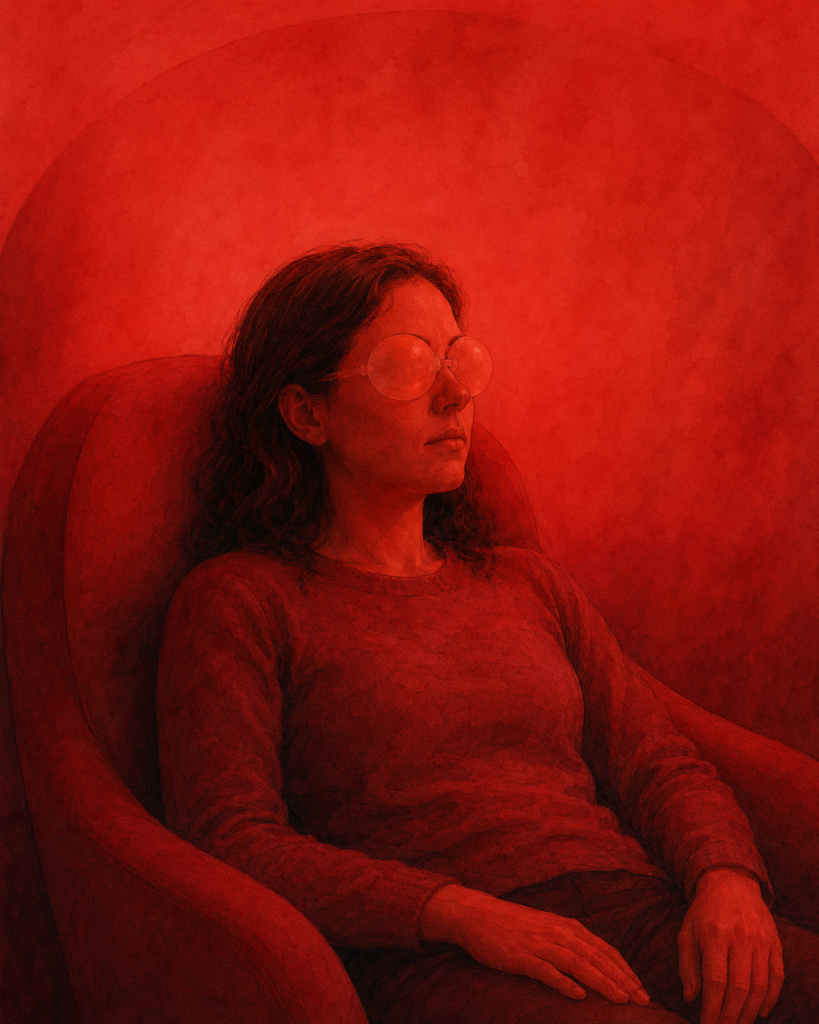
What is a Ganzfeld?
Ganzfeld is German for “whole field” or “complete field.” In perceptual psychology, it refers to a visual field that is uniform, unstructured, and without a distinct object, edge, horizon, or point of focus. The eyes remain open, but there is very little visual information for them to organise.
The classic low-cost arrangement uses two clean, translucent hemispheres placed over the eyes and illuminated by a steady red light. White, pink, or brown noise may also be played quietly through headphones to reduce changes in the auditory field. The result is sometimes called a multimodal Ganzfeld.
This is better understood as perceptual homogenisation than complete sensory deprivation. Light and sound are still present. What has been removed is variation. The field offers stimulation but very little structure.
The Ganzfeld does not show us what vision looks like without a brain. It shows us what the brain does when vision supplies almost nothing to organise.
Gestalt psychology
Wolfgang Metzger and the featureless field
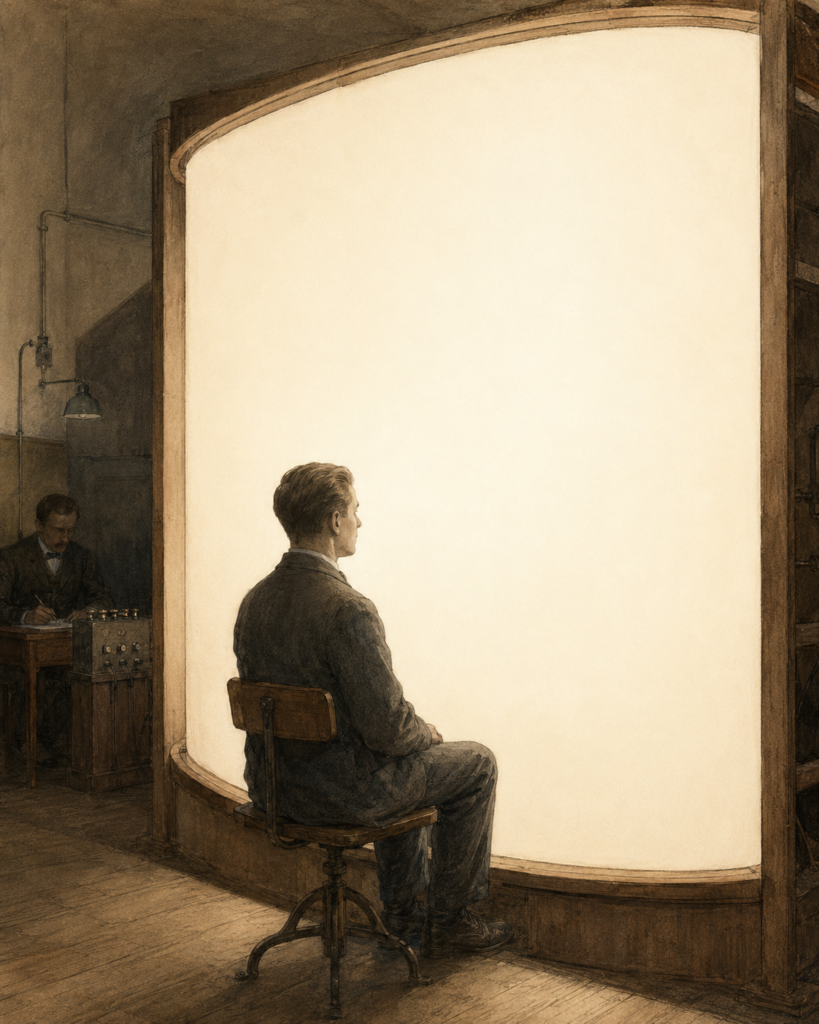
The term entered experimental psychology through the work of German Gestalt psychologist Wolfgang Metzger in 1930. Metzger investigated perception using a large, evenly illuminated surface whose edges could not be seen by the observer. Without changes in luminance, texture or contour, the field provided almost no information about shape, distance or position.
This was important to Gestalt psychology because it demonstrated that perception is not a passive copy of light entering the eye. Structure, contrast and relationship are necessary. Without a figure, the ground ceases to behave like an ordinary background. It becomes mist, volume, darkness, colour, distance or an indefinite “something.”
Later researchers replaced room-sized screens with translucent globes and then with halves of table-tennis balls. These portable eye covers made the method inexpensive and helped establish the familiar image of the red-lit Ganzfeld experiment.
The classic red-light arrangement
Translucent eye covers
Smooth white hemispheres diffuse the incoming light and conceal objects, corners and shadows. The purpose is not to block light but to distribute it across the visual field without a point of focus.
Steady red illumination
Red became customary because it was reported to support immersion and can make the field seem denser or closer. It is not essential. Modern studies also use white, blue or slowly changing colour.
Uniform noise
White, pink or brown noise reduces sudden auditory contrasts and masks speech or environmental sound. It should remain quiet and comfortable. Louder noise does not create a better Ganzfeld.
The red light used in the classic Ganzfeld is steady. Rapid flashing belongs to a different method called Ganzflicker.
What may appear?
Some people see vivid imagery, some notice only changes in brightness, and some experience very little. The absence of an effect is entirely normal.
Fading and colour loss
The red may lose saturation and become grey. A 2025 investigation distinguished gradual fade-out, darker or pulsating black-out, and pale blank-out. These are temporary perceptual changes, not damage to the eyes.
Simple imagery
Dots, lines, rings, grids, ripples, webs, clouds, colour patches and geometric forms are commonly described. Some may reflect normal retinal or entoptic phenomena that become noticeable when ordinary visual structure is absent.
Complex imagery
Faces, objects, landscapes, movement and short dreamlike scenes sometimes emerge. Participants usually retain the knowledge that these percepts are internally generated, which is why researchers have often referred to them as pseudo-hallucinations.
Depth, body and time
The field may feel close to the face, far away or without a measurable distance. Some observers report spatial disorientation, changes in body boundaries or unusual estimates of duration. Blinking and eye movement may briefly restore the original field.
Perceptual explanation
Why does the effect occur?
Adaptation
Sensory systems respond strongly to difference and change. A field that remains uniform provides less new information over time. Colour and brightness can therefore fade, fluctuate or temporarily disappear from awareness.
Neural variation
The visual system is never silent. Spontaneous activity, retinal effects and differences in visual-cortex excitability continue. With fewer external features competing for attention, this activity may be experienced as meaningful form.
Prediction and imagery
Perception uses memory and expectation to interpret incomplete input. Simple forms may depend more heavily on lower-level visual activity, while faces and scenes appear to involve stronger top-down contributions from memory, imagery and interpretation.
A 2006 EEG investigation found that multimodal Ganzfeld imagery occurred during an activated waking state rather than simply reproducing sleep-onset imagery. A 2024 study comparing steady Ganzfeld with Ganzflicker found that both produced more simple than complex percepts, although flicker produced simple imagery more frequently. People who readily experienced imagery in one condition also tended to experience it in the other, suggesting some shared sensitivity.
Metaphor and meaning
The Ganzfeld as a laboratory of metaphor
Figure and ground
Ordinary seeing separates a figure from its background. The Ganzfeld removes the figure, leaving the ground without its usual function. A background with nothing before it becomes difficult to experience as background at all.
Signal and noise
We commonly imagine perception as the detection of a signal hidden in noise. The Ganzfeld reverses the relationship. When the external signal is weakened, internally generated variation may be promoted to the role of the signal.
Seeing as construction
Phrases such as “seeing what is there” treat vision as a window. Ganzfeld imagery makes another metaphor visible: perception as an active model assembled from sensation, memory, expectation and inference.
The field
A “field” suggests an extended domain in which events can arise, whether a visual field, magnetic field, field of study or field of possibility. The Ganzfeld presents experience as a field before it presents any particular thing.
Fog, sea and distance
Early participants described mist, fog, cloud and a sea of light. These metaphors give substance and volume to something without surface or location. Language supplies the spatial structure that vision no longer provides.
Inner and outer
A perceived face seems to occupy the visual field, yet the observer knows that no face is physically present. The effect makes “inner image” and “outer sight” feel less like separate territories and more like interacting sources.
Light as medium
Ganzfeld environments in art
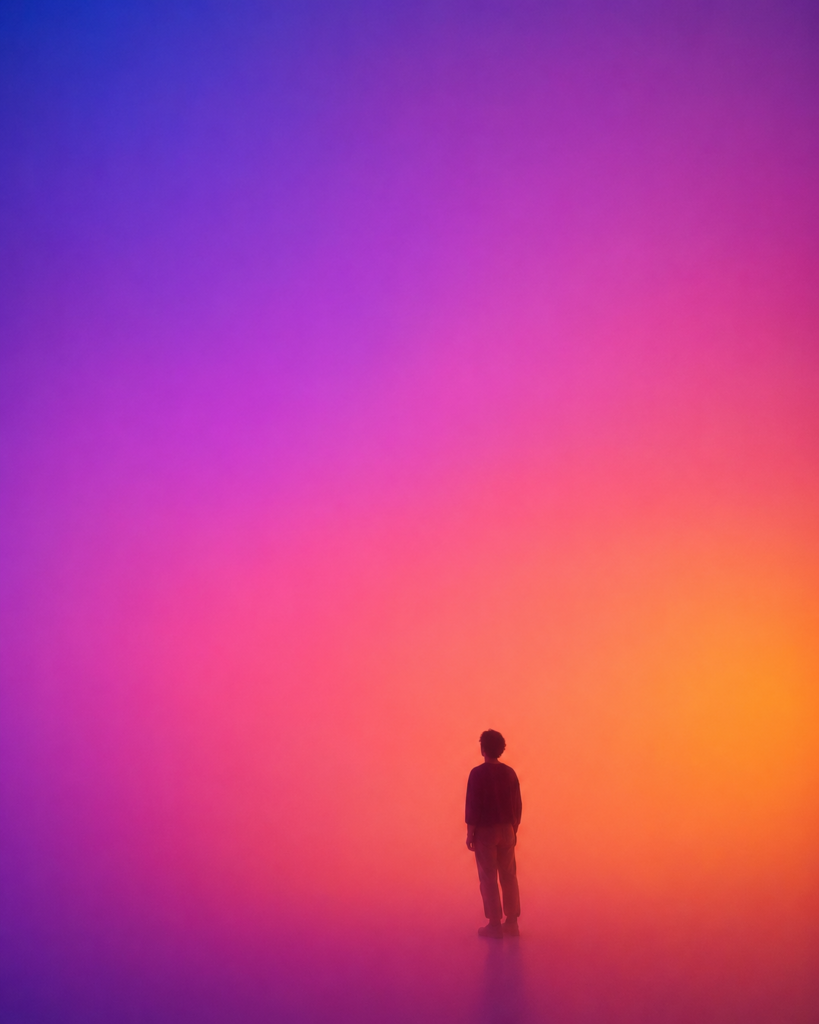
The Ganzfeld moved beyond the laboratory into immersive art. American light artist James Turrell has created room-sized Ganzfeld installations in which illuminated surfaces, concealed corners and carefully controlled colour remove ordinary depth cues. Visitors can feel that the room has lost its limits or that light has become a tangible material.
This artistic use returns the method to Metzger’s original scale. The participant is not simply looking through eye covers. The whole body enters the field. Art, architecture and perceptual experiment become difficult to separate.
Evidence and interpretation
What does research establish?
The perceptual effect itself is well established. Homogeneous visual stimulation can alter colour, brightness, apparent depth and the appearance of internally generated imagery. Contemporary studies continue to use the method to investigate visual adaptation, hallucination, imagery, attention and the balance between bottom-up sensory activity and top-down interpretation.
Research findings in brief
- Visual decay: a uniform colour can desaturate, appear to darken, vanish, or pulse. Eye movement and blinking can interrupt some of these effects.
- Imagery: simple geometric percepts are more common than complex faces, objects or scenes, although both occur.
- Individual differences: frequency, vividness and onset vary substantially. Some participants report no imagery.
- Waking state: EEG research indicates that Ganzfeld imagery is not merely ordinary sleep-onset imagery, even when it feels dreamlike.
- Top-down and bottom-up processing: recent research suggests that simple forms depend more on lower-level visual excitability, while complex imagery involves a greater contribution from memory, expectation and interpretation.
- Sound: homogeneous noise helps mask environmental changes, but a 2025 study found that adding noise did not necessarily make complex imagery more vivid.
- Time and spatial experience: altered depth, orientation, body scheme and duration are reported, but research into these effects remains smaller than the visual literature.
Ganzfeld and telepathy experiments
From the 1970s, parapsychologists adapted the Ganzfeld to test alleged telepathy. A “sender” viewed a randomly chosen picture or film while a separated “receiver,” resting in the Ganzfeld, described spontaneous impressions. The receiver later selected the closest match from a set of targets, often one target and three decoys.
This produced one of parapsychology’s longest statistical disputes. Some meta-analyses report above-chance target selection. Others have found failure to replicate, weak or near-zero effects, or results that become unpersuasive when prior probability, study quality, selective reporting and analytical flexibility are considered.
Early studies were criticised for inadequate randomisation, possible sensory leakage, handling cues, insecure target procedures and incomplete reporting. Automated methods improved some controls, but disagreement continued. A 2021 meta-analysis argued for an anomalous effect across the historical database, while earlier replication reviews and later Bayesian analyses challenged whether the evidence supports psi.
Ganzfeld imagery is genuine as a perceptual experience. It is not, by itself, evidence that information has arrived telepathically. That requires independent experimental proof beyond the existence or vividness of the imagery.
The cautious conclusion is that Ganzfeld telepathy remains controversial and is not accepted as established by mainstream psychology. The dispute remains valuable as a lesson in experimental design, replication, expectancy, statistical interpretation and the ease with which ambiguous inner material can be matched retrospectively to an external target.
A simple personal demonstration
Creating a steady-light Ganzfeld
A basic Ganzfeld can be explored without expensive equipment. The aim is not maximum intensity. It is a comfortable, evenly illuminated field without visible details. The following outline concerns steady light only, not flicker.
What you need
- Two clean, plain white table-tennis-ball halves or purpose-made translucent diffusers
- Soft medical or paper tape suitable for skin
- A diffuse, cool-running red LED lamp with a steady output
- Comfortable headphones or a nearby speaker
- A white, pink or brown-noise recording
- A supportive chair or reclined position
- A timer and, preferably, another person nearby
Basic procedure
- Smooth every cut edge. The covers must not scratch, press upon or touch the eyes.
- Secure them lightly over the surrounding orbital area while keeping the eyes open beneath them.
- Position the lamp so both visual fields are illuminated evenly, without heat, glare, visible shadows or flicker.
- Play uniform noise quietly. It should mask interruptions without feeling intrusive.
- Begin with about 10 minutes. If comfortable, later sessions can be extended towards 20 or 25 minutes.
- Observe without trying to force an effect. Note fading, colour, shape, imagery, distance and the passage of time.
- Remove the covers slowly, allow ordinary vision to settle and record the experience before interpreting it.
Do not confuse Ganzfeld with Ganzflicker
Ganzflicker uses rapidly alternating light. Flashing and flickering between approximately 3 and 60 flashes per second can trigger seizures in some people with photosensitive epilepsy, with greatest sensitivity commonly reported in the middle of that range. Do not improvise a flicker device, use a faulty lamp or use a dimmer that makes an LED visibly or imperceptibly pulse. The demonstration described here requires a genuinely steady light source.
Safety and suitability
- Stop immediately if you develop eye pain, headache, nausea, panic, marked dizziness or disorientation.
- Do not use hot lamps, ultraviolet lamps, candles or any light source that can burn, overheat or flicker.
- Never place sharp, rough or contaminated material near the eyes.
- Keep the sound low. The World Health Organisation (WHO) recommends keeping personal-device volume no higher than about 60 per cent of maximum as a practical precaution.
- Do not tape the covers so firmly that removal is difficult.
- Do not combine the experiment with alcohol, recreational drugs, sleep deprivation or hyperventilation.
- People with epilepsy, a history of photosensitive seizures, serious migraine triggered by light, acute psychosis or distressing hallucinations should obtain appropriate professional advice rather than experimenting alone.
- Children and vulnerable adults should not undertake it without appropriate supervision and consent.
- Remain seated or reclined and clear the immediate area of trip hazards.
- Do not drive or perform hazardous work until any visual aftereffects or disorientation have fully passed.
Practical resources
These resources are starting points rather than endorsements. Online instructions vary in quality. Keep the light steady, protect the eyes and favour comfort over intensity.
DIY Ganzfeld goggles
A brief photographed guide showing a simple method for making translucent eye covers. Inspect and smooth all edges before use.
A classic DIY outline
An older introduction to the table-tennis-ball and noise arrangement. Its presentation is informal, so use the safety guidance on this page alongside it.
Safe listening guidance
World Health Organisation information on volume, duration and safer headphone listening.
Photosensitive epilepsy
Epilepsy Society guidance explaining flash frequencies, patterns and other factors associated with photosensitive seizures.
Research and further reading
- Pistolas and Wagemans (2025), “And then there was light in the Ganzfeld”, Neuroscience of Consciousness.
- Shenyan et al. (2024), “Visual hallucinations induced by Ganzflicker and Ganzfeld differ in frequency, complexity, and content”, Scientific Reports.
- Pütz, Braeunig and Wackermann (2006), “EEG correlates of multimodal Ganzfeld induced hallucinatory imagery”, International Journal of Psychophysiology.
- Tressoldi and Storm (2021; revised version 2024), “Anomalous perception in a Ganzfeld condition: a meta-analysis of more than 40 years investigation”.
- Milton and Wiseman (1999), “Does Psi Exist? Lack of Replication of an Anomalous Process of Information Transfer”, Psychological Bulletin.
- Rouder, Morey and Province (2013), Bayesian reassessment of recent extrasensory-perception experiments, Psychological Bulletin.
- Jewish Museum Berlin, James Turrell’s Ganzfeld installation “Aural”.
- Epilepsy Society, photosensitive epilepsy guidance.
- World Health Organization, safe-listening guidance.
A final perspective
The Ganzfeld makes absence active. Remove objects, edges and contrasts, and perception does not simply stop. It fades, searches, predicts and invents. What appears in the featureless field reveals that seeing is always a relationship between what the world supplies and what the nervous system brings to meet it.
This page is for education and historical interest. It does not provide medical advice, establish the existence of telepathy or encourage unsafe exposure to flashing light. Stop any perceptual experiment that causes distress or physical discomfort.