From the Historia Archive — 4 of 12. By Andrew T. Austin. Edited republication of an essay from Historia Illius Itineris.
This Metaphor Society edition updates the historical context and references while retaining the original illustrations and central metaphor.
A psychopomp is a guide or conductor of souls. The term gives us a precise role to look for: someone who accompanies the dead on a passage. It is tempting to extend it to every figure associated with death, but a guide, a judge, a guardian and a ruler do different things.
That distinction is useful for metaphor. A figure who knows the road offers a different kind of help from one who weighs a heart or controls a gate. Before treating them as expressions of one archetype, we can ask what each actually does in the particular text or image.

Hermes: a guide in a particular passage
The opening of book 24 of Homer’s Odyssey supplies a clear example. Hermes gathers the souls of the slain suitors and leads them towards the realm of the dead. The passage gives the souls movement and sound; they follow a guide along a route they do not choose for themselves.[1]
This is firmer evidence than a general statement that Hermes is associated with every threshold. A specific action establishes the guiding role. His other activities—as messenger, traveller or resourceful intermediary—may enrich a reading, but they should not replace the scene we are reading.
Anubis: guidance within a judgement scene
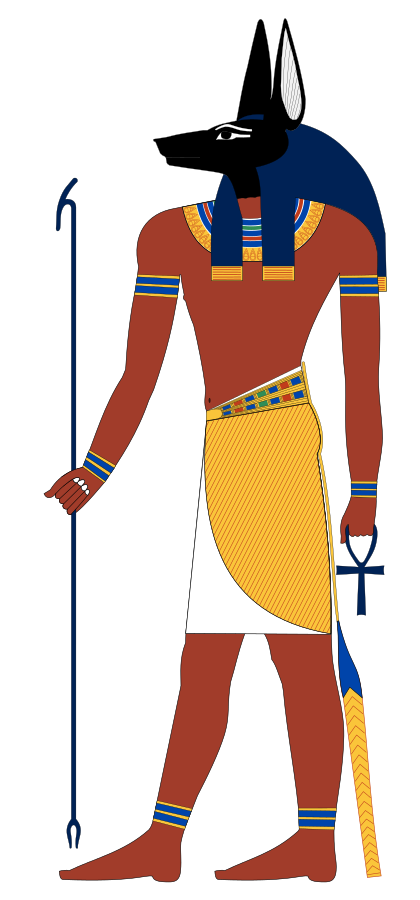
Egyptian funerary imagery supplies a related but distinct set of actions. In a weighing-of-the-heart scene, Anubis supervises the balance; the heart is assessed in relation to Ma’at. Other figures have their own roles. It is misleading to make Anubis the sole judge and ruler of the entire afterlife, or to replace the heart with an unspecified “soul” in describing the pictured weighing.[2]
The Kelsey Museum’s Death Dogs exhibition describes Anubis checking the scales and ensuring a fair weighing. The Metropolitan Museum also preserves a facsimile of a weighing scene from the tomb of Nakhtamun. These particular objects and explanations help us see the relation between preparation, guidance and judgement without claiming that every Egyptian source gives an identical account.[2]
Metaphorically, the distinction matters. “I need someone to guide me” and “I need someone to judge me fairly” express different needs. An image may contain both, but our interpretation improves when it does not collapse them.
The Valkyries: selection and the fate of battle
In Snorri Sturluson’s Gylfaginning, the Valkyries are associated with Odin, battle, the choice of those who fall and service in Valhalla. This provides a Norse comparison for the movement of the slain, while also reminding us that selection is part of the role. The source does not describe a neutral transport service for everyone who dies.[3]
Calling them guides of the dead is therefore useful only with qualifications. Their relation to battle is not interchangeable with Hermes leading the suitors, and Valhalla should not be treated as the one destination of all the Norse dead. Comparison works through these differences as well as through the common movement across a boundary.
A ferryman, a gatekeeper and a guide
Charon offers the image of a crossing that requires a boat and a ferryman. Cerberus offers a guarded boundary. In Virgil’s Aeneid, book 6, the Sibyl guides the living Aeneas through the underworld; Charon and Cerberus are obstacles or authorities encountered along the way. They do not all occupy the same role simply because they appear in the same region.[4]
The river is also worth keeping specific. Ancient accounts name and arrange the underworld’s waters differently; “the river Styx” is not a universal label for every crossing. In a metaphorical reading, the essential feature may be separation by water and dependence on a conveyance. In a historical description, the particular author’s geography still matters.
A gatekeeper and a guide can even pull in opposite directions. One controls entry or exit; the other enables movement. If we treat every death-related being as a psychopomp, we lose that tension. The same loss occurs when a scythe-bearing personification of Death is automatically interpreted as a benevolent escort. Harvesting, judging, guarding and accompanying are distinct actions.
The limits of a universal list
Association with winter, death, cosmic rule or reincarnation does not by itself establish a role as conductor of souls. A comparison needs evidence from named traditions and texts before apparently similar figures can be treated as examples of the same role.
That is a useful discipline for comparative work. A very broad category can seem impressive because it gathers so many examples, while explaining very little about any one of them. Beginning with a documented action gives the comparison a firmer basis.
What the guide makes imaginable
As a metaphor, the psychopomp allows us to imagine a passage that cannot be navigated by ordinary familiarity. Someone knows a way; someone else must travel it. The relationship contains an asymmetry of knowledge without necessarily making the traveller passive.
It also raises questions about trust. How is the guide recognised? Does the guide choose the destination, or only know the route? Can the traveller refuse? What happens at the point where the guide’s own authority ends? These are questions generated by the image, not answers supplied by the label “archetype.”
Outside funerary mythology, a guide through an unfamiliar transition can be a powerful comparison. But a transition in employment, identity or understanding is not literally a journey of the dead. The comparison highlights some features—uncertainty, separation, accompaniment—while leaving others behind.
The value of the psychopomp is therefore not that every culture secretly tells the same story. It lies in a recognisable action that can be studied in its own setting and then used carefully to think about another passage.
Sources and reading notes
- Homer, Odyssey, book 24, opening passage, A. T. Murray translation.
- Kelsey Museum, University of Michigan, Anubis in the Halls of Truth; Metropolitan Museum of Art, Anubis Weighing the Heart, Tomb of Nakhtamun.
- Snorri Sturluson, The Younger Edda, Rasmus B. Anderson translation, Gylfaginning, discussion of the Valkyries and Valhalla.
- Virgil, Aeneid, book VI, especially the passages corresponding to Latin lines 295–416: the river crossing, Charon and Cerberus. This comparison concerns the characters’ different actions, not a claim that all underworld figures are psychopomps.