From the Historia Archive — 3 of 12. By Andrew T. Austin. Edited republication of an essay from Historia Illius Itineris.
This Metaphor Society edition updates the historical context and references while retaining the original illustrations and central metaphor.
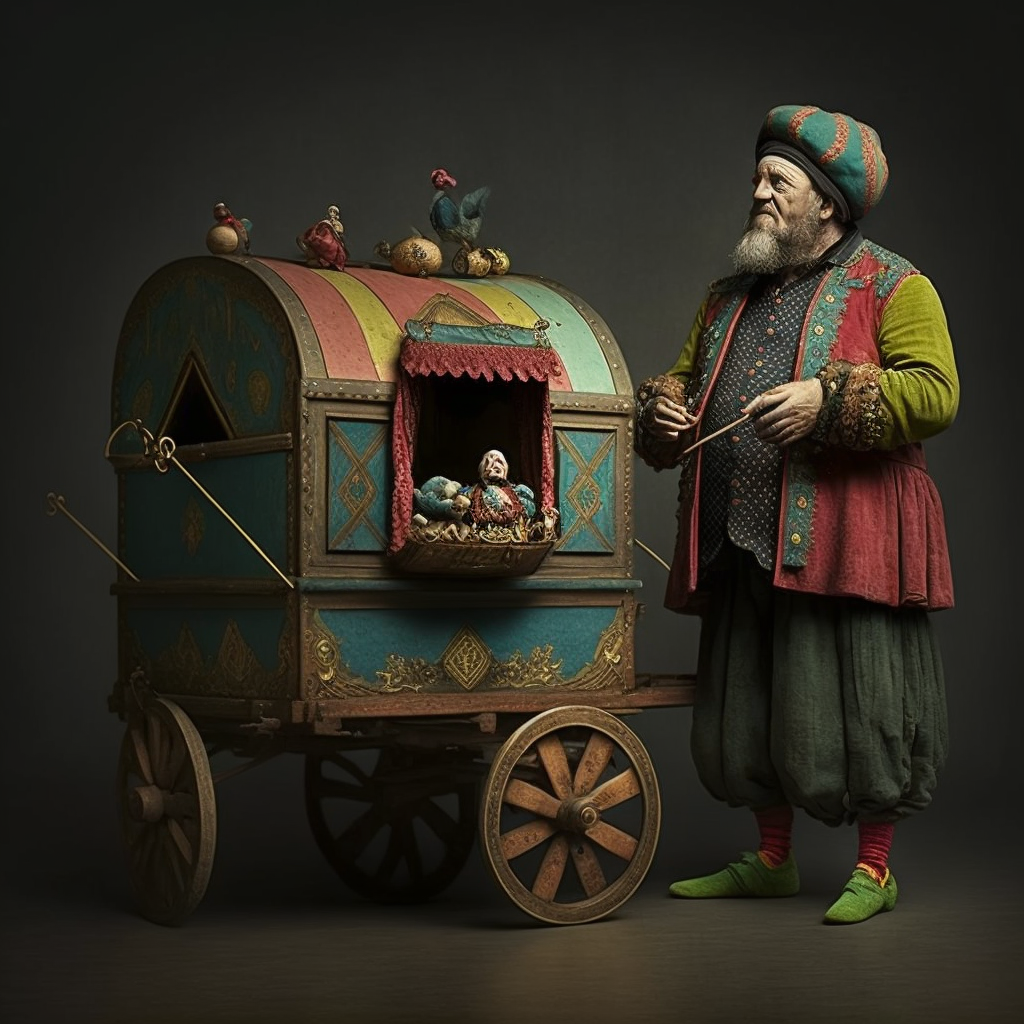
The Punch and Judy show is bloody awful. That remains my personal response to the spectacle, and it is part of what makes its endurance interesting to me. How does a performance built around domestic quarrelling, comic brutality and repeated escapes from punishment retain an audience?
One possible answer is that its characters offer unusually simple positions in a conflict: the disruptive protagonist, the vulnerable child, the pursuing official, the threatened execution, the returning victim. I want to explore those positions through archetypal comparisons. That is an interpretation of the show, not a claim that its performers inherited a secret Egyptian script.

What the historical record supports
Punch’s theatrical ancestry lies in the Italian commedia dell’arte character Pulcinella. Samuel Pepys recorded seeing an Italian puppet performance in Covent Garden on 9 May 1662. That is an early English record of the tradition, not evidence that the complete modern cast and plot were already fixed. London Museum traces the development from marionette performances to portable glove-puppet shows and the later prominence of seaside audiences.[1]

The Restoration supplies a relevant political setting, but it is too simple to say that Punch and Judy inevitably arose as a reaction to Puritan government. The tradition also has an Italian theatrical history, changing performance techniques and a commercial history.
A comic analogy can become a substitute for history if we ask it to explain too much. Describing a period as joyless may communicate an attitude, but it cannot establish that nobody laughed, that all leisure was prohibited, or that one political change alone caused a theatrical form.
A voice, a booth and a sequence of collisions
Punch’s distinctive voice is produced with a swazzle, a small device held in the performer’s mouth. The Victoria and Albert Museum describes historical versions made from bone or ivory and later ones from tin. Its account also shows how performances and characters changed over time. The resulting sound gives the puppet a voice that is instantly distinguishable from ordinary speech.[2]

A useful outline of the drama is a sequence of collisions. Domestic conflict brings Punch into contact with his wife and child; attempts to restrain or punish him introduce an official, an executioner or a supernatural adversary. Each encounter can repeat a recognisable pattern while varying the words, props and order. The repetition lets the audience anticipate a result and respond to its arrival.
The cast is not a checklist that every performance must complete. Joey, the Doctor, the Crocodile, the Ghost and other figures belong to a changing repertoire. Nor is the show’s violence automatically harmless because the bodies are puppets. The disagreement over how to read that violence is part of its reception. London Museum records both the longstanding criticism and the tradition’s continued appeal.[1]
How to use an archetypal comparison
In this reading, saying that one character “is” a mythological figure means proposing a correspondence. Judy can be compared with Nephthys, or the baby with Horus, within a symbolic reading; the comparison does not turn them into the same character or demonstrate a historical line of descent.
The comparison earns its place by showing us something about a relationship. It becomes less useful when it ignores everything that does not fit. An Egyptian deity, a comic puppet and a psychological category belong to different systems. Placing them beside one another is an act performed by the interpreter.
Punch: the disruptive figure
Punch’s historical link is to Pulcinella. Harlequin is a different commedia character. In the reading proposed here, comparing Punch with Harlequin draws attention to disruption, agility and the overturning of expectations; it does not supply an alternative theatrical genealogy.
The interesting question is what the protagonist is allowed to evade. Punch can act in ways for which other figures seek an explanation or a punishment. His repeated escape creates a world where an assertion of authority is continually followed by its collapse. Depending on the spectator, that may feel liberating, tiresome, disturbing or all three.
Judy and the baby: relationship and vulnerability
Judy introduces a relationship that Punch cannot define entirely on his own terms. She addresses him as a husband and parent, rather than simply as the star of his own adventure. Reading her beside a mythic female figure may draw attention to relationship and continuity, but “the nagging wife” is a theatrical stereotype, not an adequate account of Nephthys or of women.
The baby makes the asymmetry of power visible. A small body depends on the adults who handle it. The same prop can therefore establish family life and expose the violence that threatens it. The association with Horus is most useful at this structural level: a threatened child whose survival matters.
Stories of endangered children differ substantially. Exodus 1–2 describes Pharaoh’s order against Hebrew male infants; it is not an order against firstborn children, which belongs to another part of the Exodus narrative. Matthew 2 concerns Herod, Bethlehem and its vicinity. Such episodes can be compared without merging them into a generic plot or treating the comparison as historical proof.[3]
The Constable: authority brought within reach
The Constable gives law a body and a voice. What might otherwise remain an abstract threat can enter the booth, make demands and be struck. In this reading, the character concentrates a relation to authority into a brief encounter.
A pairing of Seth and Saturn brings together an Egyptian deity and a Roman one. Bringing them together belongs to a later comparative or esoteric scheme. The stage action can be analysed without claiming that this scheme was present in the minds of the original performers.
We also lose precision if every fable becomes an example of the common person defeating authority. Grapes that a fox cannot reach are not an authority figure, and a failed attempt to obtain them is not a political victory. A useful comparison must preserve what actually happens in the story.
The Devil and the Hangman: consequences personified
The Devil introduces the possibility that Punch cannot escape the consequences of his actions forever. An association with Apep can be explored as a comparison with threatening opposition, but the Christian Devil and the Egyptian serpent have different narrative and religious roles.
The Hangman makes punishment immediate and procedural: a body, an apparatus and an action about to occur. An association with Ma’at works, if at all, as a comparison involving judgement or order. It should not define Ma’at as an executioner. An abstract principle of order is broader than the person who carries out a sentence.
These two characters also raise different questions. Supernatural judgement can imply an inescapable moral order; an executioner is an agent within a social arrangement. Punch’s encounter with each can resemble the other dramatically while differing in what is at stake.

Joey and the Doctor: companionship and claimed expertise
Joey can function as a comic companion or contrast. London Museum connects the clown character with Joseph Grimaldi.[1] Calling Joey “the Fool” adds an interpretive layer: a figure whose apparent foolishness may expose the foolishness of someone else. It does not mean that all fools, jesters and sidekicks are interchangeable.
The Doctor brings a claim to knowledge. The costume, bag or professional manner promises that injury can be understood and remedied. Comic failure interrupts that promise. My comparison with Imhotep or Asclepius concerns the place occupied by a healer; the play’s joke may depend precisely on this particular healer failing to fulfil it.
Here a difference can be more revealing than a resemblance. A successful restoration and a futile intervention are not the same event merely because both involve healing. The comparison should preserve whether the injured person recovers, who acts, and what the audience is invited to expect.
The Crocodile and the Ghost: appetite and return
The Crocodile brings appetite into the drama. In a familiar version it pursues sausages; the immediate comic problem is keeping something desirable from being consumed.[1] Reading the animal beside Sobek is a proposed symbolic association, not a claim that the Egyptian god can be reduced to a hungry puppet.
The Ghost presents a different interruption. Something thought to have been removed returns. That gives us a way to consider memory, guilt or unfinished consequences. Comparing it with the Egyptian ba may stimulate a question, but the ba should not simply be defined as a European ghost in a white sheet.

What survives the comparison?
I remain bewildered by the appeal of the show. Archetypal reading does not settle whether it is enjoyable, or prove why it survived. What it can do is make the recurring relations visible: innocence and force, demand and refusal, authority and evasion, injury and attempted repair.
Those relations also explain why a neat list of equivalents is insufficient. “Judy equals Nephthys” is the beginning of a question. What does the comparison disclose? What does it suppress? Does it illuminate this performance, or simply demonstrate how readily an interpreter can impose a preferred system?
The farce becomes more interesting when the comparison remains open to disagreement. The puppets can keep their particular histories while we examine the broader patterns we see in their collisions.
Sources and reading notes
- London Museum, A brief history of Punch & Judy puppet shows: early English records, development of the performance, selected characters and reception.
- Victoria and Albert Museum, “That’s the way to do it!” A history of Punch & Judy, including the swazzle and changes to the repertoire.
- Exodus 1:15–2:10 and Matthew 2:13–18. The archetypal correspondences elsewhere in this essay are interpretive proposals, not claims established by these historical sources.