From the Historia Archive — 2 of 12. By Andrew T. Austin. Edited republication of an essay from Historia Illius Itineris.
This Metaphor Society edition updates the historical context and references while retaining the original illustrations and central metaphor.
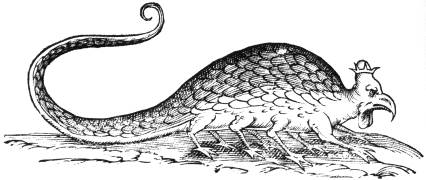
I’m indebted to Dolores Ashcroft-Nowicki for drawing my attention to the basilisk. It is a remarkable image of destructive power: a creature whose presence poisons its surroundings, yet which has a weakness of its own.
A monster with a history
Basilisks and cockatrices belong to overlapping traditions. Their appearance, birth and vulnerabilities vary between accounts. We should resist turning these stories into a single zoological description. A serpent in a Roman natural history and a later bird-like monster are related images, but their details do not necessarily travel together.
Pliny the Elder describes the basilisk in Natural History, book VIII, chapter 33. His creature is a small serpent associated with Cyrene, with a pale marking resembling a diadem. Its destructive influence extends to vegetation and stone. Pliny also reports the belief that its poison could travel up a spear to kill the rider who wielded it and the rider’s horse. These are claims in an ancient account, not observations confirmed by modern zoology.[1]

The royal imagery matters. A crown normally marks a ruler’s authority over a territory; here the creature’s power leaves that territory uninhabitable. Read metaphorically, the basilisk can represent an influence that destroys the conditions on which its own dominion depends.
The antidote is part of the story
Pliny’s weasel defeats the basilisk through its odour, but the weasel also dies. That detail prevents us from calling it immune. In this account, the antidote is effective and costly. Pliny makes the struggle an example of nature supplying something that can oppose even an apparently overwhelming danger.[1]
The resemblance to a mongoose confronting a cobra is suggestive. It does not establish that the basilisk story originated in a particular observation, or that one animal can simply be substituted for another. Likewise, a comparison with Kipling’s Rikki-Tikki-Tavi is a comparison between narrative patterns, not proof of a direct literary borrowing.
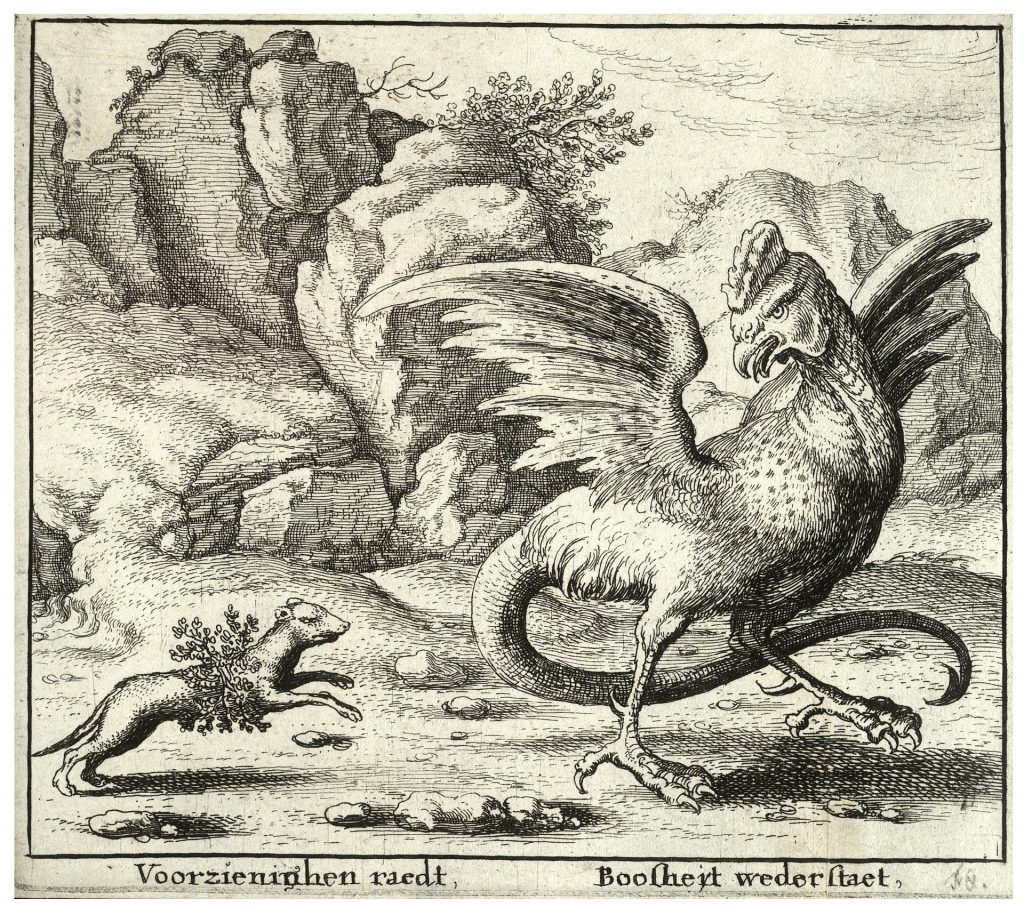
Edward Topsell’s Historie of Serpents (1608) reports the basilisk’s vulnerability to a crowing cock. He also records the story of a man defeating cockatrices through reflected images, although he rejects that story as a fable. The motifs therefore have a textual history without sharing the same status even within one author’s account.[3] Their interest here is the reversal: a sound or an image returned to its source interrupts a power that appeared irresistible.
The videos below are retained as supplementary material from the archive essay.
The rooster and the moment of recognition
The crowing rooster can announce a change of time. In the Gospel accounts of Peter’s denial it also marks a moment when an earlier warning becomes recognisable. Mark 14:30 and 14:72, and John 13:38 and 18:27, connect the crowing with Peter’s failure to do what he had promised. The accounts differ in their details, including Mark’s reference to the rooster crowing twice.[2]
For the present metaphor, the useful comparison is between an event and the recognition it produces. A familiar sound becomes the point at which a person sees their own conduct differently. It need not acquire the same meaning in every religious tradition for that comparison to work.
Nor does the rooster need to be declared the single most sacred animal of a culture. Such rankings flatten complex traditions into an easy generalisation. A specific story gives us more to examine: who hears the sound, what they remember, and what changes because of it.
Strength and its limit
We can also place the basilisk within a Western esoteric reading of severity and mercy. That is a further interpretive setting, rather than evidence that ancient authors intended a Qabalistic meaning. In such a reading, destructive strength becomes intelligible through the question of what can balance or restrain it.
This is where the reflected gaze becomes especially interesting. A power directed entirely outwards encounters its own operation. The monster’s weapon becomes the means of its undoing. We need not claim that every basilisk or cockatrice story contains this incident to explore what the incident makes imaginable.
The same distinction applies when we use the story to think about ourselves. Calling a situation “toxic” already imports a bodily model: something spreads, contact causes harm, and distance or an antidote may matter. The basilisk intensifies that model until an entire landscape is affected. The image can help us notice the scale of the claim we are making.
It can also conceal distinctions. A difficult disagreement is not automatically a poisoned environment, and describing someone as a monster can make their intentions and circumstances disappear. The metaphor is more useful when it prompts a precise question about conduct than when it becomes a total description of a person.
And so, what is the point of all this? The creature imagined as almost invulnerable may still be defeated by a change of perspective. The invitation to self-reflection survives even when the historical versions of the story are kept separate.
Sources and reading notes
- Pliny the Elder, Natural History, VIII.33, translated by John Bostock and H. T. Riley (1855). The weasel dies in this version.
- Biblical passages: Mark 14:30, 66–72; John 13:38 and 18:15–27. The discussion paraphrases the episodes rather than combining translations into an unidentified quotation.
- Edward Topsell, The Historie of Serpents, “Of the Cockatrice” (1608), pp. 119–125. Topsell accepts some reported powers while questioning others; the discussion treats them as historical beliefs.