From the Historia Archive — 1 of 12. By Andrew T. Austin. Edited republication of an essay from Historia Illius Itineris.
This Metaphor Society edition updates the historical context and references while retaining the original illustrations and central metaphor.
Plana Velut Terra and The Historia Illius Itineris
A world can feel flat without the Earth being flat. We speak of what lies ahead, what is behind us, and the point at which our familiar world ends. These images organise a position and a direction. They give the flat-Earth image a use in metaphor that is quite separate from its value as an astronomical claim.

The historical picture needs care. Greek astronomy developed arguments for a spherical Earth long before modern voyages of exploration, and spherical models continued in medieval and early modern astronomical writing. This does not tell us what every individual believed. It does show why a picture of a flat world cannot, by itself, establish the beliefs of an entire period. The Library of Congress illustrates this history through astronomical texts and diagrams.[1]
Within the metaphorical plane explored in The Historia Illius Itineris, a flat world can be read as a representation of experienced space: a plane extending outwards from the person who occupies it. That is the comparison being proposed here. It does not depend on treating the illustration as an accurate map of the planet, or on assuming that its historical makers intended this particular psychological interpretation.
The shape of the Earth and the centre of the cosmos

Flatness and geocentrism are different claims. Geocentrism places the Earth at the centre of a cosmic model; it does not require the Earth itself to be flat. In the second century CE, Claudius Ptolemy developed a mathematical account of celestial motion that became enormously influential. Its predictive techniques and later transmission deserve attention alongside the religious meanings attached to images of the heavens.[1]
Religious authority could constrain astronomical debate, but the history cannot be reduced to a general choice between agreeing and being burned. Galileo’s 1633 trial provides a specific case: he was compelled to abjure his Copernican views and sentenced to imprisonment, subsequently served as house arrest. George Coyne’s account for the Vatican Observatory places that episode within its changing scientific and institutional setting.[2]
Heavenly spheres as an image of order
A visionary account appears in Poimandres, the opening tractate of the Corpus Hermeticum. In G. R. S. Mead’s translation, sections 8–11 describe the elements, a formative Mind and seven rulers whose government is called Fate. This is a religious and philosophical narrative about the organisation of the cosmos. It should not be collapsed into Ptolemy’s astronomical model, or treated as the single cosmology of all religious traditions.[3]
For metaphorical reading, the spheres offer a pattern of enclosure, influence and possible passage. We can examine what such a pattern makes imaginable without claiming that a contemporary interpretation recovers the intention of every ancient author.
The traveller at the firmament
The familiar Flammarion engraving depicts a traveller looking through the boundary between earth and sky. It appeared in Camille Flammarion’s L’atmosphère: météorologie populaire in 1888, on page 163. The University of Oklahoma’s history-of-science exhibition identifies this nineteenth-century book as the image’s original source, despite its frequent misattribution to the Middle Ages or Renaissance. Publication in Flammarion’s book should not be mistaken for proof that he personally engraved it.[4]
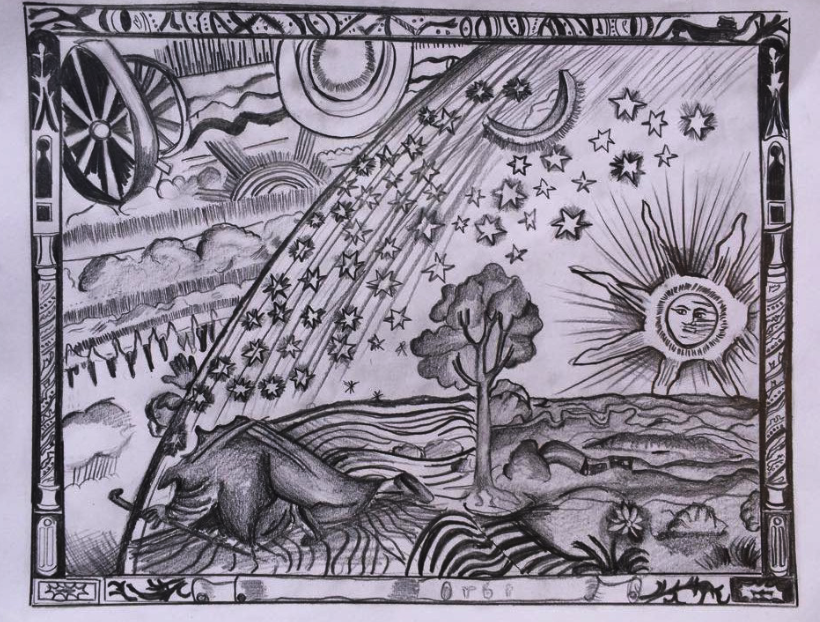
The image works through a striking change of perspective. What seemed to contain the whole world becomes a surface through which someone can look. The traveller remains partly within the familiar landscape while reaching beyond its apparent limit. As a metaphor, this can invite questions about the boundary of a description and about what that description has left outside.
The firmament separating waters in Genesis 1:6–8 supplies another image of division. Reading such a boundary as a juncture between realities is an interpretive move within this essay. The image gives us a way to consider a transition in understanding; it does not by itself establish that a physical or supernatural boundary has been crossed.
At the centre, wherever we stand
With the metaphorical plane we reach a paradox. The plane can be imagined as extending infinitely in all directions, yet the person experiencing it remains at the centre of their own orientation. Here, “centre” concerns the position from which ahead, behind, left and right are understood. It is different from the astronomical claim that the Earth occupies the centre of the universe.
The central question of The Historia Illius Itineris can then be stated as a problem of perspective: how to remain at the centre and yet penetrate through the veil. How can someone retain a point of orientation while recognising that the world they have described may exceed the limits of that description?


Sources and historical context
- Library of Congress, Ancient Greek Astronomy and Cosmology. Collection guide with historical diagrams and texts.
- Coyne, G., Galileo and His Times: Some Episodes, especially PDF page 7 on the 1633 trial and sentence.
- Corpus Hermeticum I: Poemandres, the Shepherd of Men, translated by G. R. S. Mead, sections 8–11. The historical translation preserves its own terminology.
- University of Oklahoma, The Atmosphere: Popular Meteorology; Library of Congress, catalogue record for the illustration on page 163.