The Blood of Uranus
A myth of sky and earth, rebellion and mutilation, spilled blood and unexpected creation.
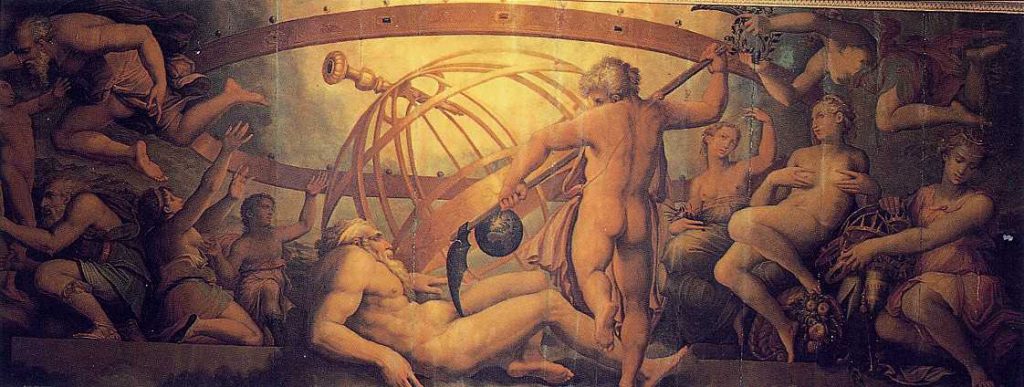
Uranus is the Greek divine personification of the sky and heavens. His name is conventionally associated with heaven or sky, although its deeper linguistic history may point toward rain and moisture.
Sky, Earth and Their Children
Uranus’s wife was Gaia, goddess and personification of the Earth and all living things. Gaia was also his mother. In the mythic genealogy, she conceived Uranus without a father, providing another example of miraculous or autonomous generation.
As Mother Earth and the origin of life, Gaia is presented as capable of bringing forth life without a partner. When Uranus reached maturity, mother and son became wife and husband.
Together they produced several races of beings. Their children included the twelve Titans, among them Cronus, Oceanus and Hyperion, as well as the goddesses Tethys, Phoebe and Theia. They also produced the Cyclopes Arges, Brontes and Steropes, and the Hecatoncheires, giants with one hundred hands and fifty heads.
Some later interpretations associate the monstrous appearance of certain children with the incestuous nature of the union. Yet the Titans themselves were portrayed as magnificent and physically flawless.
Fear, Confinement and Revolt
Uranus came to hate or fear his children. His central concern was that they might overpower him and take his place as ruler of the sky and universe. When Gaia brought forth the Hecatoncheires, Uranus attempted to prevent their emergence by forcing them back within her.
The Hecatoncheires and Cyclopes were nevertheless born. Uranus imprisoned them in Tartarus, the dark region beneath the Earth. This is the Tartarian abode later referenced in the Goetia.
Gaia grew to hate Uranus for the pain he caused her and for his hostility toward their children. She conspired with the Titans to overthrow him. Because Uranus was immortal, straightforward killing was not possible. Cronus, their youngest son, volunteered to act, and Gaia armed him with a flint sickle.
The Wound That Creates
In the best-known version of the story, Cronus ambushed Uranus and severed his genitals with the sickle. The mutilated organs were cast into the sea. Blood fell upon Gaia, the Earth, and from it arose the Giants and the Erinyes, the avenging spirits.
“What have you done? Listen; your brother’s blood is crying out to me from the ground! And now you are cursed from the ground, which has opened its mouth to receive your brother’s blood from your hand.”
Genesis 4:10–11
It is also notable that biblical sacrificial law excludes castrated animals from sacrifice, while other scriptural regulations exclude castrated men from particular sacred assemblies. Across these traditions, bodily wholeness, generative power and access to sacred space become closely associated.
The severed genitals of Uranus generated another form of life. As they moved through the sea, white foam gathered around them, and from that foam emerged Aphrodite. Violence against the sky therefore produces both avenging powers from blood upon the Earth and a goddess of beauty and desire from foam upon the sea.
The mutilated Uranus called the children who attacked him Titanes. In Hesiod’s account, the name is connected through wordplay with straining, overreaching or stretching beyond proper limits. The Titans are thus marked not only by ancestry, but by the nature of their act.
